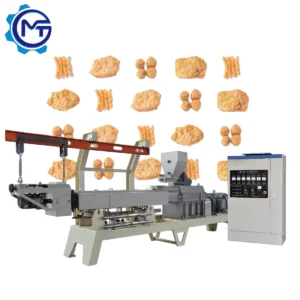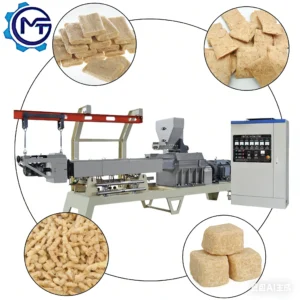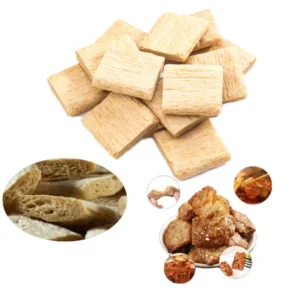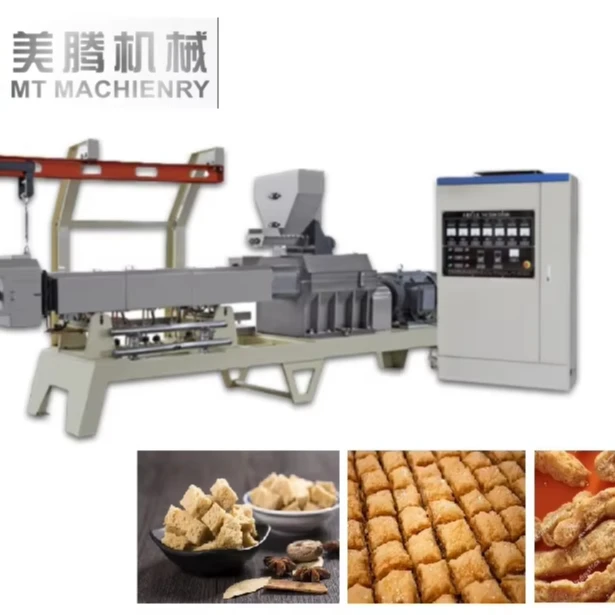
Screw configuration and die design matched to raw material — Every MT65 extruder is tested on the buyer’s actual defatted soya flour or low-temperature flakes before the line layout is finalized, ensuring the fiber structure forms correctly at the die rather than guessing from a generic build.
Technical Specifications
| Parameter | Value |
|---|---|
| Product Type | Twin Screw Extruder for Textured Vegetable Protein (TVP) / Plant Based Meat |
| Available Models | MT65 / MT70 / MT75 / MT85 |
| Screw Type | Twin-screw |
| Installed Power | 84 kW (MT65), 160 kW (MT70), 190 kW (MT75), 210 kW (MT85) |
| Power Consumption | 59 kW (MT65), 120 kW (MT70), 140 kW (MT75), 140 kW (MT85) |
| Main Motor Power | 22 kW / 30 kW / 45 kW (varies by model) |
| Output Capacity | 100–150 kg/h (MT65), 150–200 kg/h (MT70/MT75), 250–300 kg/h (MT85) (basis not stated in source — confirm raw material formulation, moisture content, die configuration) |
| Heating Power | 10 kW / 14 kW |
| Rotary Cutting Motor | 0.75 kW |
| Feeding Motor | 0.75 kW |
| Pump Motor | 0.37 kW |
| Screw Length | 1050 mm / 1520 mm |
| Control System | PLC and MCC control |
| Standards | CE, ISO |
Application Suitability
| Application | Material or Output |
|---|---|
| Textured soy protein (TVP/TSP) production | Defatted soya flour, low-temperature soya flakes |
| Soya nuggets and soya chunks | Soybean dregs, peanut dregs with interchangeable die moulds |
| Plant-based meat analogues with layered fiber | High-moisture protein formulations using twin-screw shear and temperature profiling |
| Cereal and snack production (alternate run) | Adjusted screw configuration and die setup for puffed or pellet formats |
| Meat product and deep-freeze food ingredients | TVP as partial meat replacement in patties, sausages, and ready meals |
Why "Rated Capacity" Means Nothing Without Your Raw Material
The output number on a spec sheet only holds if the extruder is configured for your exact protein-to-moisture ratio.
I once saw a plant-based meat line where the twin screw extruder was quoted at its catalogue capacity, but the buyer’s pea protein and wheat gluten blend behaved completely differently from the standard soy test material. The fiber structure collapsed at the die, and actual throughput dropped to roughly half the rated figure. That is the gap between a brochure number and what lands in your dryer. When sourcing a Twin Screw Extruder for Plant Based Meat full equipment range, the question is never just what the machine can produce — it is what it can produce on your formulation [NEED_CITE: protein gelatinisation behaviour under twin-screw shear at varying moisture levels].
Matching Every Station from Mixer Through Cooler
The full equipment range for TVP and plant-based meat starts at the vertical mixer, where stainless steel 304 contact surfaces handle defatted soya flour and low-temperature flakes without contamination. Mixer capacity tiers — 20–30 kg, 70–80 kg, and 170–180 kg — are selected against the extruder feed rate so the batching station never starves or floods the screw conveyor. Each station downstream is sized to the extruder’s confirmed output, not its theoretical maximum.
Dryer Sizing Based on Actual Extrusion Output, Not Brochure Figures
The multi-layer dryer uses a double pitch roller chain drive with round-trip drying and selectable heat sources — fuel, gas, or electricity — to match local utility conditions. Drying temperature and belt speed are set after the extruder’s real moisture discharge is measured during the trial run. An undersized dryer is one of the most common bottlenecks in plant-based meat lines; the extruder pushes product faster than the dryer can reduce moisture to storage-safe levels, and finished product ends up soggy or spoiled [NEED_CITE: moisture content targets for shelf-stable TVP storage].
What Screw Length and Die Configuration Actually Control
The available screw lengths of 1050 mm and 1520 mm determine residence time inside the barrel, which directly affects protein denaturation and fiber alignment. A longer screw gives the material more time under shear and heat, producing a denser, more meat-like fiber structure suitable for soya chunks. The die configuration is interchangeable across moulds for soya nuggets, TVP, and soya chunks, but the internal screw profile must be rebuilt for each product format. Barrel temperature zones, combined with the PLC control system, maintain consistent thermal input across production batches, reducing the variation that causes some runs to come out spongy and others brittle.
The Hidden Cost of Skipping the Trial Run
Buyers who skip pre-shipment testing on their own raw material often discover formulation problems only after the line is installed and the utility connections are live. At that point, changing the screw configuration means flying in a technician, sourcing new screw elements, and losing weeks of production. In some cases the issue is not the extruder at all but a mismatch between the mixer’s batch size and the extruder’s continuous feed rate, creating surges that destabilize barrel pressure [NEED_CITE: continuous extrusion stability under variable feed conditions]. These problems are solvable, but they are far cheaper to catch in a testing workshop than on a factory floor.
Why Sourcing the Full Equipment Range from One Supplier Matters
The Twin Screw Extruder for Plant Based Meat full equipment range is supplied as a matched system, so the mixer capacity, conveyor throughput, extruder output, dryer belt speed, and cooling rate are calculated together rather than assembled from separate vendors who each guarantee only their own station. Screw and die configurations are specified to the buyer’s raw material and target product texture, not copied from a generic template. An in-house testing workshop allows trial runs on customer-supplied defatted soya flour or low-temperature flakes before shipment. Electrical schematics and voltage are confirmed for the destination market, and the PLC control language is set before the crate leaves the factory. CE and ISO documentation supports customs clearance and local regulatory compliance.
Documentation & Verification
- Line layout and capacity calculation confirming throughput balance from mixer through cooling machine
- Screw and die configuration record specific to your soya flour formulation and target nugget or chunk size
- Electrical schematic with voltage, frequency, and PLC control language confirmed for your market
- Trial run report on your raw material from the in-house testing workshop before dispatch
- CE declaration of conformity and ISO certificate for customs and regulatory filing
- Wear parts list with screw element and die specifications for first reorder planning
Installation, Commissioning & Support
- Foundation and floor space planning based on full line dimensions up to 45000×1500×3500 mm for the MT85 configuration
- Dedicated power circuit sized to installed power up to 210 kW with confirmed local voltage and frequency
- Assembly from shipped modules with station-by-station alignment of conveyor transfer points
- First-run parameter setting including barrel temperature profile, screw speed, and die pressure on your raw material
- Operator training covering PLC interface, die changeover, and emergency stop procedures across all stations
- Spare screw elements and die moulds supplied with initial shipment to cover the first replacement cycle
What We Need to Build Your Line Proposal
To configure the Twin Screw Extruder for Plant Based Meat full equipment range for your facility, share your raw material formulation — including protein source, moisture content, and any additives — along with your target product format such as nuggets, chunks, or fine TVP. Your local voltage, frequency, and preferred control language help us finalize the electrical package. If you have an existing dryer or packaging line that the new extrusion line must integrate with, send the throughput figures so we can match station capacities.
Frequently Asked Questions
Q: What stations are included in the full line, and how is throughput balanced across them?
A: The line includes a vertical mixer, screw conveyor, twin screw extruder, air conveyor, multi-layer dryer, and cooling machine. Each station is sized based on the extruder’s confirmed output on your raw material, not its catalogue maximum. The mixer batch cycle and dryer belt speed are calculated so no station bottlenecks another during continuous production.
Q: Can the screw and die configuration be matched to my specific protein formulation?
A: Yes. The screw profile and die mould are selected based on your raw material — whether defatted soya flour, low-temperature soya flakes, or a custom blend — and your target product texture. A trial run on your material is conducted in the testing workshop before shipment, and the configuration record is documented for future reference and reorders.
Q: What voltage and control options are available for different export markets?
A: The electrical system is configured to your destination market’s voltage and frequency before production. The PLC and MCC control panel can be set to the operator’s preferred language. Electrical schematics are included in the documentation package, and all settings are verified again during on-site commissioning.
Q: What does the pre-shipment trial run cover?
A: The trial run uses your actual raw material in the testing workshop to verify fiber structure, product density, and output rate. You receive a written report documenting the screw configuration, barrel temperature profile, moisture readings, and product samples. Any adjustments to the die or screw elements are made before the line is packed for shipment.
Q: What dryer heat source options are available, and how do I choose?
A: The multi-layer dryer supports fuel, gas, or electric heating. The choice depends on your local energy cost and availability. Gas heating is common where natural gas infrastructure is reliable, while electric heating suits facilities with stable industrial power supply. The dryer capacity is matched to the extruder’s confirmed moisture discharge rate regardless of heat source selected.