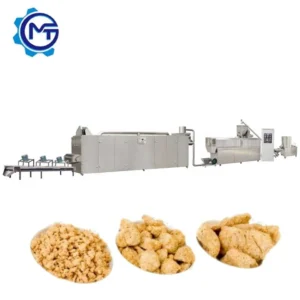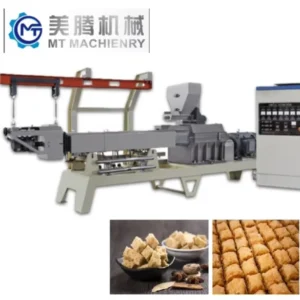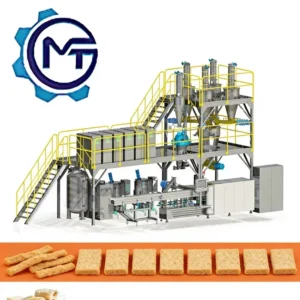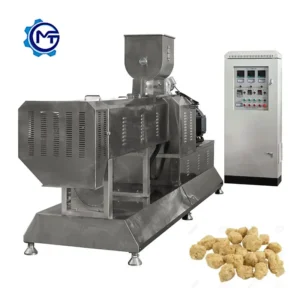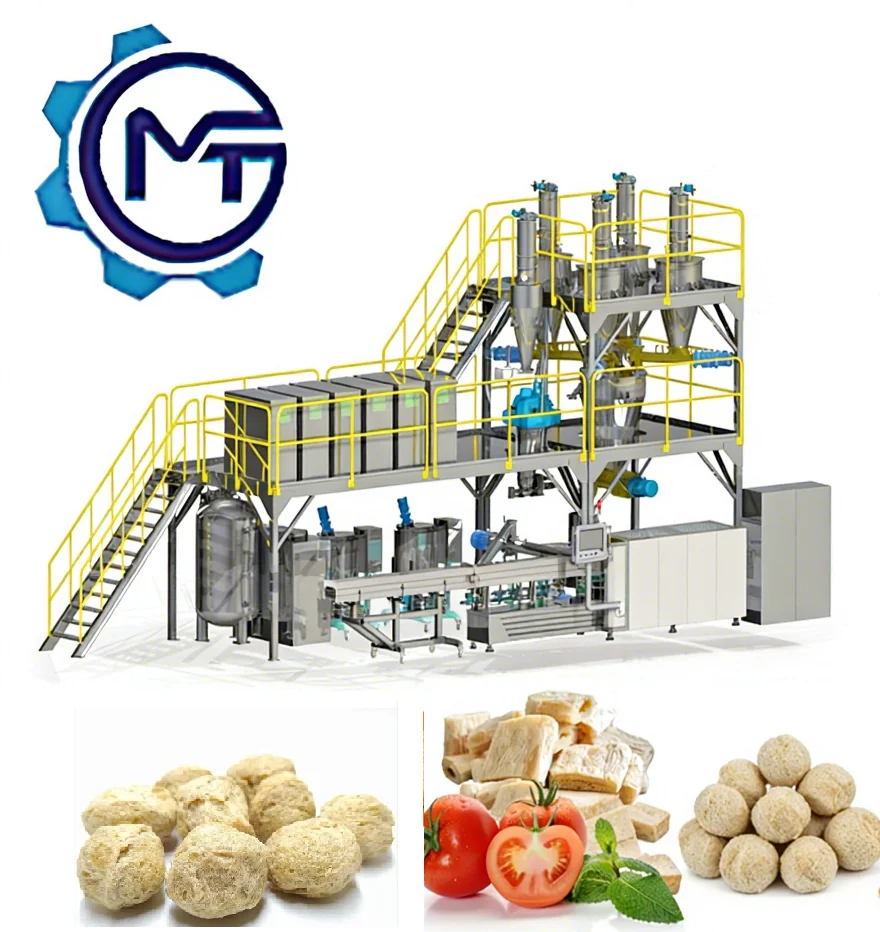
Full equipment coverage — Every station from vertical mixer through multi-layer dryer is specified and throughput-matched, so you survey the complete machine catalogue before committing to a line configuration.
Technical Specifications
| Parameter | Value |
|---|---|
| Product Type | Twin Screw Extruder for Texturized Vegetable Protein (TVP) Production Line |
| Model | MT65 / MT70 / MT75 / MT85 |
| Screw Type | Twin Screw |
| Installed Power | MT65: 84 kW; MT70: 160 kW; MT75: 190 kW; MT85: 210 kW |
| Power Consumption | MT65: 59 kW; MT70: 120 kW; MT75: 140 kW; MT85: 140 kW |
| Output Capacity | MT65: 100–150 kg/h; MT70: 150–200 kg/h; MT75: 150–200 kg/h; MT85: 250–300 kg/h (basis to be confirmed) |
| Main Motor Power | 22 kW / 30 kW / 45 kW |
| Heating Power | 10 kW / 14 kW |
| Overall Dimensions (L×W×H) | MT65: 40000×1200×2200 mm; MT70: 41000×1500×2200 mm; MT75: 43000×1500×3200 mm; MT85: 45000×1500×3500 mm |
| Mixer Power Options | 4 kW / 7.5 kW / 15 kW |
| Mixer Capacity Options | 20–30 kg / 70–80 kg / 170–180 kg |
| Dryer Drive | Double pitch roller chain drive, round-trip drying |
| Dryer Energy Options | Fuel / Gas / Electricity |
| Control System | PLC and MCC control |
| Certification | CE, ISO |
| Delivery Lead Time | 15–35 working days after deposit (subject to current schedule) |
Application Suitability
| Application | Material or Output |
|---|---|
| Texturized vegetable protein production | Defatted soya flour and low-temperature soya flakes |
| Soya nuggets and soya chunks | Soya protein concentrate with fiber structure formation |
| Vegetable meat floss and meat analogue | Plant protein blends requiring layered fiber texture |
| Layer fiber structure protein blocks | Soybean dregs and peanut dregs |
| Cereal and snack formats | Adjusted screw and die configuration on same platform |
Why "Nominal Output" Numbers Fail at Your Raw Material
Capacity must be verified on your exact soya flour or soya flake specification, not quoted from a generic benchmark.
When sourcing a twin screw extruder TVP production line manufacturer, buyers often receive a headline capacity figure that assumes ideal raw material moisture, protein content, and particle size. In practice, switching from one defatted soya flour supplier to another can shift the extruder behavior enough that the stated throughput becomes unachievable without reformulating the screw combination or barrel temperature profile. The gap between quoted capacity and actual sustained output is where most line bottlenecks originate [NEED_CITE: twin screw extrusion behavior variance across raw material specifications].
Matching Every Station to the Same Throughput Target
The mixer capacity, extruder feed rate, dryer belt speed, and cooling conveyor length must all resolve to the same hourly throughput. If the extruder runs at one rate while the multi-layer dryer was sized for a different output, product accumulates or the dryer runs underloaded. This full equipment catalogue approach lists every station — from the vertical mixer with 304 stainless steel contact surfaces through the chain-driven dryer to the cooling machine — so each component can be surveyed and confirmed before the line is assembled.
Selecting the Dryer Energy Source Against Your Factory Utilities
The multi-layer dryer supports fuel, gas, or electric heating, and the correct choice depends entirely on what your facility already has available. A dryer specified for electric heating in a region where industrial electricity tariffs are high will drive operating costs beyond projection. The dryer drive uses a double pitch roller chain for round-trip drying, which provides consistent residence time across the belt width for uniform moisture removal from TVP chunks or soya nuggets [NEED_CITE: industrial dryer energy selection for food processing facilities].
Reading the Specification Sheet for What It Actually Tells You
The main motor power ranges across 22 kW, 30 kW, and 45 kW depending on model, and this directly governs the shear energy available inside the barrel. Higher motor power allows denser protein formulations to be worked through the screw elements without stalling or surging. The heating power options of 10 kW or 14 kW determine how many barrel zones can be independently temperature-controlled, which matters when the formulation requires a precise gelatinisation curve followed by a controlled cooling zone before the die. Screw length options of 1050 mm and 1520 mm affect residence time inside the barrel — longer screws give more time for protein alignment and fiber structure development, which is critical for meat analogue applications demanding visible layered texture. The overall line dimensions, stretching up to 45 meters for the MT85 configuration, define the floor space and ceiling height your building must accommodate.
What Happens When Stations Are Mismatched
Purchasing an extruder without confirming that the dryer and cooling conveyor can keep pace leads to product sitting in buffers too long, picking up moisture from ambient air, or being packed at the wrong temperature. The result is inconsistent shelf life and texture degradation that only becomes apparent weeks after production. Buyers who skip the throughput-matching step frequently end up replacing one station shortly after commissioning [NEED_CITE: production line bottleneck diagnosis in food extrusion].
Why Source the Complete Catalogue from One Supplier
Every station on this twin screw extruder TVP production line is specified under one equipment range, meaning the mixer batch size, extruder output, dryer belt loading, and cooler capacity are calculated together rather than assembled from separate vendor quotes. Screw configuration and die design are specified against your raw material and target product format, not pulled from a generic build library. The in-house testing workshop runs trial production on your actual defatted soya flour or soya flakes before the line ships, so fiber structure and expansion behavior are confirmed in advance. Pre-sales consultation covers line layout and utility planning through to commissioning and operator training on your factory floor.
Documentation & Verification
- Line layout drawing with throughput calculation across mixer, extruder, dryer, and cooler stations
- Screw and die configuration record matched to your soya flour protein content and target chunk size
- Trial run report from in-house testing workshop using your raw material before shipment
- Machine specification sheet with electrical schematic confirming voltage and frequency for your market
- CE declaration of conformity and ISO certificate for import compliance documentation
Installation, Commissioning & Support
- Floor plan review against the 40–45 meter line length and ceiling clearance requirements for the MT75 and MT85 models
- Electrical supply confirmation for installed power up to 210 kW on the MT85 with dedicated circuit allocation
- Factory-assembled and tested equipment arrives with documented station-by-station alignment
- PLC and MCC control system configured with operator language matching your production team
- Screw and die wear parts list provided with recommended first replacement schedule
- On-site commissioning includes barrel temperature profile tuning to your specific soya formulation
What to Prepare Before Requesting a Quote
To configure the right model and supporting stations, share your raw material specification including protein content and moisture level, your target product format (soya chunks, nuggets, meat floss, or fiber blocks), and your intended hourly throughput. Include your factory floor dimensions, ceiling height, and available voltage and frequency. If you plan to run multiple product formats on the same line, list each one so screw and die configurations can be scoped accordingly.
Frequently Asked Questions
Q: How is output capacity verified against my specific raw material?
A: The in-house testing workshop runs a trial on your actual defatted soya flour or soya flakes before shipment. Screw combination, barrel temperature profile, and die selection are adjusted during the trial until the target fiber structure and throughput are confirmed. You receive a trial run report documenting the settings that achieved the result.
Q: What extruder model fits my throughput target?
A: The MT65 covers lower output ranges with 84 kW installed power, while the MT85 handles higher volumes at 210 kW. The correct selection depends on your raw material characteristics and target product density. Line layout and capacity calculation documents show how each model maps to your specific production requirements.
Q: Can the same line produce both TVP and cereal products?
A: Yes, by changing the screw configuration and die design. The twin screw platform supports texturized protein formats and cereal formats on the same extruder. The required screw element arrangement and die plate are documented for each product type so changeovers are repeatable.
Q: How do I select the right dryer energy source?
A: The multi-layer dryer supports fuel, gas, or electric heating. The selection depends on your factory utility availability and local energy costs. Share your current utility setup during the inquiry stage so the dryer specification aligns with what your facility can supply.
Q: What supporting equipment is included in the line?
A: The full range includes a vertical mixer with 304 stainless steel contact surfaces, screw conveyor, twin screw extruder, air conveyor, multi-layer dryer, and cooling machine. Each station is throughput-matched to the extruder output so no single point constrains the line.