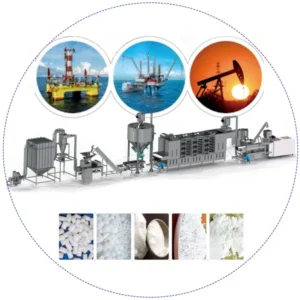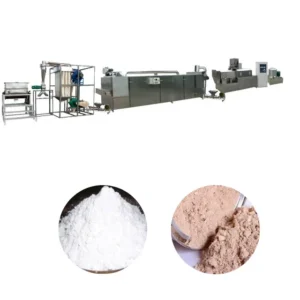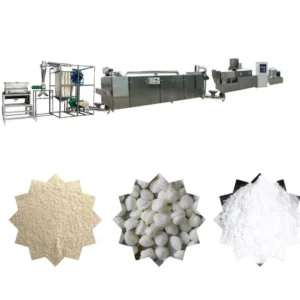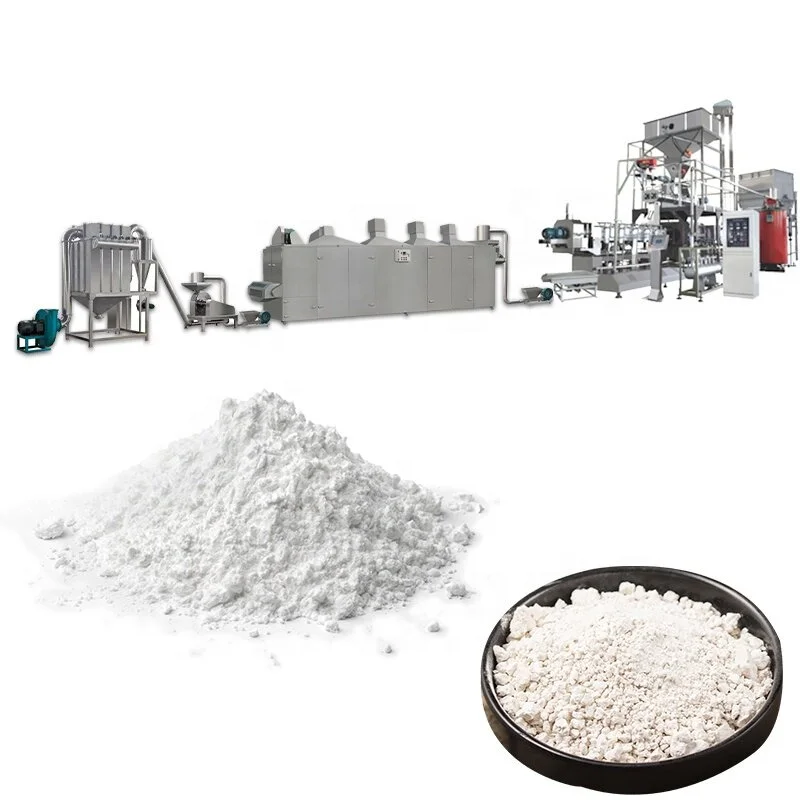
Matched Station Throughput — Every mixer, extruder, dryer and grinder in this modified starch line is sized to the same material flow rate, preventing the bottlenecks that appear when stations are sourced separately.
Technical Specifications
| Parameter | Value |
|---|---|
| Product Type | Twin Screw Pre-Gelatinized Modified Starch Processing Line |
| Model Options | MT70 / MT85 / MT75 |
| Installed Power | MT70: 160 kW / MT85: 190 kW / MT75: 210 kW |
| Power Consumption | MT70: 120 kW / MT85: 140 kW / MT75: 150 kW |
| Output Capacity | MT70: 150–200 kg/h (basis not stated in source) / MT85: 300–400 kg/h (basis not stated in source) / MT75: 300–500 kg/h (basis not stated in source) |
| Overall Dimensions (L×W×H) | MT70: 41000×1500×2200 mm / MT85: 43000×1500×3200 mm / MT75: 45000×1500×3500 mm |
| Control System | Full-automatic operation |
| Voltage & Frequency | 380V 50Hz Three Phase (verify against target market) |
| Screw Type | Twin-screw |
| Screw Material | 38CrMoAl |
| Barrel Feature | Integrated cooling system for temperature control |
| Mixer Capacity | 20–30 kg / 70–80 kg / 170–180 kg per batch (model dependent) |
| Mixer Power | 4 kW / 7.5 kW / 15 kW (model dependent) |
| Mixer Material | 201SS or 304SS stainless steel |
| Dryer Type | 5-layer baking oven |
| Dryer Dimensions | 5.0×1.2×2.3 m |
| Dryer Power | 3 kW |
| Dryer Weight | 1800 kg |
| Dryer Speed Control | Inverter |
| Dryer Heating Source | Gas or diesel |
| Grinder Type | Pulse grinder with cyclone discharge and dust collector |
| Line Sequence | Mixer → Twin-screw extruder → 5-layer dryer → Pulse grinder |
| Certification | CE; ISO |
Application Suitability
| Application | Material or Output |
|---|---|
| Oil drilling fluid loss agents | Pre-gelatinized starch from corn or potato starch |
| Textile sizing agents | Modified starch processed for warp yarn adhesion |
| Paper surface sizing | Denatured starch with controlled viscosity for coating |
| Food-grade modified starch | Pre-gelatinized corn, potato or cassava starch for thickeners and stabilizers |
| Building material additives | Gelatinized starch used as binder in gypsum board and adhesives |
What the Capacity Number on Your Starch Line Quote Really Means
Nominal output is meaningless unless it is tied to your specific starch source, moisture content and target gelatinisation degree.
I once supplied a pre-gelatinized starch line where we ran trials on corn starch and achieved consistent results. The buyer swapped to cassava starch on-site without telling us. The gelatinisation degree dropped sharply, viscosity fell outside spec, and an entire batch had to be scrapped. A modified starch processing line equipment package quoted at a flat number with no raw material basis is just a guess [NEED_CITE: starch gelatinisation behaviour across corn, potato and cassava feedstocks]. Before any configuration is locked, the raw material identity, incoming moisture and target degree of modification must be defined and tested.
How the Extruder Handles Different Starch Feedstocks
Starch gelatinisation inside a twin-screw extruder depends on the balance between barrel temperature, screw shear and residence time. Corn starch, potato starch and cassava starch each have distinct gelatinisation temperature windows and water absorption profiles. The integrated barrel cooling system on these MT models allows the operator to hold each zone within the narrow band that the target starch requires, rather than letting friction heat push the material past the point of degradation.
Matching the Dryer to the Extruder Output
Moisture leaving the extruder barrel must be reduced uniformly before grinding. The 5-layer baking oven uses inverter-controlled belt speed so that residence time can be adjusted to the specific moisture drop the starch requires. Gas or diesel heating maintains consistent air temperature across all five layers. If the dryer cannot remove moisture at the same rate the extruder produces it, the line backs up and the gelatinised starch begins to retrograde before it reaches the grinder [NEED_CITE: starch retrogradation effects on functional properties during slow drying].
Reading the Specifications Beyond the Brochure
The screw material 38CrMoAl is a nitriding steel chosen for abrasion resistance, which matters when processing starch because crystalline granules wear screw flights over time. Three model tiers — MT70, MT85 and MT75 — cover a range of installed power from 160 kW to 210 kW, giving buyers room to select based on their output target and available electrical capacity. The pulse grinder with cyclone discharge and dust collector controls particle size distribution in the finished pre-gelatinized powder while keeping the workshop environment clear of airborne starch dust. Mixer batch sizes scale with each extruder model, from 20–30 kg up to 170–180 kg, ensuring that the upstream feed rate keeps pace without starving or flooding the barrel.
The Hidden Cost of a Mismatched Starch Line Configuration
When a buyer sources the extruder from one vendor and the dryer from another, the throughput numbers rarely align. An undersized dryer forces the extruder to run below its capacity, while an oversized grinder wastes power on material that never reaches it. More critically, screw and die configurations copied from a generic starch build may produce the wrong degree of gelatinisation for a buyer’s specific raw material, leading to off-spec product that fails downstream viscosity tests. Commissioning delays caused by unconfirmed voltage and frequency add weeks of idle time before the first saleable batch [NEED_CITE: industrial equipment commissioning delays due to voltage mismatch].
Why Source the Complete Line from One Supplier
Every station from the stainless steel mixer through the twin-screw extruder, 5-layer dryer and pulse grinder is supplied as a single matched set, so material flow is balanced at each handoff point. Screw configuration and die design are specified to the buyer’s actual starch raw material and target gelatinisation degree rather than pulled from a generic template. The in-house testing workshop runs trial production on the buyer’s own feedstock before shipment, so the process parameters are documented and verified before the equipment leaves the factory. Pre-sales engineering consultation covers layout and utility planning, and on-site installation support carries through to commissioning and operator training.
Documentation & Verification
- Screw and die configuration record matched to your starch type and target gelatinisation degree
- Trial run report on your raw material from the in-house testing workshop before dispatch
- Electrical schematic with voltage and frequency confirmed for your facility
- Line layout drawing with station throughput calculations for your chosen model
- CE declaration of conformity and ISO certificate with the modified starch processing line equipment shipment
- Wear parts list covering screws, dies and mixer blades for your first replacement cycle
Installation, Commissioning & Support
- Foundation must support the full line length up to 45000 mm and the 1800 kg dryer weight
- Dedicated three-phase circuit sized to the selected model’s installed power up to 210 kW
- Stations arrive as separate assemblies requiring on-site alignment and belt connection
- First run includes barrel temperature profiling and screw speed calibration on your starch
- Operator training covers PLC interface navigation and inverter dryer speed adjustment
- Spare screw and die inventory scheduled around your production calendar
What to Include with Your Inquiry
To configure a modified starch processing line equipment package that actually holds its output on your material, share your starch source — corn, potato, cassava or other — along with incoming moisture data and the target gelatinisation degree or viscosity range your market requires. Specify your local voltage, frequency and preferred control language so the electrical package is built correctly before production begins. If you have existing upstream batching or downstream packing equipment, include the interface dimensions so the line connects without gaps.
Frequently Asked Questions
Q: How is the output capacity verified, and what raw material conditions is it based on?
A: Capacity figures for the MT70, MT85 and MT75 are listed without a stated raw material basis, so we verify output by running a trial on your actual starch feedstock in our testing workshop. The trial report documents the achievable throughput at your target moisture and gelatinisation degree before the configuration is finalized.
Q: Can the line voltage and frequency be configured for my local power supply?
A: The standard specification is 380V 50Hz three-phase, but the electrical package is confirmed against your facility’s supply before production. This avoids the commissioning delays that occur when a modified starch processing line equipment package arrives with the wrong motor ratings or transformer capacity for the local grid [NEED_CITE: voltage and frequency standards by export market].
Q: How is screw and die configuration selected for different starch types?
A: Corn, potato and cassava starches each have distinct gelatinisation temperatures and shear sensitivity. We select screw element arrangement and die geometry based on trial runs with your specific feedstock, documenting the configuration so replacement parts match the original setup exactly.
Q: What supporting stations are included, and how is throughput matched?
A: The line includes a stainless steel mixer, twin-screw extruder, 5-layer dryer and pulse grinder with cyclone discharge. Each station is sized so that batch feed rate, extruder output, dryer residence time and grinder capacity align, preventing bottlenecks that occur when stations are sourced from separate vendors.
Q: Is a trial run on my raw material performed before shipment?
A: Yes. Before the line ships, we run your starch feedstock through the configured extruder in our in-house testing workshop. The trial report records barrel temperature profile, screw speed, moisture drop through the dryer and final particle size from the grinder so you have verified process parameters from day one.