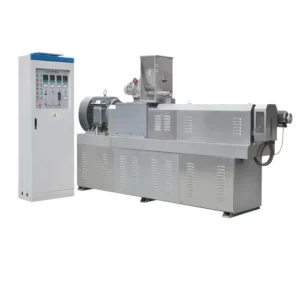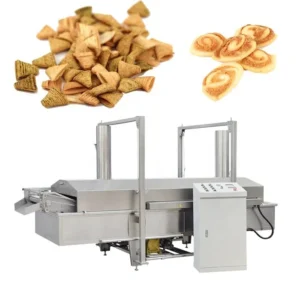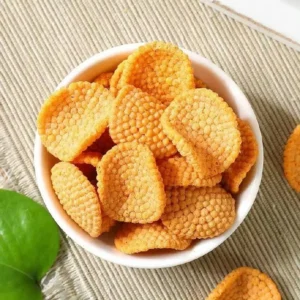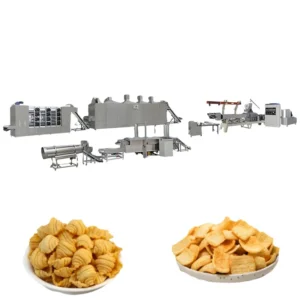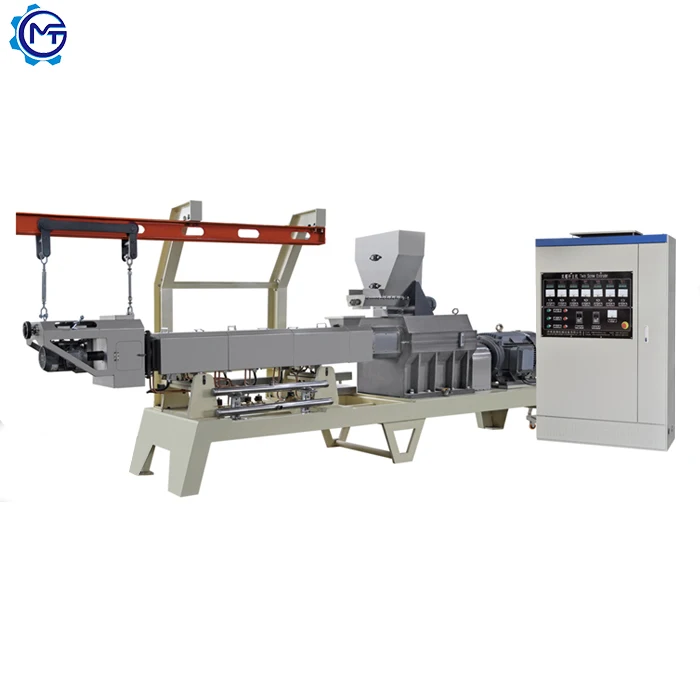
Throughput-Matched Stations — every machine in the Fried Puffed Salad Strips Line is specified against the extruder’s actual output so no single station bottlenecks your production rate.
Technical Specifications
| Parameter | Value |
|---|---|
| Product Type | Fried Puffed Snack Production Line |
| Extruder Type | Single Screw Extruder |
| Model Number | MT100 / MT120 |
| Raw Materials | Wheat flour, corn starch, potato starch |
| Output Capacity | 120 kg/h (basis not stated in source — confirm moisture content, product shape, and frying parameters) |
| Total Power | 50–70 kW (electricity); 50–60 kW (gas or diesel heating alternative) |
| Voltage & Frequency | Three-phase 380V/50Hz, single-phase 220V/50Hz (customizable to local voltage) |
| Energy Options | Electricity, gas, diesel, or steam |
| Motor & Electrical | Siemens (China) or top Chinese brand motors; Delixi or Delta inverters |
| Material | Food-grade stainless steel 201/304 |
| Overall Dimensions (L×W×H) | 12,000–26,000 × 1,200 × 2,200 mm |
| Die Configuration | Adjustable dies for multiple shapes (screw shell, round tube, square tube, ring, cartoon shapes) |
| Line Stations | Mixer → Screw Conveyor → Single Screw Extruder → Pulling and Cutting Machine → Automatic Fryer → Automatic Flavoring Line → Cooling |
| Standards | CE, ISO 9001 |
Application Suitability
| Application | Material or Output |
|---|---|
| Fried puffed salad strips and vegetable rolls | Wheat flour and corn starch blends with vegetable powder inclusions |
| Golgappa / pani puri shells | Wheat flour and semolina mixes requiring uniform secondary puffing |
| Extruded ring and tube snacks | Potato starch and corn starch formulations for varied die shapes |
| Cartoon-shaped fried puffed snacks | Starch-based dough with food-grade colorants for novelty formats |
What Buyers Miss When Quoting a Frying Chips Making Machine Full Equipment Range
A single under-sized station can cap the output of an otherwise capable line.
When I first started sourcing extrusion lines for European snack producers, the quoted capacity always looked impressive on paper. But once the line was installed, the fryer could not keep pace with the extruder, or the flavoring drum was too small to handle the throughput, leaving half the product unseasoned. These imbalances rarely show up until commissioning day, when the line is already bolted to your floor and the vendor’s technician is watching the clock. Buyers evaluating a frying chips making machine full equipment range need station-by-station confirmation that mixing volume, extruder output, fryer belt speed, and drum capacity all align before the first pallet ships [NEED_CITE: throughput balancing methodology for sequential food processing stations].
Station-by-Station Survey of the Complete Catalogue
The value of surveying the frying chips making machine full equipment range lies in understanding where each machine fits and what it contributes to the overall flow. The mixer initiates uniform hydration of the starch and flour blend, feeding into the screw conveyor which meters material into the single screw extruder at a controlled rate. The extruder itself generates the shear and temperature profile needed for partial gelatinisation, and the pulling and cutting machine sizes the extrudate before it enters the fryer.
Downstream, the automatic fryer completes the secondary puffing through rapid moisture flash-off, and the flavoring drum applies seasoning while the product surface still carries residual oil for adhesion. The cooling conveyor then stabilises the product temperature before packing, preventing condensation inside the bag that would compromise shelf life. Each station is specified independently, allowing buyers to evaluate, add, or replace individual machines within an existing line.
Energy Source Selection for Fryer and Dryer Stations
Fryer energy choice is one of the most consequential decisions on a puffed snack line, yet it is often deferred until the order is placed. This line supports electricity, gas, diesel, or steam as energy sources for the frying station, each carrying distinct operating cost profiles depending on local utility rates [NEED_CITE: industrial frying energy cost comparison by region]. Gas-fired fryers are common in regions where natural gas tariffs remain low relative to electricity, while steam-heated options integrate with existing boiler infrastructure in larger food plants.
The total electrical load sits between 50–70 kW for the all-electric configuration and 50–60 kW when gas or diesel heating is selected for the fryer. Voltage is configurable from the standard three-phase 380V/50Hz to match local supply, and single-phase 220V/50Hz is available for specific stations. Confirming these values during the quotation stage prevents the costly rewiring that delays commissioning when the line arrives with the wrong motor specifications.
Reading the Specifications That Actually Matter
The single screw extruder at the heart of this line operates on a fundamentally different principle from twin-screw designs: material is conveyed primarily through drag flow along the screw channel, which makes it well suited to starch-based formulations with moderate moisture content. The adjustable die plate allows operators to switch between screw shell, round tube, square tube, ring, and cartoon shapes without replacing the entire barrel assembly, reducing changeover time between production runs.
Food-grade stainless steel 201/304 construction across all product contact surfaces meets hygiene requirements for direct food processing and withstands the caustic wash-down chemicals used in snack line sanitation. The overall line footprint ranges from 12,000 to 26,000 mm in length depending on the fryer and cooling conveyor configuration selected, which directly affects the floor space and utility routing your facility must accommodate. Delixi or Delta inverters on the drive motors give operators variable speed control at the extruder and conveyor stations, allowing fine adjustment of residence time to compensate for raw material batch variation.
The Hidden Cost of Ignoring Station Compatibility
When a fryer is under-rated relative to the extruder output, product backs up at the cutting station, and operators begin manually clearing the conveyor to prevent dough buildup. I have seen this exact scenario force a snack producer to run the extruder at reduced speed, effectively paying for capacity they could never use [NEED_CITE: consequences of mismatched station throughput in snack extrusion lines]. Conversely, an oversized fryer wastes energy heating oil volume that the line never fills, driving up per-kilogram production costs without any quality benefit.
These imbalances also accelerate wear on the extruder screw and barrel because the machine is either starved or overloaded relative to its designed throughput window. The result is unplanned downtime for screw and die replacement well before the expected service interval, compounding the original capacity problem with spare parts cost and lost production time.
Why Source the Full Range Here
Complete lines from batching through packing come from a single supplier, so throughput is matched across every station rather than assembled from separate vendors who each optimise only their own machine. Screw configuration and die design are specified to the buyer’s raw material formulation and target product shape, not copied from a generic build that produces incorrect texture or density.
An in-house testing workshop runs trial production on your actual raw material before shipment, so product development begins at the factory rather than on your floor during commissioning. The equipment range covers single screw extrusion across pet food, aquatic feed, snacks, cereals, starch, and protein applications, giving buyers a reference base for future line expansion. Pre-sales consultation covers engineer design through on-site installation, commissioning, and ongoing maintenance, with a single point of accountability across the entire project.
Documentation & Verification
- Machine specification sheet for each station confirming extruder motor power, fryer capacity, and flavoring drum volume
- Line layout and capacity calculation showing station-by-station throughput balance for your target product
- Screw and die configuration record matched to your selected shapes and raw material blend
- Electrical schematic and voltage confirmation document verified against your facility power supply
- Trial run report produced on your raw material in the testing workshop before dispatch
- CE declaration of conformity and ISO certificate covering the complete line scope
Installation, Commissioning & Support
- Floor space planning based on the 12,000–26,000 mm line length and 1,200 mm width for utility routing
- Three-phase 380V/50Hz dedicated circuit with confirmed amperage for the 50–70 kW total electrical load
- Station modules shipped in assembly groups with documented reconnection points for on-site reassembly
- First-run parameter setting for barrel temperature profile, screw speed, and fryer oil temperature
- Operator training on die changeover between screw shell, ring, and tube shapes
- Wear parts list covering screws, dies, and fryer belt sections with recommended replacement intervals
What to Include in Your Inquiry
To configure the right line, share your target product format, raw material formulation including any vegetable powder or specialty starch percentages, and your daily production target. Specify your facility voltage, frequency, and available floor space so the layout can be drawn to scale before quotation. If you have existing upstream or downstream equipment that this line must integrate with, include station dimensions and throughput rates for those machines as well.
Frequently Asked Questions
Q: How do I match extruder output to fryer and flavoring drum capacity to avoid bottlenecks?
A: Request a station-by-station capacity calculation that lists the rated throughput of each machine based on your specific product shape and frying time. The extruder output, fryer belt speed, and flavoring drum volume must all be aligned to the same target rate, and this balance should be documented in the line layout proposal before production begins.
Q: What voltage and frequency options are available, and how are they confirmed before shipment?
A: The line supports three-phase 380V/50Hz and single-phase 220V/50Hz as standard, with custom voltage configurations available for local supply requirements. An electrical schematic and voltage confirmation document is issued during the order stage, and motor nameplates are verified against your facility specifications during the factory test before dispatch.
Q: Which die shapes are available, and can custom dies be configured for specific product formats?
A: Standard dies produce screw shell, round tube, square tube, ring, and cartoon shapes. Custom die configurations can be engineered for proprietary product formats based on your target dimensions and expansion ratio, with the die design recorded in the screw and die configuration document supplied with the line.
Q: What is the difference between electricity, gas, diesel and steam energy options for the fryer station?
A: Electric heating offers precise temperature control but higher energy cost in many regions. Gas and diesel heating reduce operating cost where fuel tariffs are favourable. Steam heating integrates with existing plant boiler systems. The choice affects total power rating and utility infrastructure requirements, and should be confirmed during line specification.