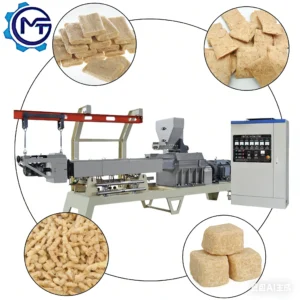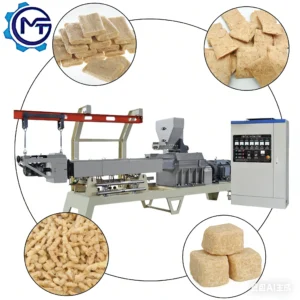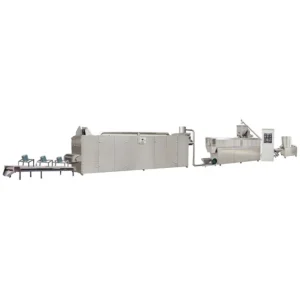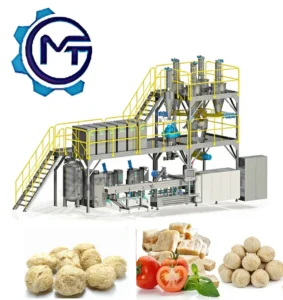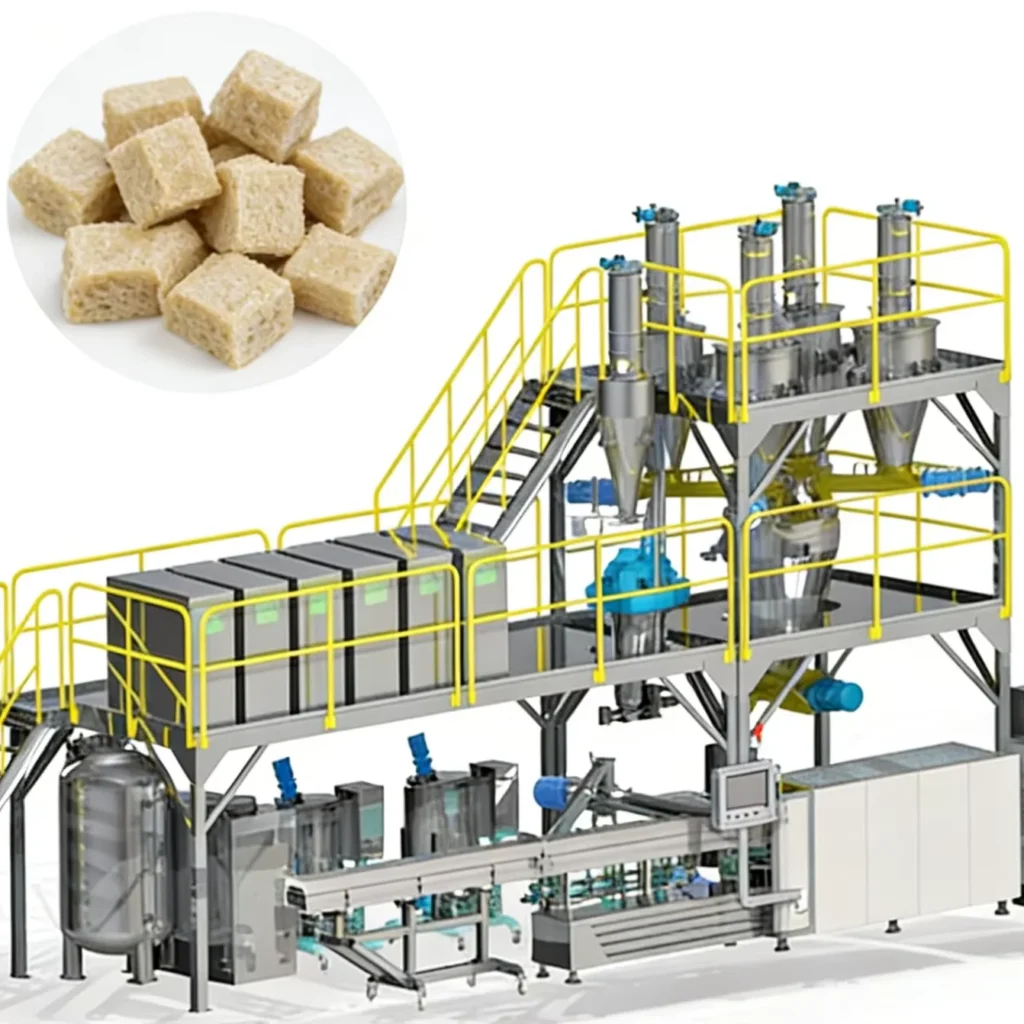
Matched Throughput Across Every Station — A single supplier sizes the mixer, twin-screw extruder, multi-layer dryer, and cooling conveyor to your raw material and target TVP format, so no station bottlenecks the line.
Technical Specifications
| Parameter | Value |
|---|---|
| Product Type | Texturized Vegetable Protein (TVP) Extrusion Line |
| Available Models | MT65 / MT70 / MT75 / MT85 |
| Screw Type | Twin-screw |
| Screw Length | 1050 mm / 1520 mm |
| Main Motor Power | 22 kW / 30 kW / 45 kW (varies by model) |
| Feeding Motor Power | 0.75 kW |
| Rotary Cutting Motor Power | 0.75 kW |
| Pump Motor Power | 0.37 kW |
| Heating Power | 10 kW / 14 kW (varies by model) |
| Mixer Type | Vertical, 304 stainless steel contact parts, carbon steel frame |
| Mixer Batch Capacity | 20–30 kg / 70–80 kg / 170–180 kg (scales with model) |
| Mixer Power | 4 kW / 7.5 kW / 15 kW |
| Dryer Drive | Double pitch roller chain, round-trip layout |
| Dryer Energy Options | Fuel / Gas / Electricity (selectable) |
| Dryer Temperature & Time | Adjustable |
| Die Configuration | Interchangeable moulds (nuggets, chunks, layered fibre shapes) |
| MT65 Installed Power | 84 kW (Consumption: 59 kW, Dimensions: 40000×1200×2200 mm) |
| MT70 Installed Power | 160 kW (Consumption: 120 kW, Dimensions: 41000×1500×2200 mm) |
| MT75 Installed Power | 190 kW (Consumption: 140 kW, Dimensions: 43000×1500×3200 mm) |
| MT85 Installed Power | 210 kW (Consumption: 140 kW, Dimensions: 45000×1500×3500 mm) |
| Output MT65 | 100–150 kg/h (basis not stated in source — confirm raw material, moisture, and die format) |
| Output MT70 | 150–200 kg/h (basis not stated in source — confirm raw material, moisture, and die format) |
| Output MT75 | 150–200 kg/h (basis not stated in source — confirm raw material, moisture, and die format) |
| Output MT85 | 250–300 kg/h (basis not stated in source — confirm raw material, moisture, and die format) |
| Standards | CE (since 2014), ISO |
Application Suitability
| Application | Material or Output |
|---|---|
| TVP and soya chunk production | Defatted soya flour, low-temperature soya flakes |
| Soya protein blocks | Soybean dregs, peanut dregs |
| Plant-based meat analogue scaling | Pea protein blends, mixed plant protein formulations |
| Cereal and snack format pivot | Reconfigured screws and dies on the same extrusion platform |
What "150 kg/h Output" Leaves Out About a Texturized Vegetable Protein Extrusion Line Equipment for Sale
Capacity figures on twin-screw lines are only meaningful when tied to your exact raw material, moisture level, and die geometry.
I once worked with a European buyer producing plant-based meat who ordered a line based on a catalogue capacity number. Their recipe used a blend of pea protein and soya concentrate that behaved completely differently from the defatted soya flour the quoted figure was based on. The fibre structure collapsed, density was wrong, and actual throughput fell well short of expectations. The fix required reconfiguring the screw combination and running multiple trial batches before the fibre alignment came back. [NEED_CITE: common causes of extruder output shortfall on plant protein blends] When sourcing a texturized vegetable protein extrusion line equipment for sale, the first question should always be: what material, at what moisture, through which die, produced that number?
How Screw Configuration Shapes Fibre Structure in Plant Protein
The twin-screw arrangement on the MT series extruders allows operators to adjust screw element sequencing, which controls shear intensity and residence time inside the barrel. For defatted soya flour, a specific balance of conveying and kneading elements is needed to achieve the layered fibre structure buyers expect in soya chunks. Switch to a pea protein blend and that same configuration may generate too much shear, breaking the protein matrix before it exits the die. The screw length options — 1050 mm and 1520 mm — give process engineers room to extend or shorten the working barrel depending on how much conditioning the material requires before expansion at the die face. Every texturized vegetable protein extrusion line equipment for sale should ship with a documented screw configuration record matched to the buyer’s material.
Matching Dryer Capacity to Extruder Output on a TVP Line
A frequent source of downtime on protein extrusion lines is a dryer that cannot keep pace with the extruder. The multi-layer dryer on this line uses a double pitch roller chain with a round-trip path, giving the product enough dwell time for moisture reduction without requiring excessive floor space. Temperature and drying time are adjustable, and the energy source — fuel, gas, or electricity — is selectable based on local utility costs and availability. If the dryer is undersized, wet TVP chunks pile up between the extruder and the dryer inlet, losing temperature and deforming before they enter the drying chamber. [NEED_CITE: impact of dryer bottleneck on extruded protein product quality] The dryer station on each MT model is sized to the corresponding extruder output range so material flows continuously through the line.
Reading the Power and Throughput Specs on a TVP Line
The installed power across the MT series ranges from 84 kW on the MT65 to 210 kW on the MT85, with actual consumption typically running lower than the installed figure. The main motor power steps up from 22 kW to 45 kW across the range, which directly affects the torque available to push viscous protein dough through the barrel and die. Higher motor power supports denser formulations and larger die openings, both of which increase resistance inside the extruder. The heating power of 10 kW to 14 kW maintains barrel zone temperatures necessary for protein denaturation and starch gelatinisation. Mixer batch capacities scale from 20–30 kg up to 170–180 kg, ensuring that moisture addition is consistent batch-to-batch and that the extruder feed hopper never starves between mixing cycles.
The Hidden Cost of Mismatched Line Stations
I have seen buyers source an extruder from one vendor and a dryer from another, only to discover during commissioning that the dryer belt width does not match the extruder output volume. The result is a production line that physically cannot run at the extruder’s rated pace. Wet product sits in transfer conveyors, surface moisture causes clumping, and operators end up running the extruder at reduced speed to let the dryer catch up. On a texturized vegetable protein extrusion line equipment for sale, every station from the vertical mixer through the cooling machine should be calculated as a single system. [NEED_CITE: throughput mismatch consequences in multi-vendor extrusion lines] When one supplier designs and matches the full line, throughput calculations account for the actual material behaviour rather than generic assumptions.
Why Source This Line From a Single Supplier
Every station on the MT series TVP line — mixer, screw conveyor, twin-screw extruder, air conveyor, multi-layer dryer, and cooling machine — is sized and matched under one supplier’s responsibility. Screw configuration and die design are specified to the buyer’s raw material and target product density before production begins. An in-house testing workshop runs trial batches on the buyer’s actual material before shipment, so fibre structure and density are confirmed rather than assumed. The extrusion platform is reconfigurable: screws and dies can be changed to shift between TVP, soya chunks, cereal, and snack formats, protecting the buyer’s investment if market demand shifts. Pre-sales consultation extends through engineer design, on-site installation, commissioning, and ongoing maintenance support. [NEED_CITE: benefits of single-supplier responsibility in food extrusion projects]
Documentation & Verification
- Line layout and capacity calculation showing throughput matching across all stations for your TVP format
- Screw and die configuration record specifying barrel zones, element sequence, and die geometry for your raw material
- Trial run report on your actual defatted soya flour or protein blend produced in the testing workshop before shipment
- Electrical schematic with voltage, frequency, and control language confirmed for your target market
- CE declaration of conformity and ISO certificate for customs and regulatory clearance
- Operation and maintenance manual with wear parts list covering screws, dies, and cutting blades
Installation, Commissioning & Support
- Foundation and floor space planning based on the line’s 40–45 metre length depending on the selected MT model
- Dedicated electrical circuit sized to the installed power of 84–210 kW with voltage and frequency matched to local supply
- Extruder barrel and screw assembly verified on-site after transport to confirm alignment and heating zone integrity
- First production run supervised by an engineer who sets barrel temperature profile, screw speed, and dryer parameters to your material
- Operator training covering die changeover, screw reconfiguration for alternate formats, and daily cleaning procedures
- Wear parts supply plan for screws, dies, and cutter blades with lead times confirmed before the first replacement cycle
What We Need to Configure Your Line
To specify the right texturized vegetable protein extrusion line equipment for sale for your project, share the raw material type and protein content of your formulation, the target product format such as nuggets or chunks, and your expected daily production volume. Include your workshop dimensions and ceiling height so the line layout can be drafted to fit. Confirm the local voltage, frequency, and preferred control language so electrical schematics and the HMI interface are correct before the equipment leaves the factory.
Frequently Asked Questions
Q: How is output capacity verified before the line ships?
A: Each line goes through a trial run in our testing workshop using your actual raw material — whether defatted soya flour, pea protein, or a blend. We measure throughput, product density, and fibre structure against your specification and document the results in a trial run report. This confirms what the line produces on your material, not a generic catalogue figure.
Q: How are screw and die configurations matched to different protein sources?
A: Defatted soya flour requires a different screw element sequence and die geometry than pea protein or mixed blends. We adjust the conveying and kneading element ratio, barrel temperature zones, and die opening size based on trial runs with your material. The configuration record ships with the line so your team has a baseline for future adjustments.
Q: How do you prevent the dryer from bottlenecking the extruder?
A: The multi-layer dryer on each MT model is sized to the corresponding extruder output range, with adjustable temperature and dwell time. During the line design phase, we calculate the moisture removal requirement based on your product specification and match the dryer capacity accordingly so material flows continuously without queuing.
Q: What electrical and control options are confirmed before production?
A: Voltage, frequency, and control panel language are confirmed during the specification stage based on your target market. The electrical schematic is reviewed and approved before manufacturing begins, so the line arrives ready for connection without on-site rewiring or component swaps.
Q: What spare wear parts are included with the line?
A: The line ships with a wear parts list covering screws, dies, and rotary cutting blades. A first set of replacement wear parts is typically included or quoted alongside the line so you have them on hand when the first changeover is due, avoiding production stops while waiting for shipments.