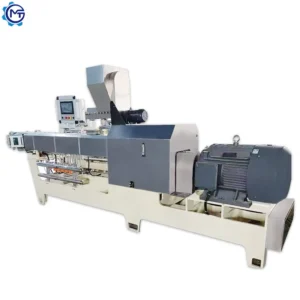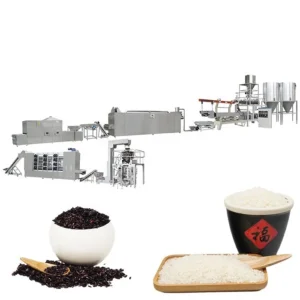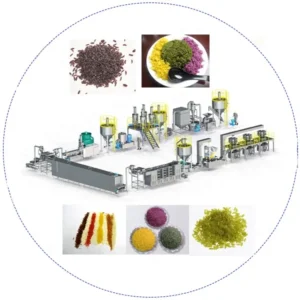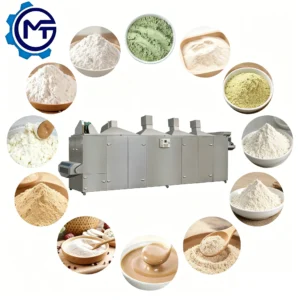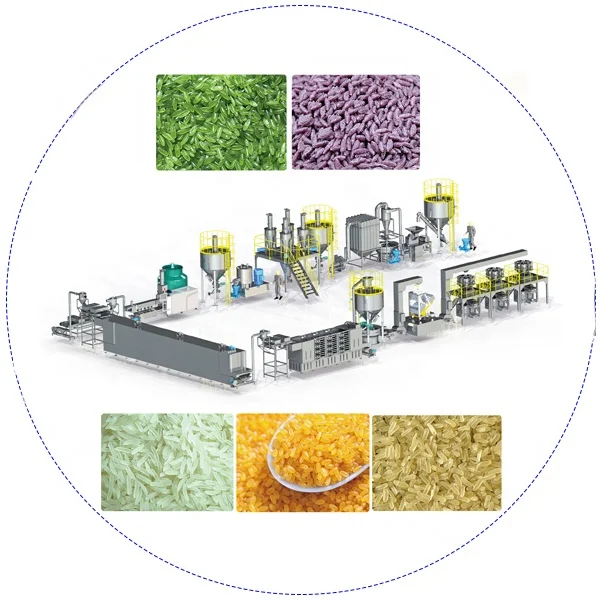
Matched throughput across every station — the twin-screw extruder, drying oven, and cooling conveyors are sized together so a fortified rice kernel production line never chokes at a downstream bottleneck.
Technical Specifications
| Parameter | Value |
|---|---|
| Product Type | Fortified Rice Kernel Extrusion Production Line |
| Models Available | MT65 / MT70 / MT85 / MT75 / MT95 |
| Screw Type | Twin screw (single or double screw feeding system selectable per material) |
| Installed Power | MT65 — 85 kW; MT70 — 120 kW; MT85 — 235 kW; MT75 — 180 kW; MT95 — 260 kW |
| Power Consumption | MT65 — 60 kW; MT70 — 85 kW; MT85 — 165 kW; MT75 — 135 kW; MT95 — 195 kW |
| Output Capacity | MT65 — 80–100 kg/h; MT70 — 100–120 kg/h; MT85 — 200–300 kg/h; MT75 — 300–500 kg/h; MT95 — 800–1000 kg/h (basis not stated in source — confirm raw material formulation, moisture content and pellet size) |
| Overall Dimensions (L×W×H) | MT65 — 28 × 1.2 × 2.2 m; MT70 — 30 × 1.5 × 2.2 m; MT85 — 34 × 3.5 × 4.3 m; MT75 — 32 × 3.5 × 4.3 m; MT95 — 36 × 3.5 × 4.3 m |
| Control System | Frequency speed controlling with high automation |
| Drying Oven Heating Source | Electric or gas |
| Drying Oven Feature | Circulation drying process, mesh belt speed controlled by frequency motor |
| Screw Material | Special wear-resistant alloy |
| Lubrication & Cooling | Automatic lubricating and cooling system |
| Line Stations | Mixing → Extruding → Vibrating → Low-temperature drying → Cooling → High-temperature roasting → Cooling → Packing |
| Certification | CE, ISO |
Application Suitability
| Application | Material or Output |
|---|---|
| Nutrition programme fortified rice kernels | Broken rice and rice flour with embedded vitamins and minerals |
| Reconstituted artificial rice from milling by-products | Broken rice, rice bran with starch binders |
| Quick-cooking and instant rice for retail | Rice grits, corn, millet, wheat, oats, buckwheat with supplementary nutrients |
| Pilot-scale product development runs | Starch-based formulations with bean and oat blends for texture testing |
What "Rated Output" Leaves Out on a Fortified Rice Kernel Production Line Equipment Order
Capacity numbers are meaningless without the exact formulation and moisture level they were measured on.
I learned this the hard way early in my career. A customer producing nutritional powder sent us a sample that flowed beautifully through the hopper. We quoted a line based on the nominal capacity plate. When they shipped their production-grade raw material — higher starch content, stickier when hydrated — the twin screws could not keep up. Output dropped to roughly half, and the extrudate clumped before it even reached the dryer. The mismatch was not the machine’s fault; it was the assumption that one number fits every recipe [NEED_CITE: twin-screw extrusion capacity dependence on raw material formulation].
That is why every fortified rice kernel production line equipment proposal we issue now starts with a question: what exactly are you feeding the hopper, and at what moisture?
How Screw and Feeder Selection Shapes Kernel Density
A twin-screw extruder handles the shear and mixing demands of fortified rice dough far better than a single-screw alternative, especially when the recipe includes fine vitamin premixes that tend to segregate in gravity feeders. The option to select single or double screw feeding lets the operator match the feeder to the raw material behaviour — a dry, free-flowing rice grit works with single screw feeding, while a sticky, vitamin-loaded blend benefits from the positive displacement of double screw feeding. Getting this choice right at the extruder inlet determines whether the kernels exit the die at consistent density or vary batch to batch.
Why Drying Oven Sizing Cannot Be an Afterthought
The drying stage on a fortified rice kernel production line equipment setup is where most throughput losses hide. If the oven belt is too short or the circulation airflow is undersized relative to the extruder output, kernels arrive at the roasting stage with uneven moisture. Some will be over-dried and cracked; others will retain enough water to spoil in storage. The circulation drying process with a frequency-controlled mesh belt keeps the residence time adjustable, so the operator can slow the belt for high-moisture formulations or speed it up for leaner recipes. Matching oven capacity to extruder output is a calculation, not a guess [NEED_CITE: food extrusion line drying capacity matching principles].
Reading the Power and Dimension Figures
Installed power and actual power consumption tell two different stories. The MT65 draws 85 kW installed but consumes around 60 kW under normal running conditions, meaning the motor capacity includes headroom for startup loads and short peaks when the screw encounters a denser feed zone. For buyers planning electrical infrastructure, the consumption figure is the one to size cables and breakers against. The dimension spread across models — from 28 m line length on the MT65 up to 36 m on the MT95 — reflects the additional drying and cooling length needed for higher throughput. Taller profiles on the MT85, MT75, and MT95 (4.3 m versus 2.2 m on smaller models) usually indicate multi-tier drying ovens or elevated cooling conveyors, which affects the clear height requirement in the production hall. Buyers should confirm ceiling height and overhead crane availability before finalising the layout.
The Hidden Cost of Skipping a Trial Run
Every extrusion line looks reliable on a spec sheet. The problem surfaces when your specific raw material meets the screw profile for the first time. I have seen a nutrition programme supplier receive a full line, install it, and then spend weeks adjusting screw configurations because the kernel shape did not match the WFP visual standard. The die was correct, but the screw element sequence had been set up for a different starch ratio. A trial run on the buyer’s actual formulation before shipment would have caught that in the factory, not on the customer’s floor three time zones away [NEED_CITE: pre-shipment trial run value for extrusion equipment buyers].
Why Procurement from One Supplier Matters on This Line
Every station on the fortified rice kernel production line equipment — mixing, extruding, vibrating, drying, roasting, cooling, packing — is supplied as one integrated project. The extruder output is matched to the dryer belt speed, and the cooling conveyor length is calculated against the roasting stage discharge rate, so no single station becomes a bottleneck. The screw configuration and die design are specified against the buyer’s target kernel shape and nutrient blend rather than pulled from a generic build file. An in-house testing workshop allows trial runs on the buyer’s raw material before the line ships. Pre-sales consultation covers line layout and utility planning, and the same engineering team stays involved through on-site commissioning and operator training. Voltage, frequency, and control language are confirmed against the installation site before production begins.
Documentation & Verification
- Line layout and capacity calculation specific to your kernel shape and formulation
- Screw and die configuration record matched to your target nutrient retention profile
- Trial run report on your raw material before the line leaves the factory
- Electrical schematic with voltage and frequency confirmed against your site supply
- Operation and maintenance manual with wear parts list for screws and dies
Installation, Commissioning & Support
- Floor plan and foundation load points mapped to the 28–36 m line length range
- Dedicated power circuit sized against confirmed consumption from 60 kW to 195 kW
- Line arrives in modular sections for staged assembly within the confirmed footprint
- First-run parameter setting covering screw speed, barrel temperature, and dryer belt frequency
- Operator training on die changes and screw element replacement for different kernel shapes
- Spare wear parts list provided with recommended replacement intervals for screws and dies
What to Include in Your Inquiry
A detailed inquiry shortens the proposal cycle considerably. Provide your raw material formulation including the vitamin and mineral premix ratio, the target kernel shape and size, and your daily output requirement so the correct model from the MT65 through MT95 range can be recommended. Confirm your site voltage and frequency, the available floor space and ceiling height, and whether the control panel and HMI need to be in a specific language. If you have existing upstream batching or downstream packing equipment, note the interface specifications so the line can be matched accordingly.
Frequently Asked Questions
Q: How is the output capacity verified before the line ships?
A: We run a trial on your actual raw material formulation in our testing workshop. The extruder is fitted with the screw and die configuration specified for your kernel shape, and we measure throughput, moisture at the dryer exit, and kernel integrity after cooling. A written trial report with these results accompanies the shipment.
Q: Which voltage and frequency configurations are available?
A: The control system and motors can be configured to match your site electrical supply. We confirm voltage, frequency, and phase during the proposal stage and reflect these in the electrical schematic. This avoids commissioning delays caused by mismatched drives or transformer requirements on site.
Q: How is the screw configuration matched to a specific kernel shape?
A: Screw element type, sequence, and compression ratio are selected based on your raw material behaviour and target kernel density. The die plate is machined to the exact kernel cross-section. Both are documented in the configuration record so replacements can be ordered with certainty.
Q: Can I send my raw material for a trial run before placing the order?
A: Yes. We encourage buyers to ship a representative sample of their production-grade formulation to our testing workshop. The trial confirms whether the selected model can hold the required output on that specific blend and identifies any adjustments needed in screw configuration or feeder type.
Q: What spare wear parts should I plan for in the first year?
A: Screws and dies are the primary wear items. We provide a wear parts list with recommended replacement intervals based on your formulation abrasiveness. Keeping one spare screw element set and a replacement die plate on hand prevents unplanned downtime during the first production year.