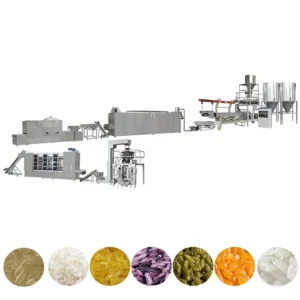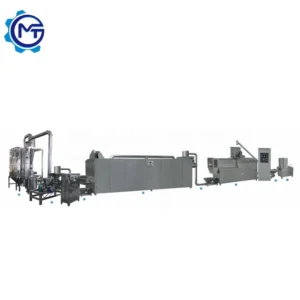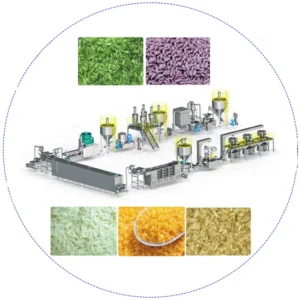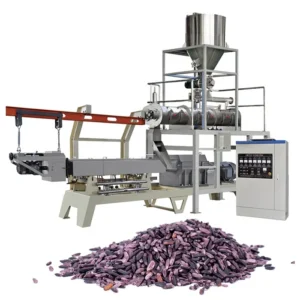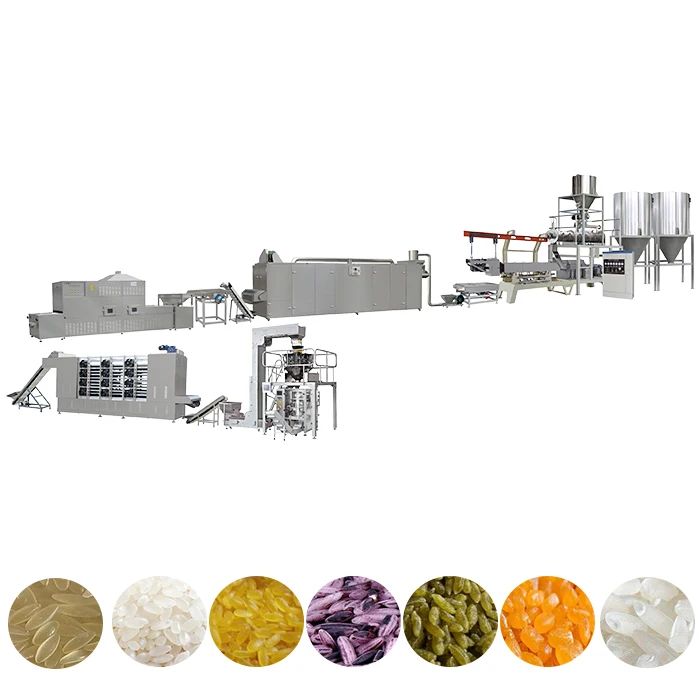
Thermodynamic Profiling — Barrel zones and screw pitch calibrated against your actual rice-corn blend before shipment, preventing the discharge clogging that stalls commissioning.
Technical Specifications
| Parameter | Value |
|---|---|
| Product Type | Artificial Fortified Rice Making Machine |
| Model | MT-70 |
| Screw Type | Single-screw extruder |
| Screw Length | 1510 mm |
| Contact Material | Stainless Steel (SS201 & SS304) |
| Line Stations | Mixer → Screw Conveyor → Extruder → Dryer |
| Mixer Main Motor | 4.0 kW |
| Mixer Batch Output | 3.0 – 4.0 kg/time |
| Mixer Dimensions | 1.2 × 0.9 × 1.4 m |
| Screw Conveyor Motor | 1.1 kW |
| Screw Conveyor Feed Rate | 0 – 150 kg/h |
| Screw Conveyor Dimensions | 2.5 × 0.6 × 2.3 m |
| Extrusion System | Interchangeable die moulds |
| Raw Materials | Rice powder, corn powder, vitamins, minerals |
| Standards | CE, ISO |
| Nominal Capacity | 100 – 500 kg/h (basis not stated in source — confirm raw material formulation and moisture content) |
Application Suitability
| Application | Material or Output |
|---|---|
| Fortified rice production | Rice powder and corn powder blended with vitamin and mineral premixes |
| Instant rice manufacturing | Pre-gelatinised starch matrices requiring rapid rehydration |
| Puffed rice grain formats | Low-moisture cereal blends expanded through single-screw shear |
| Nutrition programme supply | Standardised micronutrient-dosed grain analogues for institutional distribution |
| Pilot-scale formulation trials | Small-batch rice and corn blends tested on interchangeable die moulds |
What "500 kg/h on Paper" Leaves Out When Your Blend Has Oil
Rated throughput assumes a baseline moisture and oil profile that your actual premix may not match.
I remember a fortified rice project where the line was quoted at a nominal capacity based on standard corn-rice blends. The buyer’s formulation carried a higher lipid ratio from added fat-soluble vitamins, and the extruder discharge began clogging within the first hour. The screw pitch and barrel temperature zones were set for a leaner mix, and the material simply would not flow consistently through the die plate. It took several days of on-site re-profiling before the line ran at a stable rate. That experience reinforced why I always recommend reviewing screw and die configuration records against your specific raw material before the artificial fortified rice making machine full equipment range is dispatched [NEED_CITE: raw material variability in fortified cereal extrusion].
Barrel Temperature Zones and Shear Control
The MT-70 uses a single-screw configuration with a 1510 mm screw length, which defines the residence time your material spends inside the barrel. Longer residence means more gradual starch gelatinisation, giving operators finer control over the final grain density. When processing rice powder blended with corn powder and micronutrient premixes, each barrel heating zone must be profiled to match the gelatinisation onset of your specific starch ratio. The interchangeable die moulds then shape the expanded material into the target grain geometry. Getting the artificial fortified rice making machine full equipment range set correctly at this stage determines whether the output holds its shape through the dryer or fractures into fines.
Throughput Matching Across Every Station
A mixer that batches 3.0 – 4.0 kg per cycle feeds a screw conveyor rated at up to 150 kg/h, which in turn supplies the extruder. If any one station runs faster or slower than the others, material either starves the extruder or accumulates upstream. The 4.0 kW mixer motor and 1.1 kW conveyor motor are sized so that the mass flow balances across each transfer point. Buyers surveying individual units from the artificial fortified rice making machine full equipment range should cross-reference each station’s throughput against their target daily output to confirm the chain holds together under continuous operation [NEED_CITE: mass balance principles in extrusion line design].
Reading the Specification Sheet Beyond the Nameplate
The screw length of 1510 mm places this extruder in a mid-range category suitable for moderate-shear applications like rice and corn blends. For buyers comparing machines, the L/D ratio derived from this length and the screw diameter indicates how much mechanical work the material receives per pass — critical when you need partial gelatinisation without over-cooking heat-sensitive vitamins. Stainless steel contact materials (SS201 and SS304) are specified across food-contact zones, which matters for compliance with food safety audits. The CE and ISO certifications cover manufacturing process and safety directives, but the actual die configuration and screw profile must still be matched to your formulation before production begins.
The Hidden Cost of Skipping a Trial Run
When a line ships without a trial on the buyer’s actual raw material, the first commissioning week often turns into an extended debugging session. Barrel temperatures need adjustment, screw pitch may need reconfiguring, and die selection might prove wrong for the target grain shape. Each day of on-site troubleshooting delays production start and consumes raw material that cannot be reprocessed. Buyers who skip the trial run phase effectively pay for product development after installation rather than before shipment, shifting the risk entirely onto the commissioning window [NEED_CITE: commissioning delays in food extrusion installations].
Why Buyers Survey Equipment Here
Every station in the line — mixer, screw conveyor, single-screw extruder, dryer — is listed with individual specifications so buyers can evaluate each unit before committing to a full layout. Screw configuration and die design are specified against the buyer’s raw material and target grain shape, rather than copied from a generic build. An in-house testing workshop allows trial runs on your actual rice-corn-vitamin blend before the equipment leaves the factory. The artificial fortified rice making machine full equipment range is documented with machine specification sheets, electrical schematics, and trial run reports so that every parameter is verifiable before dispatch. Pre-sales engineering consultation carries through to on-site installation, commissioning, and operator training.
Documentation & Verification
- Machine specification sheet listing motor ratings, dimensions, and material grades for each station
- Screw and die configuration record matched to your rice-corn formulation
- Electrical schematic with voltage, frequency, and control language confirmed per destination market
- Trial run report on your actual raw material before equipment leaves the workshop
- CE declaration of conformity and ISO certificate for the manufacturing facility
- Operation and maintenance manual covering each station in the processing line
Installation, Commissioning & Support
- Foundation requirements verified against mixer and extruder footprint dimensions before floor preparation
- Dedicated electrical circuits confirmed for 4.0 kW mixer and 1.1 kW conveyor motor loads
- Screw conveyor arrives partially assembled; field alignment checked against the 2.5 m frame length
- Barrel temperature zones profiled on your raw material during first commissioning run
- Operator training covers die changeover procedures on the interchangeable mould system
- Wear parts list provided covering screws, dies, and seals specific to the MT-70 configuration
Before You Request a Quote
Provide your raw material formulation including the ratio of rice powder to corn powder and the type of vitamin-mineral premix you intend to use. Specify your local voltage and frequency standards along with the preferred control panel language. If you are retrofitting individual machines into an existing line, share the upstream and downstream equipment details so station throughput can be matched. Let us know whether you want a trial run on your material before shipment.
Frequently Asked Questions
Q: How do I match each station’s throughput so no single machine bottlenecks the line?
A: Start with your target hourly output and work backward through each station. The mixer produces 3.0 – 4.0 kg per batch, the screw conveyor handles up to 150 kg/h, and the extruder’s nominal range requires confirmation against your specific formulation. We provide a line layout with capacity calculations so every transfer point is balanced before production begins.
Q: What screw and die configurations are available for different rice and corn powder blends?
A: The MT-70 uses interchangeable die moulds and a configurable screw profile. The 1510 mm screw length allows adjustment of pitch and flight depth to match the gelatinisation behaviour of your specific rice-corn ratio. Configuration records are documented and provided with each shipment.
Q: Which spare wear parts should I order with the initial shipment?
A: Screws, die moulds, and barrel liners are the primary wear items in single-screw extrusion. A wear parts list specific to your MT-70 configuration is included in the documentation package. Ordering the first replacement set with the initial shipment avoids production downtime when the first changeover is due.
Q: How are voltage, frequency, and control panel language confirmed before production begins?
A: An electrical schematic is issued during the specification confirmation stage. The buyer reviews and signs off on the voltage rating, frequency, and control panel language before the machine enters production. This step prevents commissioning delays caused by mismatched electrical standards at the installation site.
Q: Can individual machines from this range be ordered to retrofit an existing fortified rice line?
A: Yes. Each station — mixer, screw conveyor, extruder, dryer — is available as a standalone unit with its own specification sheet. Buyers retrofitting an existing line should share current equipment details so throughput matching and mechanical interface compatibility can be confirmed before order placement.