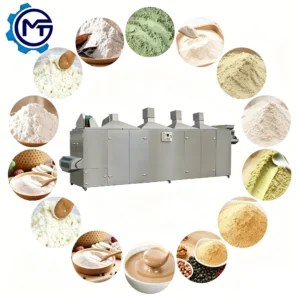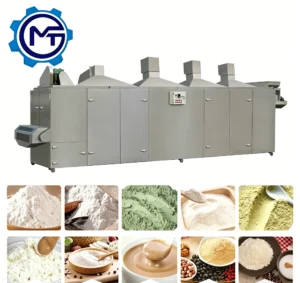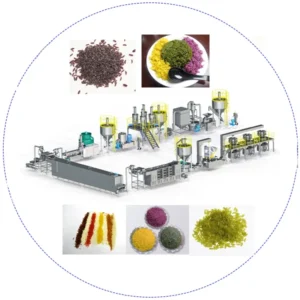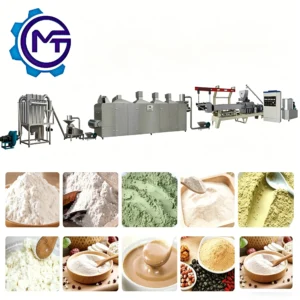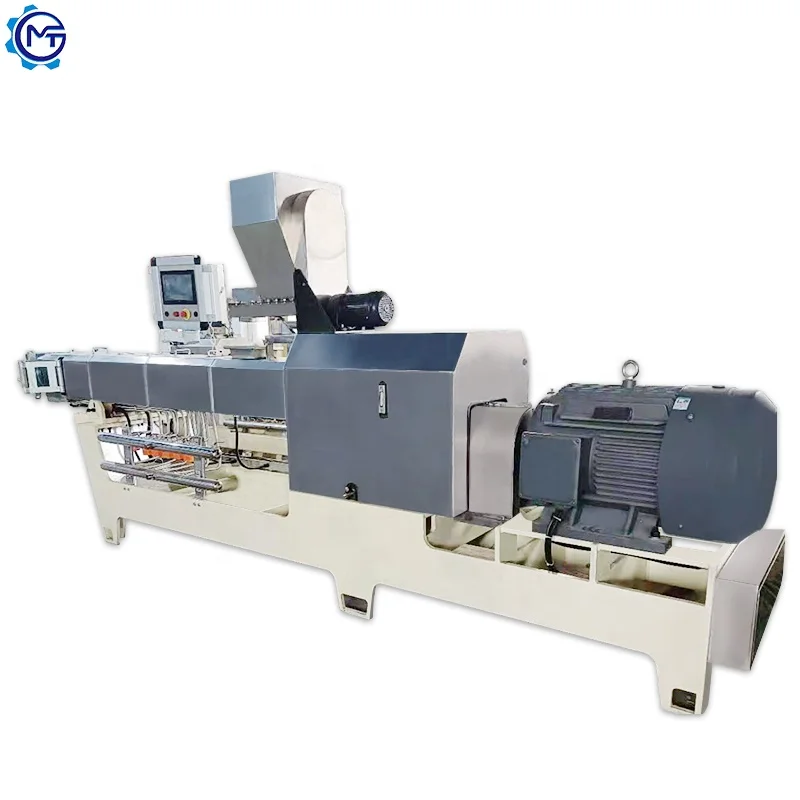
Line-Wide Equipment Matching — Every station from mixing to packing is sized against the extruder’s actual throughput on your grain formulation, eliminating mid-line bottlenecks before commissioning begins.
Technical Specifications
| Parameter | Value |
|---|---|
| Model | MT65 / MT70 / MT85 / MT75 / MT95 |
| Product Type | Fortified Rice Processing Line |
| Screw Type | Twin-screw |
| Installed Power | 85 kW (MT65) / 120 kW (MT70) / 235 kW (MT85) / 180 kW (MT75) / 260 kW (MT95) |
| Power Consumption | 60 kW (MT65) / 85 kW (MT70) / 165 kW (MT85) / 135 kW (MT75) / 195 kW (MT95) |
| Output Capacity | 80–100 kg/h (MT65) / 100–120 kg/h (MT70) / 200–300 kg/h (MT85) / 300–500 kg/h (MT75) / 800–1000 kg/h (MT95) (basis not stated in source — confirm raw material formulation and moisture content) |
| Overall Dimensions (L×W×H) | 28×1.2×2.2 m (MT65) / 30×1.5×2.2 m (MT70) / 34×3.5×4.3 m (MT85) / 32×3.5×4.3 m (MT75) / 36×3.5×4.3 m (MT95) |
| Feeding System | Single or double screw feeding, selectable based on material |
| Screw Material | Wear-resistant alloy |
| Lubrication | Automatic lubricating and cooling system |
| Drying Oven Heating Source | Electric or gas |
| Drying Oven Feature | Circulation drying, mesh belt speed controlled by frequency motor |
| Control System | Frequency speed control, automated |
| Line Stations | Mixing → Extruding → Vibrating → Low temperature drying → Cooling → High temperature roasting → Cooling → Packing |
| Assembly State | Complete line, turnkey |
| Certification | CE, ISO |
Application Suitability
| Application | Material or Output |
|---|---|
| Fortified rice kernel production | Broken rice, rice bran blended with vitamins and minerals |
| Artificial rice from multi-grain blends | Corn, millet, wheat, oats, buckwheat, bean, starch-based formulations |
| Nutritional rice programmes | Micro-nutrient fortified kernels for food security initiatives |
| Starch-based grain analogues | Modified starch and pregelatinised starch with protein enrichment |
What Capacity Ratings Leave Out When Stations Are Mismatched
A 500 kg/h extruder feeding a 300 kg/h dryer does not produce 300 kg/h of finished rice — it produces a jammed oven and half-cooked kernels.
I have stood beside a running line in Shandong where the extruder pushed material faster than the dryer could pull moisture out. The mesh belt backed up, kernels stuck together in clumps, and the roasting stage downstream received product at inconsistent moisture levels. The entire fortified rice processing line equipment catalogue exists to prevent that exact scenario. Every station must be surveyed together before a single unit is ordered. [NEED_CITE: thermal load matching in continuous grain drying systems]
How the Extruder Range Maps to Your Fortified Rice Output Target
The five twin-screw models span production scales from pilot batches to industrial volume. Selecting the right unit depends not only on desired hourly output but also on the starch-to-protein ratio in your formulation, because higher protein content increases barrel viscosity and demands more torque. Each model’s installed power and screw geometry are matched to a specific throughput band so that gelatinisation stays consistent across the barrel length.
Drying and Roasting Stages That Hold Tolerance on Fortified Kernels
After extrusion, the kernels enter a low-temperature circulation dryer where moisture drops gradually. The mesh belt speed is governed by a frequency motor, allowing operators to adjust residence time based on ambient humidity and kernel size. The subsequent high-temperature roasting stage develops surface hardness and shelf stability. Both stages must be specified against the extruder’s actual output rather than a nominal catalogue figure. [NEED_CITE: moisture migration kinetics in extruded grain products]
Reading the Power and Footprint Figures for Workshop Planning
Installed power on the MT95 reaches 260 kW, but actual consumption under load sits around 195 kW — the gap matters for transformer sizing and electrical infrastructure. The MT95 line stretches to 36 metres in length and over 4 metres in height, which sets minimum workshop bay requirements before delivery. Frequency-controlled feeding across single or double screw options means you can switch between fine rice flour and coarse multi-grain blends without changing hardware. The automatic lubricating and cooling system reduces unplanned stops during continuous shifts, a factor that matters more on the larger models running extended campaigns.
What Happens When the Dryer Cannot Keep Pace with the Extruder
Buyers often size the extruder first and pick the dryer later based on budget. The result is a line where the extruder runs at partial feed to prevent the oven from flooding, so you never reach the throughput you paid for. On artificial rice lines, uneven drying also causes surface cracking during the roasting stage, pushing kernels outside the visual and textural specification that buyers in fortified food programmes require. [NEED_CITE: surface defect formation in partially dried extruded rice kernels]
Why Sourcing the Full Range from One Supplier Matters Here
Every station in this fortified rice processing line equipment catalogue is specified against the others, so throughput calculations hold from the mixer hopper to the packing scale. Screw configuration and die design are matched to your exact grain formulation before the extruder leaves the workshop. An in-house testing workshop allows trial runs on your actual raw material, revealing viscosity and expansion behaviour before you commit to container loading. Electrical schematics and voltage confirmation are documented per target market, preventing rewiring delays during commissioning. Operator training covers the full station sequence, not just isolated machines.
Documentation & Verification
- Line layout and capacity calculation confirming station-by-station throughput match
- Machine specification sheet per model with installed power, consumption, and footprint
- Screw and die configuration record matched to your grain formulation
- Electrical schematic and voltage confirmation for your target market grid
- Trial run report on your actual raw material before shipment
- CE declaration of conformity and ISO certificate
Installation, Commissioning & Support
- Workshop bay must accommodate up to 36 m line length and 4.3 m height clearance on the MT95
- Dedicated electrical circuit sized for up to 260 kW installed load with voltage confirmed before dispatch
- Line arrives in sectioned modules; on-site assembly aligns conveyor transfer points between stations
- First-run parameter setting covers barrel temperature profile, mesh belt speed, and roasting zone temperature
- Operator training addresses frequency-controlled feeding adjustments for different grain blends
- Wear parts list includes screw elements and die plates with reorder lead times documented
Before You Request a Quotation
Share your raw material formulation — broken rice percentage, added starch, protein content, and target moisture in the finished kernel. Confirm your local voltage, frequency, and the control language your operators need on the HMI. Provide workshop dimensions so the line layout can be drafted before the proposal stage.
Frequently Asked Questions
Q: What equipment stations are included in the complete fortified rice line and where does each fit?
A: The line sequence runs from mixing through twin-screw extruding, vibrating, low-temperature drying, cooling, high-temperature roasting, a second cooling stage, and packing. Each station is capacity-matched to the extruder model you select, so throughput stays consistent from raw material input to finished kernel output.
Q: How do I select the right extruder model based on my target capacity and raw material?
A: Start with your target hourly output on your actual grain blend, then match it against the five model ranges. Higher protein or fat content in your formulation increases barrel viscosity, which may shift you to a larger model with more installed power and torque headroom.
Q: What drying oven options are available and how is the heating source chosen?
A: The circulation drying oven is available with electric or gas heating. Electric suits markets with stable grid supply and strict emission controls. Gas reduces operating cost where natural gas infrastructure is available. Mesh belt speed is frequency-controlled for residence time adjustment.
Q: Can individual machines be ordered separately or only as a full line?
A: Individual stations can be ordered to replace or supplement existing equipment. However, capacity matching across stations is only guaranteed when the full line is specified together, ensuring no single unit bottlenecks the extruder output.
Q: What supporting equipment is available to match the extruder?
A: The catalogue covers mixing and batching systems, screw conveyors, vibrating screens, dryers, cooling conveyors, roasting units, and packing stations. Each unit is sized against the extruder’s confirmed throughput on your formulation to maintain continuous material flow.