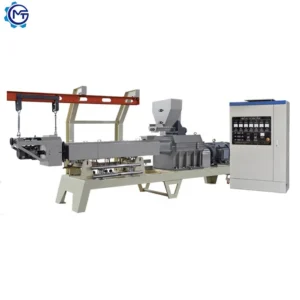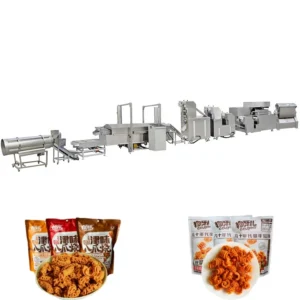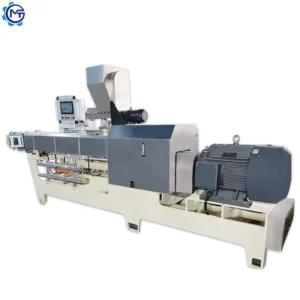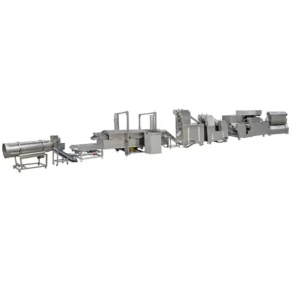
Throughput-Matched Station Integration — every fryer we configure is verified against upstream extruder output and downstream seasoning capacity, so your snack line runs without bottlenecks from mixing through packing.
Technical Specifications
| Parameter | Value |
|---|---|
| Product Type | Automatic Continuous Deep Fryer |
| Power Source | Electric / Gas (dual option available) |
| Voltage & Frequency | 380V / 50Hz |
| Rated Heating Power | 60 kW (drive motor 2.6 kW) |
| Oil Capacity | 320 L |
| Control System | PLC |
| Overall Dimensions (L×W×H) | 6700 × 2200 × 1200 mm |
| Net Weight | 2000 kg |
| Output Capacity | 100–1000 kg/h (basis not stated in source — confirm product format, moisture content and frying time) |
| Belt System | Upper and lower double-layer mesh belt with frequency conversion stepless speed regulation |
| Oil Filtration | Integrated continuous oil circulation filtration system |
| Slag Discharge | Bottom-mounted automatic residue discharge system |
| Lifting System | Automatic lifting of upper hood and mesh belt for cleaning |
| Construction Material | Food-grade 304 stainless steel |
| Assembly State | Fully assembled, continuous inline configuration |
| Warranty | 1 year (core components: 1 year) |
Application Suitability
| Application | Material or Output |
|---|---|
| Fried extruded corn chips | Corn masa, corn grits, corn flour dough |
| Fried puffed snacks | Wheat, rice, or multi-grain extrudates |
| Fried pellet chips | 2D or 3D starch-based pellets |
| Fried formed snack shapes | Sheeted or extruded dough pieces for retail or food service |
What "100–1000 kg/h" Really Means for Your Snack Line
Capacity figures on a continuous frying machine for snack production line are meaningless without knowing the product format, moisture content, and frying time.
I have watched buyers compare two fryer quotes based on a single headline number, only to discover during commissioning that the machine cannot hold that throughput on their specific product. A corn chip at 18% moisture entering the fryer behaves completely differently from a pellet chip at 12% moisture. Frying time, oil uptake, and belt speed all shift accordingly. If your upstream extruder pushes a certain hourly volume, the fryer must match it precisely — otherwise you are either starving the fryer or piling product on the discharge belt. This is the kind of mismatch I try to prevent during the first conversation, before a line layout is drawn [NEED_CITE: matching extruder throughput to downstream frying capacity].
Station-to-Station Balance Starts at the Fryer
The fryer sits at the most capital-intensive junction of a fried snack line. Upstream, the extruder and forming station set the pace. Downstream, the de-oiling drum, seasoning system, and cooling conveyor must absorb whatever the fryer delivers. If the continuous frying machine for snack production line is undersized, product backs up and moisture migration degrades texture. If it is oversized, oil degradation accelerates because the bath runs partially empty. Getting this balance right requires looking at the entire line as one system, not selecting each station from a separate catalogue.
Double-Layer Belt Mechanics and Frying Uniformity
The upper and lower mesh belts on this unit work together to submerge the product completely during the fry cycle. Single-belt fryers let lightweight snacks float to the surface, resulting in uneven colour and inconsistent oil absorption across the batch. The frequency-controlled stepless speed regulation allows operators to adjust the residence time from a few seconds to several minutes without stopping the line. This matters when a producer switches between corn chips and pellet chips on the same equipment — each format demands a different fry profile, and the belt speed is the primary variable that makes the transition possible.
Interpreting the Specification Sheet for Real Workshop Conditions
The 60 kW heating load draws a substantial amount of power, and this figure does not include the 2.6 kW drive motor or the oil circulation pump. Buyers need to confirm that their workshop electrical panel can supply this total load on a dedicated circuit at 380V / 50Hz — or specify an alternative voltage before production begins. The 320-litre oil capacity means that the filtration system must handle a high turnover rate; the integrated continuous oil circulation filter is designed to keep the acid value within acceptable limits by removing fine particulate and polymerised oil [NEED_CITE: acid value limits for reused frying oil in food processing]. The 6700 mm length of the unit also dictates the minimum straight-run floor space required, separate from the approach and discharge conveyors that connect to neighbouring stations.
The Hidden Cost of a Mismatched Frying Station
When the fryer capacity does not align with the extruder output, the consequences show up in ways that are not immediately obvious. Oil darkens faster because product dwell time varies unpredictably. Belt speed is constantly adjusted by operators trying to compensate, which increases wear on the frequency drive. Seasoning application downstream becomes inconsistent because the product temperature and surface oil content fluctuate batch to batch. In the worst cases I have seen, producers were forced to throttle their extruder to match a smaller fryer, leaving paid-for capacity on the table every shift [NEED_CITE: production bottleneck effects in multi-stage food processing lines].
Why Buyers Source the Full Equipment Range Here
- The fryer is designed as one station in a complete snack line, so throughput calculations account for upstream mixing and extrusion as well as downstream de-oiling and packing.
- Screw and die configurations on the upstream extruder are specified together with the fryer belt speed and temperature profile to match the buyer’s raw material and target product.
- In-house testing workshop allows trial runs on the buyer’s actual raw material before the equipment ships, verifying that the continuous frying machine for snack production line performs as expected.
- Voltage, frequency, control language, and utility connections are confirmed against the destination market before production starts, reducing commissioning delays.
- Every station from mixing through packing comes from one supplier, so mechanical interfaces, control integration, and warranty responsibility are unified.
Documentation & Verification
- Line layout showing fryer position, throughput match, and utility connections
- Machine specification sheet with confirmed voltage, frequency, and control language
- Electrical schematic covering 60 kW heating circuit and drive motor wiring
- Factory test record or video outgoing inspection before shipment
- CE declaration of conformity and ISO certificate for export compliance
- Wear parts list covering mesh belt segments and heating elements
Installation, Commissioning & Support
- 6700 × 2200 mm footprint requires level concrete floor with drainage for oil spill containment
- Dedicated 380V three-phase circuit sized for 60 kW heating load plus auxiliary motors
- Arrives fully assembled; requires utility hookup and conveyor alignment to upstream and downstream stations
- First-run commissioning includes oil fill, temperature ramp-up, and belt speed calibration to target product
- Operator training covers PLC interface, oil filtration maintenance, and automatic slag discharge procedures
- Spare mesh belt segments and replacement heating elements stocked for typical wear cycles
What We Need to Configure Your Frying Station
To make sure the continuous frying machine for snack production line fits your line, share the product format you intend to fry, the moisture content of the product as it enters the fryer, and the target output per hour. Let us also know your workshop voltage and frequency, and whether the fryer will connect to existing upstream or downstream equipment. With these details we can draft a line layout that shows station-to-station throughput alignment before any commitment is made.
Frequently Asked Questions
Q: How is the 100–1000 kg/h capacity range verified for a specific snack format?
A: The capacity range depends on product format, incoming moisture content, and required frying time. We run a trial in our testing workshop using your actual raw material to measure real throughput, oil uptake, and colour consistency. The resulting data is documented in a trial run report so you can see the verified output before the equipment ships.
Q: Can this fryer be matched to an upstream twin-screw extruder and downstream seasoning line?
A: Yes. We design the entire line layout from mixing through packing, so the fryer belt speed and oil temperature are coordinated with extruder output and downstream de-oiling drum capacity. This prevents bottlenecks and ensures product quality remains consistent across every station.
Q: What voltage and control language options are confirmed before production?
A: Voltage and frequency are confirmed against your local electrical standard — typically 380V / 50Hz but configurable for other markets. The PLC interface language is set to your preference before the control panel is wired. Both specifications are recorded in the machine specification sheet and locked before fabrication begins.
Q: How is oil filtration performance validated during the factory test?
A: During the factory test we measure the acid value of the oil at set intervals while running product through the fryer. The continuous oil circulation filtration system must keep the acid value within the acceptable range for your product category. Filter media type and replacement schedule are documented in the operation manual.