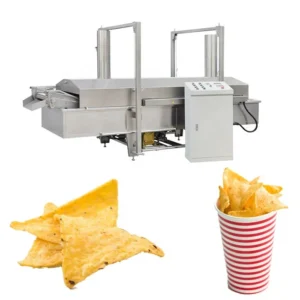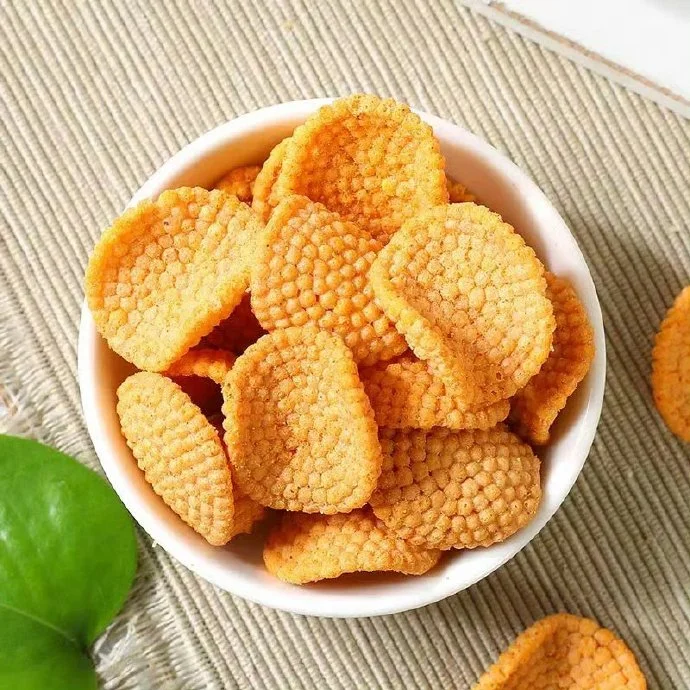
Automatic Continuous Deep Frying Machine for Corn Chips – Full Range
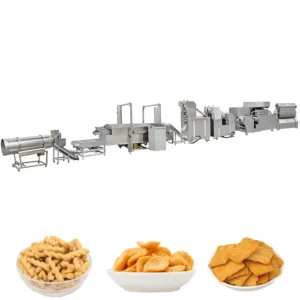
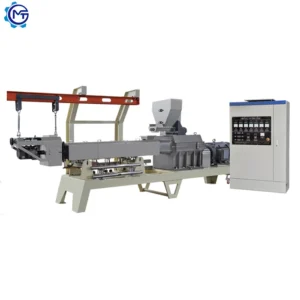
Throughput-matched frying integration — This continuous deep frying machine is sized and configured as a complete station within MT extrusion-based snack lines, ensuring the fryer beat aligns with upstream extruder output and downstream seasoning capacity.
Technical Specifications
| Parameter | Value |
|---|---|
| Product Type | Continuous Deep Frying Machine |
| Power Source | Electric / Gas (configurable) |
| Voltage | 380V / 50Hz |
| Rated Power | 2.6 kW (drive/control) + 60 kW (heating tube) |
| Oil Capacity | 320 L |
| Control System | PLC |
| Overall Dimensions (L×W×H) | 6700 × 2200 × 1200 mm |
| Net Weight | 2000 kg |
| Capacity Range | 100–1000 kg/h (basis not stated in source — confirm product format / moisture / oil temperature) |
| Heating Method | Electricity Heating / Gas Heating |
| Conveyor Type | Upper and lower double-layer mesh belt |
| Speed Control | Frequency conversion stepless speed regulation |
| Oil Filtration | Automatic circulation filtration system |
| Lifting System | Automatic lifting of upper hood and mesh belt |
| Slag Discharge | Bottom slag discharge system |
| Construction Material | Food-grade 304 stainless steel |
| Warranty | 1 Year (core components: 1 Year) |
| Standards | CE, ISO |
Application Suitability
| Application | Material or Output |
|---|---|
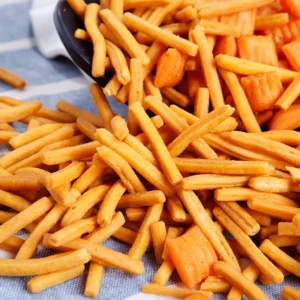
| Fried puffed snack production | Corn chips, Bugles-type snacks, maize chips from extruded pellets or direct-expanded dough |
| Pellet snack finishing | 2D/3D pellet snacks requiring a post-extrusion frying stage for texture and colour development |
| Pet food and treat processing | Specific kibble or treat formats requiring controlled oil absorption and surface browning |
| Aquatic feed specialty lines | Floating or slow-sinking feed formats where frying adjusts density and palatability |
Why "Nominal Capacity" on a Fryer Can Stall Your Entire Snack Line
A frying chips making machine must be verified against actual product density, moisture content, and upstream extruder output — not quoted on a nameplate figure alone.
I spent years on the buyer’s side before moving to the seller’s desk, and the most expensive lesson I watched a client learn was in a Saudi snack plant. They sourced a frying machine separately from a vendor who quoted a capacity number with no reference to the corn chip format or the extruder feeding it. Chips sat too long in the oil, came out dark and brittle, and the whole line had to throttle back. A continuous deep frying machine manufacturer that quotes capacity without asking what product you are running and at what moisture is quoting blind [NEED_CITE: extrusion line throughput matching principles]. The number on the plate means nothing until it is validated against your actual raw material and the station upstream.
How Oil Temperature Profile Shapes Snack Texture
The way heat transfers through 320 L of oil to a moving bed of extruded corn chips determines whether you get a crisp, uniformly golden product or a batch of scorched edges and undercooked centres. The PLC-controlled heating system on this unit allows operators to set and hold oil temperature within a narrow band, while the frequency conversion stepless speed regulation on the mesh belt adjusts residence time independently. That separation of variables — temperature versus dwell time — is what gives a process engineer real control over expansion, oil uptake, and final crunch. A snack frying equipment for sale that locks these two parameters together forces you to compromise on one every time you adjust the other.
Double-Layer Mesh Belt Conveying and Product Uniformity
Extruded snack pieces vary in density. Some float immediately on contact with hot oil; others sink before they expand. The upper and lower double-layer mesh belt on this continuous deep frying machine sandwiches the product, preventing lighter pieces from floating to the surface where they would fry unevenly or spin in the current. This is the same principle I insisted on after watching a single-belt fryer in a Middle East plant lose nearly a third of its Bugles output to inconsistent colour — the ones that floated browned on one side only. Sandwich conveying keeps every piece submerged and moving at the same speed through the oil bath [NEED_CITE: mesh belt frying uniformity standards for extruded snacks].
Reading the Specs That Actually Matter on a Frying Station
The 60 kW heating element capacity tells you how fast the oil recovers temperature after a cold product load enters the bath — a critical factor when the extruder upstream is pushing product continuously. If recovery is slow, oil temperature drops with each batch and you get greasy, under-fried chips at the discharge end. The automatic circulation filtration system continuously pulls particulate residue from the oil, which slows the rise in acid value and extends the service life of the edible oil between full change-outs. Food-grade 304 stainless steel construction across the 6700 mm length means the fryer withstands daily wash-downs without corrosion pitting, which matters when sanitation audits are part of your export compliance. The automatic lifting system for the upper hood and mesh belt cuts cleaning time by giving maintenance crews full access to the oil bath interior without manual disassembly.
The Hidden Cost of Sourcing a Fryer Outside Your Line Package
When a snack producer buys a frying machine from a separate vendor, the fryer arrives with its own control logic, its own belt speed range, and no awareness of what the extruder or the de-oiling drum downstream expects. The result is a bottleneck that no amount of operator tweaking can fix — the fryer either starves or floods, and the seasoning drum receives product at inconsistent temperature and oil content. I have seen lines where the frying station was the reason the entire plant ran at a fraction of its designed output, simply because nobody matched the throughput across stations before the machines were built [NEED_CITE: production line bottleneck analysis in snack manufacturing]. The cost is not the fryer itself; it is every hour the extruder idles waiting for the fryer to catch up.
Why Procure This Frying Station Through MT
Every station in an MT snack line — from batching through extrusion to frying, cooling, and packing — is configured under one supplier, so throughput is calculated and matched before any machine is built. The screw configuration on the extruder and the oil temperature profile on this fryer are specified together, against your raw material and target product. MT runs trial production on your actual raw material in an in-house testing workshop before shipment, so product development happens before installation, not after. Electrical schematics, voltage confirmation, and PLC control language are agreed before production starts, avoiding commissioning delays on-site. Wear parts lists and spare screw and die configurations are documented so the first replacement cycle does not become a crisis.
Documentation & Verification
- Line layout confirming fryer throughput matched to upstream extruder and downstream seasoning stations
- Machine specification sheet with voltage, frequency, and heating method confirmed to your facility
- Trial run report on your raw material from in-house testing workshop before dispatch
- Electrical schematic and PLC control language confirmation for your operator team
- CE declaration of conformity and ISO certificate for your market entry documentation
Installation, Commissioning & Support
- Foundation and floor space planning around the 6700 × 2200 mm footprint and 2000 kg operating weight
- Dedicated 380V / 50Hz circuit with capacity for the 60 kW heating load plus drive motors
- Assembly from shipping configuration with upper hood and mesh belt lifting system re-engaged on site
- First-run oil temperature profiling and belt speed calibration against your extruder output rate
- Operator training on PLC interface, filtration cycle management, and slag discharge procedures
- Wear parts list covering mesh belt segments, heating elements, and filtration media for first-year planning
What to Prepare Before You Request a Quote
To size this continuous deep frying machine correctly within your line, share your target snack format, the raw material formulation, and the moisture content at the extruder discharge. Confirm your facility voltage, frequency, and whether electric or gas heating suits your energy cost structure. Let us know the language your operators need on the PLC interface and whether you want a trial run on your raw material in our testing workshop before the machine ships.
Frequently Asked Questions
Q: How is frying capacity verified against my specific snack product format and raw material moisture content?
A: Capacity is not taken from a generic plate figure. MT runs your actual raw material through the fryer in the in-house testing workshop, measuring oil uptake, colour development, and throughput at your target moisture level. The resulting trial run report becomes the basis for the final machine configuration and line capacity calculation.
Q: What voltage, frequency, and heating source options are available, and how are they confirmed before production?
A: The unit supports 380V / 50Hz as standard, with voltage and frequency confirmed against your facility supply before production begins. Heating is available in electric or gas configurations. An electrical schematic and voltage confirmation document are issued for your approval, preventing commissioning surprises on site.
Q: How does the PLC control system language and interface get configured for my operators?
A: The PLC interface language is specified during the pre-production confirmation stage. MT documents the control language in the electrical schematic and verifies it during the factory test, so your operators see a familiar interface from the first day of commissioning rather than discovering a mismatch after installation.
Q: How is this fryer’s throughput matched to the upstream extruder and downstream seasoning equipment in my line?
A: MT calculates throughput across every station — extruder, fryer, de-oiling drum, seasoning, and cooling — as one system. The line layout and capacity calculation document shows the matched beat rate at each station, so no single machine becomes a bottleneck that throttles the entire production line.