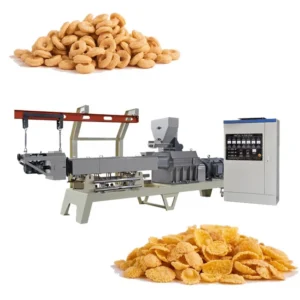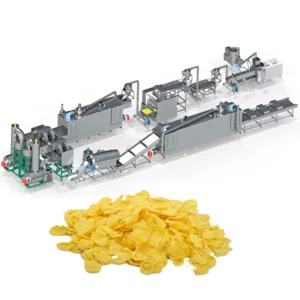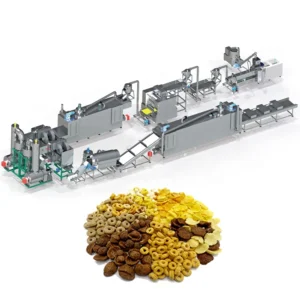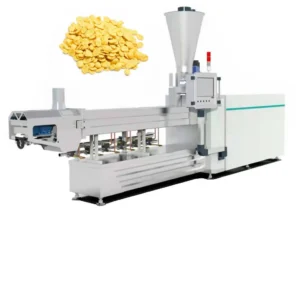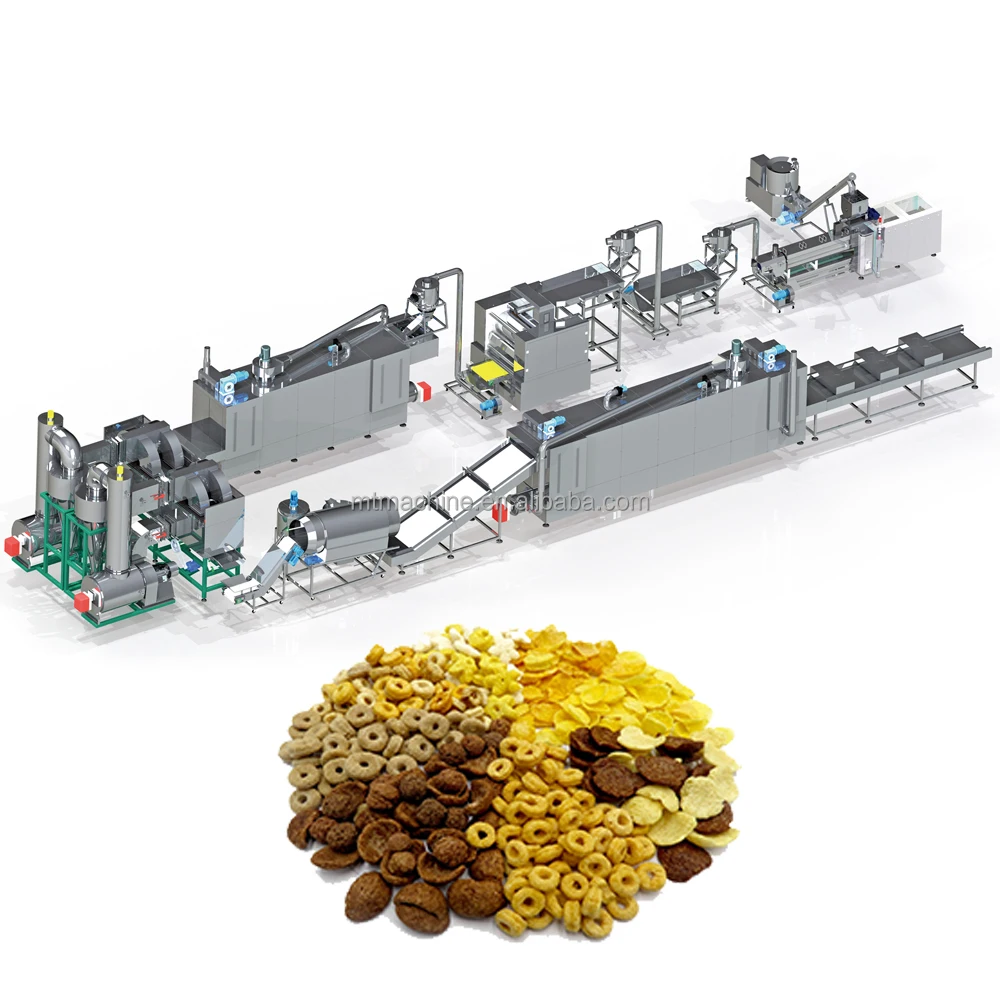
Complete Line Throughput Matching — Every station from mixing through packing is sized to the extruder’s real output on your specific grain blend, preventing the dryer or roaster from becoming a bottleneck mid-shift.
Technical Specifications
| Parameter | Value |
|---|---|
| Model | MT70 / MT85 / MT75 |
| Product Type | Corn Flakes Production Line |
| Extruder Type | Twin Screw (MT-75) |
| Installed Power | 160 kW (MT70) / 190 kW (MT85) / 210 kW (MT75) |
| Power Consumption | 120 kW (MT70) / 140 kW (MT85) / 150 kW (MT75) |
| Output Capacity | 150–200 kg/h (MT70, basis to be confirmed) / 300–400 kg/h (MT85, basis to be confirmed) / 300–500 kg/h (MT75, basis to be confirmed) |
| Overall Dimensions (L×W×H) | 41 × 1.5 × 2.2 m (MT70) / 43 × 1.5 × 3.2 m (MT85) / 45 × 1.5 × 3.5 m (MT75) |
| Screw Material | Wear-resistant alloy, special technology treatment |
| Control System | PLC with automated flaking machinery integration |
| Flaking Machinery Drive | Double motors for separate roller driving; hydraulic system for gap adjustment |
| Flaking Temperature Control | Infrared sensor |
| Dryer Heating Source | Gas or electric (configurable) |
| Roasting Oven | Hot air roasting with conciliation burner, dual circulating fans, cyclone dust removal |
| Coating System | Double tumble sugar melter, elevator, coating drum, dedicated spraying nozzle |
| Extruder Lubrication | Automatic lubricating and cooling function |
| Raw Materials | Corn, rice, wheat, oat, and barley powder |
| Standards | CE, ISO |
Application Suitability
| Application | Material or Output |
|---|---|
| Natural corn flake production | Corn grits and corn flour blends |
| Sugar-coated breakfast cereal SKUs | Corn, rice, or wheat base with sugar slurry coating |
| Extruded cereal shapes | Rings, balls, stars, fruit loops, tubes, wheels, and hearts from oat or barley flour |
| Fortified nutrition cereal programs | Multi-grain blends requiring consistent flake density and uniform coating |
Why Extruder Output Means Nothing Without Dryer Alignment
A corn flakes machine full equipment range only delivers its rated capacity when every downstream station is sized to the extruder’s actual throughput on your raw material.
I have watched lines stall within the first week because the dryer was spec’d for a generic output figure while the extruder was running a high-moisture oat blend that demanded longer residence time. The flakes pile up, stick together, and the roaster downstream starts receiving uneven feed. This is the gap between a catalogue number and a working production floor. Buyers often focus negotiation energy on the extruder motor size and forget that a mismatched hot air roasting oven will quietly cap your real daily output [NEED_CITE: throughput matching principles in continuous food processing lines].
How Each Station Connects to the Next
The corn flakes machine full equipment range begins at the batching and mixing station, where raw corn, rice, wheat, oat, or barley powder is blended to a target moisture level before entering the twin-screw extruder. The MT-75 extruder uses automatic lubricating and cooling to maintain barrel temperature stability across long production runs, which directly affects starch gelatinisation consistency entering the flaking stage.
From the extruder, the cooked dough passes through the hydraulic double-roller flaking machinery. PLC control paired with an infrared sensor monitors flaking temperature in real time, adjusting roller pressure to maintain uniform flake thickness. This matters because inconsistent flake thickness creates uneven drying downstream — thin flakes scorch while thick flakes retain moisture, and no roaster can correct what the flaker failed to control.
Drying and Roasting: Where Flake Density Is Won or Lost
After flaking, the pre-drying stage uses either gas or electric heating to reduce surface moisture before the flakes enter the hot air roasting oven. This oven runs a conciliation burner with two separate circulating fans and a cyclone dust removal device, which keeps the roasting environment sanitary and the temperature profile even across the full belt width [NEED_CITE: hot air circulation requirements for uniform cereal roasting]. The dual fan arrangement means you can balance airflow between the entry and exit zones, preventing the common failure mode where flakes at the belt edges receive less heat than those in the center.
For sugar-coated SKUs, the line routes through a double tumble sugar melter and coating drum before a second drying pass. The spraying nozzle is matched to the line’s throughput so that syrup application stays proportional to flake volume, avoiding the sticky clumping that blocks the cooling conveyor and forces unplanned line stops.
Reading the Specifications Against Your Raw Material
The twin-screw extruder configuration in the MT-75 is specified to the buyer’s actual grain blend, not copied from a generic build. Screw pitch, barrel segment arrangement, and die geometry all change depending on whether you are running pure corn grits or a multi-grain mix with oat and barley, because each grain gelatinises at different moisture and temperature thresholds. A screw setup designed for corn will under-cook an oat-heavy blend, producing flakes that fracture during roasting instead of holding their shape.
Installed power ranges from 160 kW on the MT70 to 210 kW on the MT75, with operating consumption between 120 kW and 150 kW depending on model and load. The hydraulic flaking system draws additional power through its double-motor drive, so your total electrical demand must account for both the extruder and flaking stations simultaneously. Voltage, frequency, and control language need confirmation before production begins, because a PLC programmed for 50 Hz operation will run motor speeds incorrectly on a 60 Hz supply, altering screw RPM and residence time inside the barrel [NEED_CITE: voltage and frequency standards by export market].
Line footprint stretches to 45 meters in length for the largest configuration, which means your facility needs clear linear floor space plus service access on both sides for maintenance and screw extraction.
The Hidden Cost of an Undersized Coating Station
When the sugar coating drum is not matched to extruder output, the syrup residence time drops and flakes leave the drum with patchy coverage. Your packaging line then receives a product that does not meet the sugar content specification your market expects, and the rejected batches carry the full cost of every upstream station that ran correctly. I have seen producers try to compensate by slowing the entire line to give the coater more time, which then starves the roaster and shifts its temperature profile [NEED_CITE: coating uniformity requirements for breakfast cereal quality standards]. The result is a line that technically runs but never reaches the throughput you planned your business case around.
Why Procurement Here Differs
Every station in this corn flakes machine full equipment range is sourced from one manufacturer, so the flaker, dryer, roaster, and coater are all calculated against the same extruder output baseline rather than assembled from vendors who each quote their own independent capacity. Screw configuration and die design are recorded against your specific raw material before the extruder enters production, not borrowed from a template.
The in-house testing workshop runs your actual grain blend through the extruder and flaker before shipment, generating a trial run report that confirms flake thickness, density, and roasting behavior on your material. Electrical schematics and voltage specifications are confirmed to your local supply before wiring begins, eliminating the commissioning delays that happen when a control panel arrives configured for the wrong frequency. Pre-sales engineering covers line layout and capacity calculation for your factory footprint, and on-site installation includes operator training on the PLC interface and maintenance schedules for wear parts.
Documentation & Verification
- Line layout and capacity calculation confirming throughput match across every station
- Screw and die configuration record specified to your grain blend and target flake shape
- Electrical schematic with voltage and frequency confirmed to your facility supply
- Trial run report on your actual raw material from the in-house testing workshop
- Operation and maintenance manual with wear parts list and reorder references
- CE declaration of conformity and ISO certificate for customs and compliance
Installation, Commissioning & Support
- Linear floor space up to 45 meters required with clearance on both sides for screw extraction and belt access
- Dedicated electrical circuit sized for combined extruder and flaker motor load, up to 210 kW installed
- PLC control panel language and interface configured to operator preference before commissioning
- First-run parameter setting includes barrel temperature profile, roller gap, and roaster airflow balance
- Wear parts inventory covers screws, dies, and roller surfaces with documented reorder lead times
- Automatic lubricating system on the extruder reduces daily maintenance to visual inspection intervals
Preparing Your Inquiry
To size the corn flakes machine full equipment range correctly for your facility, share your target grain blend composition and moisture content, the daily output volume you need to hit, and your local voltage and frequency specifications. Include your available floor length and ceiling height so the line layout can be drawn to fit. If you plan to run both natural and sugar-coated SKUs on the same line, note the changeover frequency so the coating station can be specified for quick cleaning between runs. Send a sample of your actual raw material for a trial run in the testing workshop before the extruder is finalized.
Frequently Asked Questions
Q: How is each station’s capacity matched to the extruder output to prevent bottlenecks?
A: Every downstream station — flaker, dryer, roaster, and coater — is calculated against the extruder’s confirmed throughput on your specific raw material, not a generic catalogue figure. The capacity calculation document provided with your quotation shows the matched output at each station so you can verify there are no throughput gaps before production begins.
Q: What voltage, frequency, and control language options are confirmed before production?
A: Your local electrical supply specifications and operator language preference are confirmed during the engineering phase and documented in the electrical schematic before the control panel is wired. This prevents the commissioning delays that occur when an extruder arrives configured for the wrong frequency or with PLC menus in an unfamiliar language.
Q: Which dryer heating source suits my facility?
A: Gas and electric heating options are both available for the pre-drying and roasting stages. The choice depends on your local utility costs and available gas supply infrastructure. Gas heating typically suits facilities with existing industrial gas lines, while electric heating works for sites where gas permits or supply are restricted.
Q: Can the flaking machinery produce different flake thicknesses?
A: The hydraulic double-roller system adjusts the roller gap to produce different flake thicknesses according to your product specification. The PLC controls the hydraulic pressure, and the infrared sensor monitors temperature at the nip point to maintain consistent thickness across the full roller width during production.
Q: What spare wear parts are included and what is the reorder process?
A: The initial shipment includes a documented wear parts list covering screws, dies, and roller surfaces specific to your configuration. Reorder lead times are provided at the time of purchase so you can plan inventory before your first replacement cycle, avoiding unplanned downtime while waiting for parts.