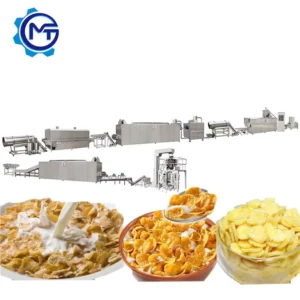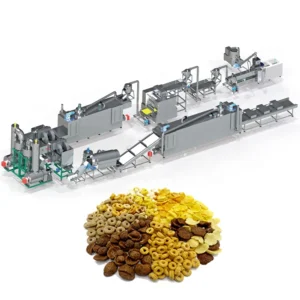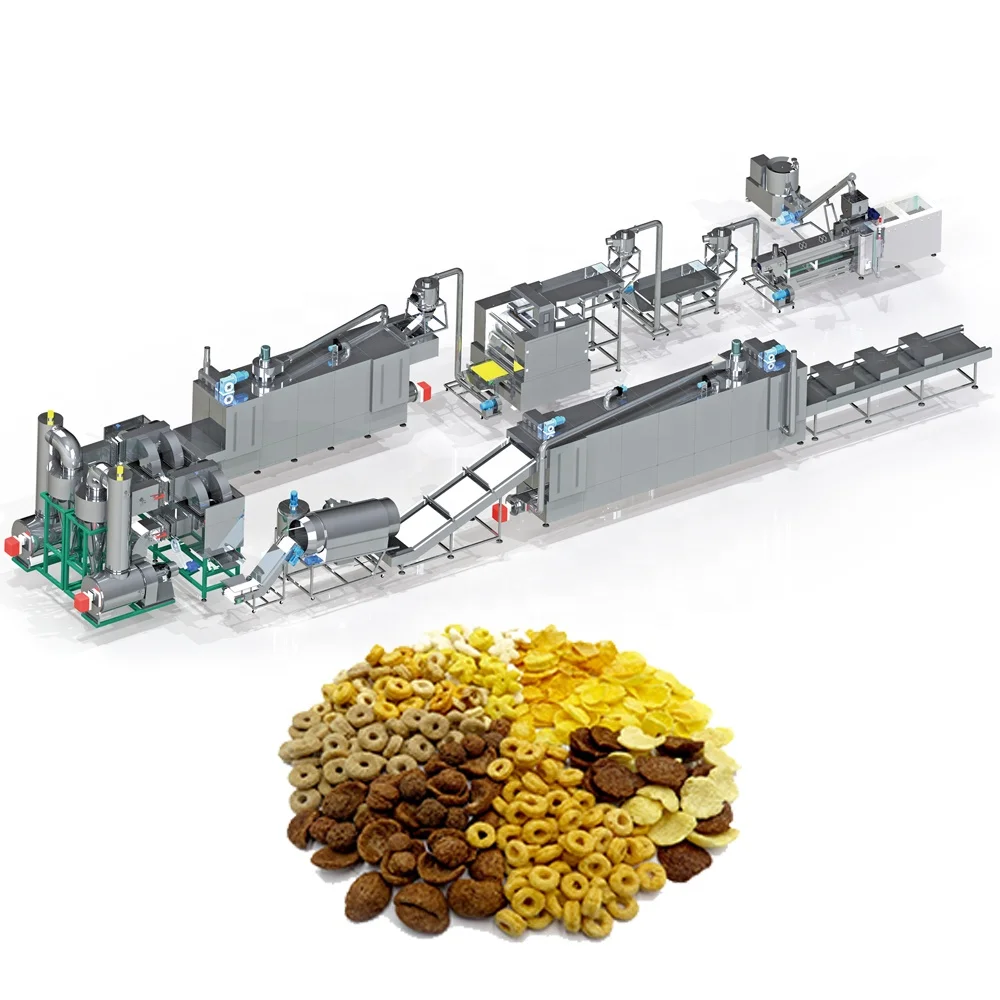
Turnkey Line Engineering — Every station in this corn flakes line is throughput-matched from mixer to packing conveyor, eliminating the mismatched bottlenecks that occur when equipment is sourced from separate vendors.
Technical Specifications
| Parameter | Value |
|---|---|
| Product Type | Corn Flakes Breakfast Cereal Production Line |
| Model | MT70 / MT85 / MT75 |
| Screw Type | Twin-screw |
| Installed Power | MT70: 160 kW; MT85: 190 kW; MT75: 210 kW |
| Power Consumption | MT70: 120 kW; MT85: 140 kW; MT75: 150 kW |
| Capacity | MT70: 150–200 kg/h (basis to be confirmed); MT85: 300–400 kg/h (basis to be confirmed); MT75: 300–500 kg/h (basis to be confirmed) |
| Overall Dimensions (L×W×H) | MT70: 41 × 1.5 × 2.2 m; MT85: 43 × 1.5 × 3.2 m; MT75: 45 × 1.5 × 3.5 m |
| Control System | PLC control system |
| Flaking Machinery | Hydraulic double-roller system with infrared temperature control |
| Dryer Heating Source | Gas or Electric |
| Roasting Oven | Vibrating pan, conciliation burner, cyclone dust removal |
| Coating System | Double tumble drum with sugar melting, elevator, spraying nozzle |
| Standards | CE, ISO |
Application Suitability
| Application | Material or Output |
|---|---|
| Natural corn flakes production | Corn powder, corn grits |
| Sugar-coated breakfast cereal | Corn, rice, wheat, oat, barley powder |
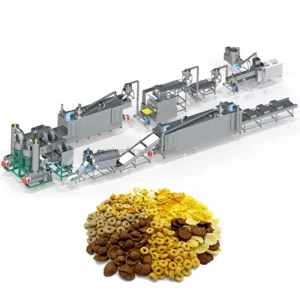
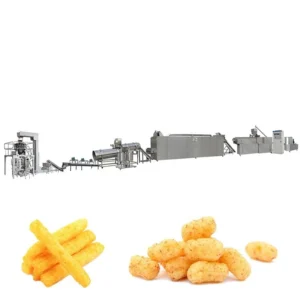
| Multi-shape cereal expansion | Ball, tube, ring, fruit loop, star, wheel shapes via die change |
| Fortified cereal processing | Grain blends with nutritional premix additives |
Why Nominal Capacity Figures Can Mislead Your Budget
A rated output means nothing if the dryer cannot keep pace with the extruder. I have watched a breakfast cereal installation in Southeast Asia stall because the roasting oven was specified for a lighter grain formula, while the buyer was actually running a high-fiber oat blend that retained more moisture and required longer dwell time. The extruder pushed material forward, but the downstream stations backed up, forcing the operator to throttle the entire line to the slowest link. This is a recurring pattern when buyers assemble a line from separate vendors who quote each station in isolation [NEED_CITE: line throughput balancing principles in food extrusion]. A properly configured corn flakes machine full equipment range avoids this by sizing every piece of equipment — from the mixer through flaking, drying, roasting, and coating — against the same verified output target and raw material profile.
Extruder and Barrel Configuration for Cereal Doughs
The twin-screw extruder in this line handles the gelatinisation of starch-based cereal doughs under controlled shear and temperature. Automatic lubricating and cooling functions on the extruder maintain consistent barrel conditions during continuous runs, which is essential when processing grain powders that can vary in moisture content batch to batch. The screw elements and die design are configured to the specific grain blend — whether it is pure corn or a multi-grain mix — so that the extrudate exits with the correct density and moisture level for the flaking stage downstream. This is where a corn flakes machine full equipment range proves its value: the extruder output is already calibrated for what the flaking rollers expect.
Flaking, Roasting and Coating Station Integration
After extrusion, the hydraulic double-roller flaking machinery compresses the cooked dough into uniform flakes, with infrared sensors monitoring roller temperature to prevent sticking or uneven thickness. The flakes then pass through a pre-dryer to set their structure before entering the hot air roasting oven, where a conciliation burner and two circulating fans deliver the surface bubbling and crispness that consumers expect in a breakfast cereal. If sugar-coated variants are on the production plan, the coating system — complete with sugar melting tumble, elevator, and spraying nozzles — integrates directly after roasting. Each station in the corn flakes machine full equipment range is specified so that the material flow rate remains constant throughout [NEED_CITE: thermal processing parameters for flaked cereal products].
Reading the Specification Sheet Like a Process Engineer
The installed power ratings — ranging from 160 kW to 210 kW depending on model — reflect the combined energy demand of the feeding, extruding, cutting, heating, and gearing systems. Power consumption figures are lower than installed capacity, indicating headroom for startup surges and load variations when raw material density shifts mid-run. The twin-screw design, as opposed to single-screw, allows for better mixing of multi-grain formulations inside the barrel and more forgiving response to variations in feed moisture. The PLC control system ties together temperature profiles, screw speed, and feeder rates so that operators can replicate batch parameters precisely. On the roasting side, the cyclone dust removal device captures fine particulate generated during high-temperature air roasting, which keeps the production environment cleaner and reduces product loss.
The Cost of Unmatched Downstream Equipment
When the dryer or roasting oven is undersized relative to the extruder output, the entire line runs below its rated capacity. Operators compensate by slowing the extruder, which changes the residence time inside the barrel and alters starch gelatinisation — resulting in flakes that are either too dense or too fragile. Over weeks of production, this mismatch drives up scrap rates and forces unplanned stops to clear blockages. I have seen situations where buyers added a second dryer after the initial installation to recover lost throughput, spending more than if the line had been configured correctly from the start [NEED_CITE: downstream bottlenecking effects in cereal extrusion lines]. The hidden cost is not just equipment — it is the weeks of commissioning delays while the fix is engineered and installed.
Why Procurement Through This Equipment Range Works
Every station from batching to packing is supplied under one configuration responsibility, so throughput calculations are cross-checked before any machine is built. Screw and die configurations are specified against the buyer’s actual grain formulation and target flake texture, not copied from a generic template. An in-house testing workshop runs trial production on the buyer’s raw material before shipment, catching formulation issues while adjustments are still inexpensive. The line covers both natural and sugar-coated corn flakes on the same core extrusion and flaking equipment, reducing the need for duplicate capital investment. Pre-sales engineering through on-site installation, commissioning, and ongoing maintenance support means the same team that designed the line is accountable for its output on the factory floor.
Documentation & Verification
- Line layout and capacity calculation showing matched throughput at every station
- Screw and die configuration record matched to your grain formulation and target flake density
- Factory trial run report on your raw material conducted before dispatch
- Electrical schematic with voltage and frequency confirmed to your site supply
- Operation and maintenance manual with wear parts list for rollers, screws, and dies
Installation, Commissioning & Support
- Foundation and floor space planned around the line’s overall length up to 45 m
- Dedicated electrical circuit sized to the model’s installed power up to 210 kW
- PLC interface configured to local operator language and voltage frequency at site
- On-site commissioning with parameter tuning on your actual grain blend
- Operator training covering screw speed, barrel temperature, and flaking roller gap adjustment
- Wear parts inventory including replacement screws, dies, and roller surfaces
What We Need to Configure Your Line
To build an accurate proposal, provide the grain types and particle size specifications you plan to run, your target hourly output in kilograms of finished flakes, and whether your product range includes sugar-coated variants alongside natural flakes. Share your workshop floor dimensions and ceiling height so the layout can be engineered to fit, and confirm the local voltage, frequency, and preferred control language for the PLC system. If you have existing upstream batching or downstream packing equipment, let us know the interface requirements.
Frequently Asked Questions
Q: How is capacity verified across each station to prevent bottlenecks?
A: Every station — extruder, flaking rollers, dryer, roasting oven, and coating drum — is calculated against the same throughput target and raw material profile. The capacity calculation document shows the material flow rate at each point so you can verify there are no restrictions before the line is built.
Q: What raw material details do you need before configuring the line?
A: We need the grain type (corn, rice, wheat, oat, barley, or blends), particle size distribution, and incoming moisture content. These parameters determine screw configuration, barrel temperature profile, and flaking roller settings for the target flake texture and density.
Q: Can the same line produce both natural and sugar-coated corn flakes?
A: Yes. The core extrusion, flaking, drying, and roasting stations are shared. The sugar coating system — including the melting tumble drum, elevator, and spraying nozzles — is added as a downstream module that activates only when coated variants are scheduled.
Q: How are voltage and control language confirmed before shipment?
A: The electrical schematic and voltage confirmation document are reviewed with the buyer during the specification stage. The PLC system is configured to match the local power supply frequency and operator language before the factory test run.
Q: Which spare wear parts are included with the initial delivery?
A: The shipment includes a wear parts list covering screws, die plates, and flaking roller surfaces. Replacement parts are documented with specifications so reorders can be processed without additional engineering consultation.