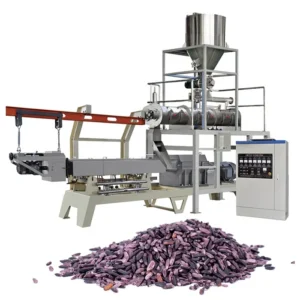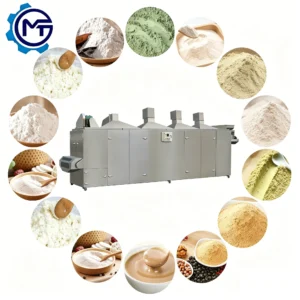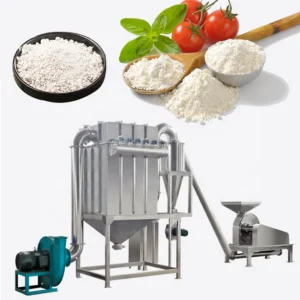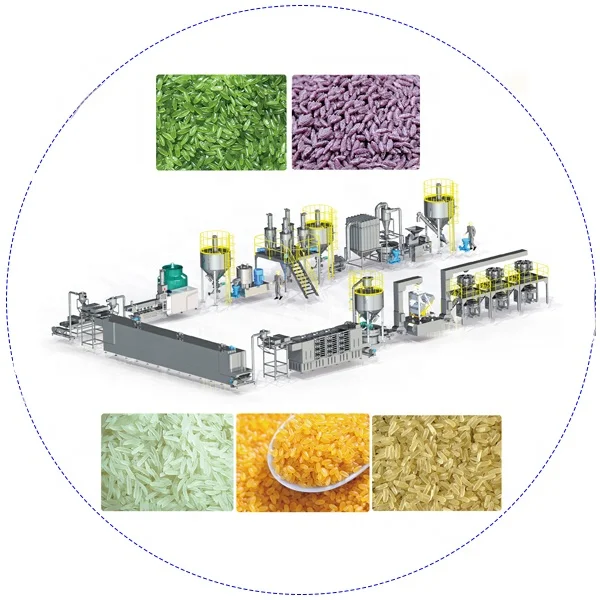
Matched Throughput Across Every Station — Each model in the Fortified Rice Extrusion Line full equipment range is sized so the extruder, dryer, cooling conveyors, and packing station run at the same output, eliminating the bottleneck that occurs when machines are sourced separately.
Technical Specifications
| Parameter | Value |
|---|---|
| Model | MT65, MT70, MT85, MT75, MT95 |
| Product Type | Fortified Rice Extrusion Line |
| Screw Type | Twin-screw |
| Installed Power | MT65: 85 kW / MT70: 120 kW / MT85: 235 kW / MT75: 180 kW / MT95: 260 kW |
| Power Consumption | MT65: 60 kW / MT70: 85 kW / MT85: 165 kW / MT75: 135 kW / MT95: 195 kW |
| Output Capacity | MT65: 80–100 kg/h / MT70: 100–120 kg/h / MT85: 200–300 kg/h / MT75: 300–500 kg/h / MT95: 800–1000 kg/h (basis not stated in source — confirm raw material formulation, moisture content, grain type) |
| Overall Dimensions (L×W×H) | MT65: 28×1.2×2.2 m / MT70: 30×1.5×2.2 m / MT85: 34×3.5×4.3 m / MT75: 32×3.5×4.3 m / MT95: 36×3.5×4.3 m |
| Control System | Frequency speed control, automated operation |
| Feeding System | Single or double screw feeding (selected according to material) |
| Screw Material | Wear-resistant alloy with special grinding-resistant treatment |
| Lubrication | Automatic lubricating and cooling system |
| Line Stations | Mixing → Extruding → Vibrating → Low temperature drying → Cooling → High temperature roasting → Cooling → Packing |
| Dryer Heating Source | Electric or gas (configurable) |
| Dryer Feature | Circulation drying with frequency motor controlled mesh belt speed |
| Standards | CE, ISO |
Application Suitability
| Application | Material or Output |
|---|---|
| Fortified rice kernel production | Broken rice, rice bran, corn, millet, wheat, oats, buckwheat, beans, starch as main ingredients with vitamin and mineral micro-nutrients |
| Artificial rice manufacturing | Reconstituted grain blends with added iron, folic acid, vitamin A, zinc, and other micro-nutrient premixes |
| Institutional nutrition programme supply | Fortified kernels blended with natural rice for school feeding, relief distribution, and public health programmes |
| Grain by-product valorisation | Broken rice and rice bran converted into uniform, high-nutrition reconstituted kernels for retail or food service |
What "Nominal Capacity" Leaves Out About Grain Extrusion
The throughput number on a quotation only matters when it is tied to your actual grain formulation and moisture level.
I spent years on the assembly floor before moving into technical sales, and the most expensive mistake I keep seeing is buyers comparing lines on a single capacity figure without asking what raw material that figure was measured on. A twin-screw extruder running pure rice flour at 14% moisture behaves completely differently from the same machine processing a buckwheat-and-bean blend at 18% moisture. The starch gelatinisation temperature shifts, the dough viscosity changes inside the barrel, and the die pressure required to hold kernel shape moves outside the original design window [NEED_CITE: starch gelatinisation behaviour across grain blends]. When a Fortified Rice Extrusion Line full equipment range is quoted without that material context, the number is essentially a guess — and the line arrives on site unable to hold the promised output on the buyer’s actual recipe.
Why Screw Configuration Must Follow the Recipe
Twin-screw extrusion for fortified rice requires a screw profile that balances shear intensity with residence time so that starch fully gelatinises without scorching the heat-sensitive vitamin premix. Each model in this Fortified Rice Extrusion Line full equipment range allows the screw element sequence — conveying, kneading, and reverse-flight sections — to be rearranged before shipment. The die plate is matched to the target kernel length and cross-section, whether the buyer needs a long-grain shape for Southeast Asian markets or a short, round grain for West African blending ratios.
Matching Dryer Capacity to Extruder Output
The drying stage is where many grain extrusion lines fail to hold throughput. If the mesh belt dryer is undersized relative to the extruder discharge rate, moisture remains too high in the kernel core, and the downstream high-temperature roasting stage cannot achieve the surface hardening that prevents cracking during storage and transport. The circulation drying process on this line uses frequency-controlled belt speed so the residence time inside each dryer zone can be adjusted independently, accommodating both the low-temperature pre-dry and the high-temperature roasting pass [NEED_CITE: multi-stage drying requirements for reconstituted grain kernels]. Electric and gas heating options allow the installation to be configured for the site’s available utilities and local energy costs.
Reading the Specification Sheet Against Your Actual Production
Three parameters deserve close attention when comparing models. Installed power and power consumption differ significantly — a motor rated at 260 kW on the MT95 does not draw that load continuously, and the 195 kW consumption figure reflects typical running conditions rather than peak draw, which matters for transformer sizing at the facility. The feeding system choice between single and double screw directly affects batch consistency; double screw feeding maintains a more uniform charge rate when processing blends that include fine vitamin premix powders alongside coarse grain flours. The automatic lubricating and cooling system on the screw shaft reduces unplanned stops for manual greasing, which is especially relevant on the higher-capacity MT75 and MT95 models where shaft bearings operate under continuous thermal load.
The Cost of Skipping Pre-Shipment Material Trials
One Southeast Asian buyer installed a nutritional rice line that ran perfectly during our standard tests on pure rice flour. When the buyer switched to their actual millet-and-sorghum formulation on site, the starch gelatinisation window was entirely different and the extruder produced undercooked, crumbly kernels that broke apart in the dryer. An entire production batch was scrapped before the screw configuration could be reworked. Since then, every Fortified Rice Extrusion Line full equipment range we build is trial-run on the customer’s own raw material blend in our testing workshop before crating. The screw profile, die geometry, and barrel temperature zones are adjusted until the kernel density, cooking degree, and surface finish match the buyer’s specification — and a trial run report ships with the line [NEED_CITE: pre-shipment testing protocols for food extrusion machinery].
Why Sourcing the Full Line from One Supplier Matters Here
Throughput matching across every station is not optional when producing fortified rice. The extruder discharge rate, the vibrating screen capacity, the dryer belt width and length, the cooling conveyor airflow, and the packing station weigh-and-bag cycle must all be calculated from the same output assumption. When these stations come from separate vendors, each supplier sizes conservatively to protect their own equipment, and the resulting mismatches create choke points that reduce effective line output. Having the mixing system through packing supplied by one source means the capacity calculation document covers the entire line as a single system rather than a collection of individual machines. The screw and die configuration record is also tied to the buyer’s exact grain blend, so the documentation reflects the specific product rather than a generic build.
Documentation & Verification
- Line layout drawing showing station-by-station throughput calculation for your chosen model
- Screw element sequence and die plate drawing matched to your grain blend and kernel shape
- Electrical schematic with voltage and frequency confirmed for your destination market before production
- Trial run report on your actual raw material conducted in the in-house testing workshop
- Wear parts list specifying screw segments, die inserts, and mesh belt sections for first-year spares
Installation, Commissioning & Support
- Floor plan based on the selected model footprint, from 28 m length on the MT65 to 36 m on the MT95, with utility drop points marked
- Dedicated power circuit sized to the model’s installed power rating, up to 260 kW on the MT95, with voltage confirmed to local standards
- Dryer heating source configured as electric or gas per site availability before the line leaves the factory
- Frequency-controlled drives on the feeding system, extruder main motor, and dryer mesh belt set and calibrated during on-site commissioning
- Operator training covering screw configuration changes for different grain recipes and routine lubrication system checks
- First-year wear parts kit including replacement screw elements and die plates shipped with the line
Preparing Your Inquiry
To size the line accurately, share your target grain formulation — including the percentage of each grain, starch, and micro-nutrient premix — along with the desired kernel shape and your daily production volume. Specify the available voltage and frequency at the installation site, and confirm whether electric or gas heating is preferred for the dryer stages. If you can send a sample of your raw material blend, we can run a trial in the testing workshop and include the results with the quotation.
Frequently Asked Questions
Q: How is line throughput matched between extruder, dryer and packing so no station becomes a bottleneck?
A: Each station is sized from the same output calculation based on your chosen extruder model and raw material. The dryer belt width and length, cooling conveyor capacity, and packing station cycle rate are all derived from the extruder discharge rate, so no single machine restricts the line. A full capacity calculation document is provided with the proposal.
Q: Which extruder model fits my target capacity and raw material blend?
A: The range covers five models from MT65 to MT95, spanning installed power from 85 kW to 260 kW. The correct model depends on your daily production target and the viscosity behaviour of your specific grain formulation under twin-screw shear. A trial run on your actual material helps confirm the right choice before the order is finalised.
Q: What dryer heating source options are available and how do they affect line footprint?
A: Electric and gas heating are both available. Gas-fired dryers generally require external venting and gas supply piping, which can affect the floor layout. Electric dryers simplify utility connections but may require a larger transformer capacity. The choice is confirmed during the layout design phase based on your site conditions.
Q: Can the feeding system be configured for my specific grain formulation?
A: Yes. Single or double screw feeding is selected based on the material characteristics. Blends containing fine vitamin premix powders alongside coarse grain flours typically perform better with double screw feeding, which maintains a more uniform charge rate and reduces segregation in the hopper.
Q: What documentation ships with the line and what pre-shipment testing is included?
A: The line ships with a layout drawing, capacity calculation, screw and die configuration record, electrical schematic, operation and maintenance manual, wear parts list, and a trial run report from the in-house testing workshop. The trial run uses your actual raw material blend to verify kernel quality before the equipment is packed for dispatch.