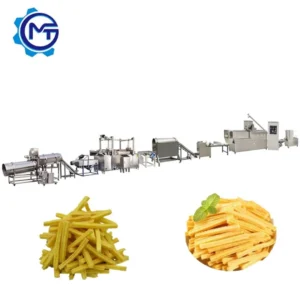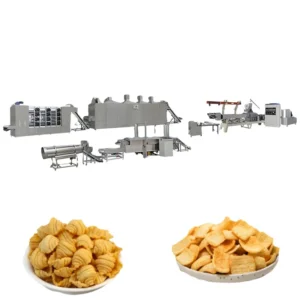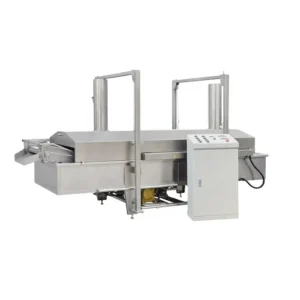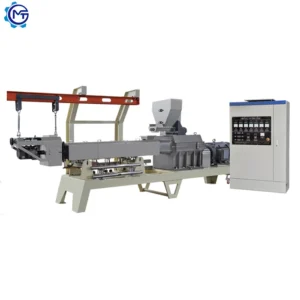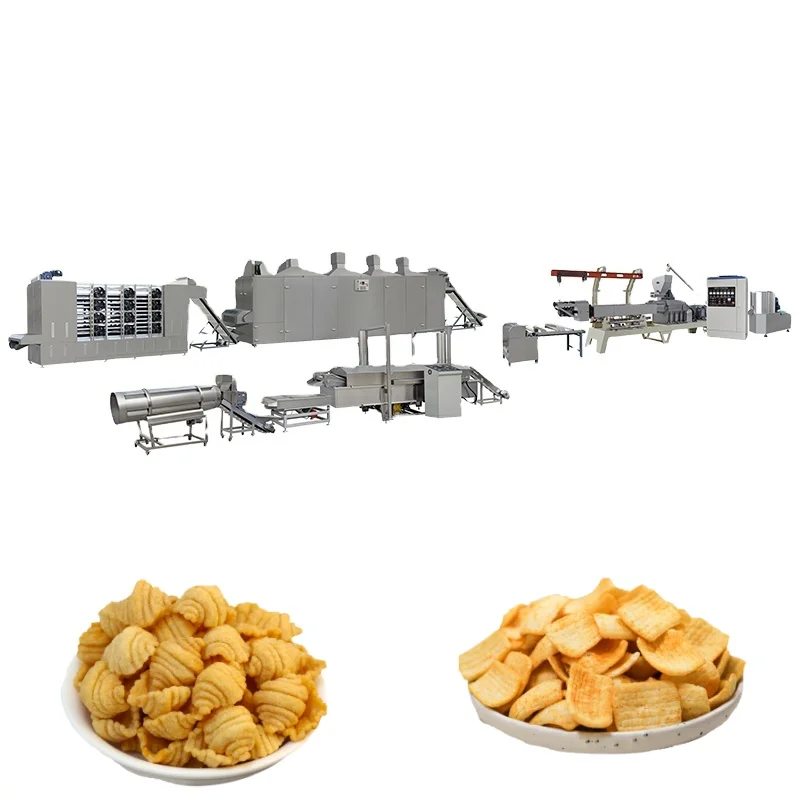
Throughput-Matched Extrusion Lines — Every station from mixer to fryer is sized to the same output so no single unit bottlenecks the fried snack food extrusion line manufacturer configuration you specify.
Technical Specifications
| Parameter | Value |
|---|---|
| Product Type | Fried Snack Food Extrusion and Frying Production Line |
| Models Available | MT-65, MT-70, MT-85, MT-75, MT-95 |
| Main Motor Power | 100 kW (MT-65) / 130 kW (MT-70) / 180 kW (MT-85) / 185 kW (MT-75) / 280 kW (MT-95) |
| Output Capacity | 120–150 kg/h to 800–1000 kg/h depending on model (basis not stated in source — confirm raw material type, moisture content and die configuration) |
| Screw Type | Twin-screw, co-rotating sectional modules |
| Barrel Contact Material | Stainless steel |
| Mixer Power | 4 kW / 7.5 kW / 15 kW matched to line model |
| Cutting Machine Power | 1.47 kW |
| Cutting Machine Dimensions | 2500 × 600 × 1100 mm |
| Fryer Belt Width | 600 mm stainless steel mesh belt |
| Fryer Heating Source | Electricity or fuel gas, configurable |
| Drying Method | Gas, electric, or diesel heating |
| Voltage & Frequency | Customizable (e.g. 3ph 380V 50Hz, 3ph 415V 60Hz, 3ph 220V 60Hz) |
| Die Options | Interchangeable dies for sticks, square sheets, rib chips, diamond chips, wavy chips, pillows, bugles, shells, screws, tubes |
| Raw Materials | Corn powder, wheat flour, potato starch, potato powder, corn starch |
| Certifications | CE, ISO |
Application Suitability
| Application | Material or Output |
|---|---|
| Tortilla chips and Doritos-style snacks | Corn flour or corn powder base with seasoning post-fry |
| Corn chips and extruded chip formats | Corn grits or corn starch blends through interchangeable dies |
| Bugles, shells, and tube snacks | Wheat flour or mixed cereal formulations |
| Fried pellet snacks (2D/3D shapes) | Potato starch, potato powder, or blended starches |
| Pillow and wavy chip variants | Corn-wheat blends with moisture-adjusted extrusion |
What "Matched Capacity" Actually Means on a Fried Snack Line
A frying chips making machine is only as productive as its slowest station, and throughput mismatch is the most common reason new snack lines underperform.
When the fryer runs faster than the extruder, oil temperature drops every time a cold batch hits the belt and product absorbs excess oil. When the extruder outpaces the fryer, dough pieces pile up on the conveyor, lose surface moisture, and fry unevenly. I have seen entire production days lost to this kind of station imbalance — operators tweaking belt speeds and oil temperatures trying to compensate for a line that was never sized as one system [NEED_CITE: common causes of throughput loss in snack extrusion lines]. The models here are configured so mixer output, extruder throughput, cutting speed, and fryer belt capacity align to the same production target before the line ships.
How the Stations Connect Across the Line
The production sequence runs from batching and mixing through twin-screw extrusion, forming or cutting, frying, and into downstream cooling and seasoning. Each station is selected based on the output target of the specific model tier, so a MT-70 line rated at a given throughput will have a mixer, fryer belt, and cutting unit all matched to that same rate. This is the core value of sourcing a complete fried snack food extrusion line manufacturer package rather than assembling units from separate vendors.
Extruder and Fryer Sizing Logic
The twin-screw extruder uses co-rotating sectional screw modules that handle forward transport, mixing, de-gassing, cooking, and forming within a single barrel. The screw configuration is specified to the buyer’s raw material — corn-based dough behaves differently from potato starch blends in terms of gelatinisation temperature and expansion. The 600 mm stainless steel fryer belt then carries formed pieces through heated oil at a speed matched to the extruder output, maintaining consistent oil temperature and residence time [NEED_CITE: twin-screw extrusion parameter effects on snack texture].
Reading the Power and Capacity Tiers
The five models span from 100 kW main motor on the MT-65 up to 280 kW on the MT-95, reflecting the progression from compact to high-throughput configurations. Main motor power directly determines the shear energy available inside the barrel, which governs how completely starch gelatinises at a given throughput. Mixer power scales accordingly — 4 kW for smaller batches up to 15 kW for the larger models — ensuring raw material preparation keeps pace with extrusion. The cutting machine at 1.47 kW handles forming across all tiers with interchangeable rollers for shape changeover. Fryer heating is available in electric or fuel gas options, letting buyers match energy costs to their local utility rates. Voltage and frequency are configurable across standard industrial ranges, which matters because running a 50 Hz motor on 60 Hz power changes screw RPM and throws off every downstream calculation.
What Happens When One Station Is Undersized
I worked with a snack producer in Southeast Asia who sourced a fryer separately from the rest of their tortilla chip line. The fryer had noticeably higher capacity than their extruder and seasoning drum, so chips piled up on the transfer conveyor, cooled before reaching the flavouring station, and would not hold seasoning powder. The line sat partly idle for weeks while they re-engineered the material flow between stations [NEED_CITE: risks of single-vendor versus multi-vendor line integration]. That kind of mismatch does not show up in any single machine’s spec sheet — it only appears when the whole line runs together under real production conditions.
Why Sourcing the Full Line Matters
Every station in these configurations is documented with a line layout and capacity calculation that shows throughput at each point. Screw and die configuration records are matched to your specific raw material formulation, not copied from a generic build. The in-house testing workshop runs trial production on customer-supplied raw material before shipment, so product development starts before installation rather than after. Electrical schematics confirm voltage, frequency, and control language for the target market before the line enters production. CE and ISO compliance documentation is included with each shipment, and a wear parts list covers screws, dies, and cutting rollers so the first replacement cycle is planned in advance.
Documentation & Verification
- Line layout showing throughput at mixer, extruder, cutter, and fryer stations
- Screw and die configuration record matched to your raw material formulation
- Trial run report from in-house testing workshop on customer-supplied material
- Electrical schematic confirming voltage, frequency, and control panel language
- CE declaration of conformity and ISO certificate included with shipment
- Wear parts list covering screws, dies, and cutting rollers with replacement intervals
Installation, Commissioning & Support
- Foundation and floor space planning based on the specific model footprint (up to 30 m line length for MT-95)
- Dedicated power circuit sizing per main motor rating (100–280 kW depending on model)
- On-site assembly supervision covering extruder barrel alignment and fryer belt tensioning
- First-run parameter setting for barrel temperature profile and fryer belt speed
- Operator training on die changeover and screw module replacement procedures
- Scheduled maintenance plan covering bearing lubrication and belt inspection intervals
What to Include in Your Inquiry
Provide your primary raw material (corn flour, wheat flour, potato starch, or a blend), target daily output, available workshop floor space and ceiling height, and local voltage and frequency standards. If you already have downstream seasoning or packing equipment, share those unit capacities so the line can be matched end-to-end. Let us know whether you want to send raw material samples for a trial run in the testing workshop before shipment.
Frequently Asked Questions
Q: What output capacity can I expect from each model?
A: The five models span a range of capacity tiers, but actual output depends on your raw material type, moisture content, and the die configuration selected. We confirm throughput on your specific formulation during a trial run in our testing workshop before the line ships, so the capacity you see is the capacity you get on your material.
Q: Which stations are included in the line, and how is throughput balanced?
A: The standard configuration covers mixer, twin-screw extruder, cutting or forming machine, and fryer with a 600 mm stainless steel belt. Each station is sized to the same production target as the extruder model selected, preventing bottlenecks. Downstream cooling, flavouring, and packing stations are available to complete the line.
Q: Can voltage and control language be configured for my market?
A: Yes. Voltage and frequency are configurable across common industrial standards such as 380V 50Hz, 415V 60Hz, and 220V 60Hz. Control panel language is confirmed during the specification stage so operators can read alarms and set points in their working language from day one.
Q: Are spare wear parts available when the first replacement is due?
A: A wear parts list covering screws, dies, and cutting rollers is provided with every line. Replacement components are manufactured to the same sectional module specifications as the originals, and lead times are confirmed at the time of initial order so your first changeover is planned in advance.
Q: What downstream equipment is available to complete the production line?
A: Cooling conveyors, flavouring drums, seasoning coating systems, and packing stations can be added to match the extruder and fryer throughput. Including these stations under the same line configuration ensures material flow and belt speeds stay synchronized from mixing through to final packaging.