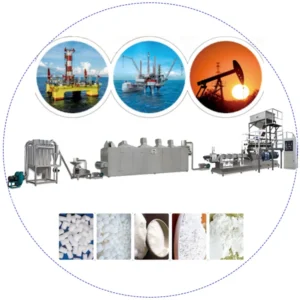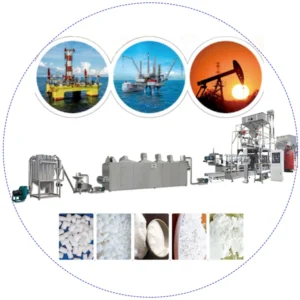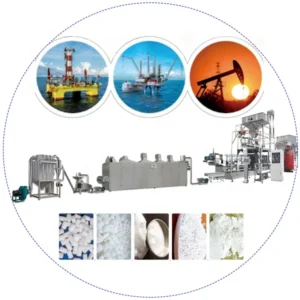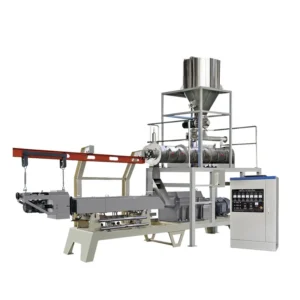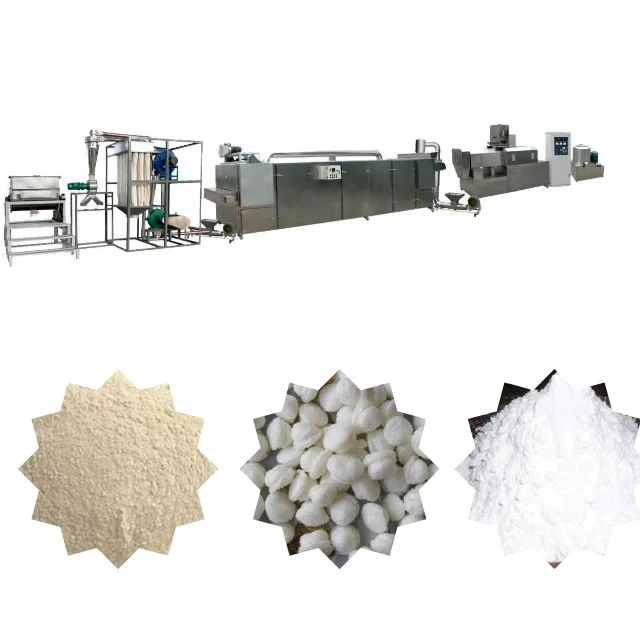
Matched Throughput Stations — A modified starch line where every station from mixer to packer is sized to the extruder’s real output, not a brochure figure, preventing the bottleneck that stalls a continuous thermochemical process.
Technical Specifications
| Parameter | Value |
|---|---|
| Product Type | Modified Starch Twin-Screw Extrusion Line |
| Available Models | MT-65, MT-70, MT-85, MT-95 |
| Screw Configuration | Twin-screw, three-phase (conveying, smelting, inflated) |
| Screw & Barrel Material | Carbon steel |
| Rated Power | 45 kW (MT-65), 55 kW (MT-70), 75 kW (MT-85), 90 kW (MT-95) |
| Output Capacity | 300 kg/h (MT-65, basis to be confirmed); 500 kg/h (MT-70, basis to be confirmed); 800 kg/h (MT-85, basis to be confirmed); 1500 kg/h (MT-95, basis to be confirmed) |
| Voltage Options | Configurable for 380V / 220V / 430V systems |
| Control Architecture | PLC and MCC |
| Raw Material Compatibility | Potato starch, maize starch, cassava starch |
| Primary Line Stations | Mixing, extruding, baking (thermochemical treatment) |
| Standards | CE certified, ISO certified |
Application Suitability
| Application Scenario | Material or Output Focus |
|---|---|
| Industrial modified starch production | Maize starch as primary feedstock for thermochemical modification |
| Pregelatinised starch for food ingredients | Potato starch processed for cold-water swelling properties |
| Adhesive and binder starch grades | Cassava starch modified for viscosity and stability targets |
| Continuous starch treatment at mid-scale | Output matching MT-65 or MT-70 extruder throughput |
| High-volume modified starch supply | MT-85 or MT-95 line configuration for larger daily tonnage |
Why Nominal Capacity Figures Hide the Real Bottleneck
A modified starch processing line equipment range only delivers its rated output when the screw configuration, barrel gap, and downstream drying capacity are matched to the specific starch source and target modification grade.
I have seen starch processors invest in an extruder based on a single output number, only to discover during commissioning that their maize starch requires a different residence time than the generic screw profile provided. The line runs, but at a fraction of the quoted throughput because the smelting phase cannot complete gelatinisation at the speed the conveying phase demands. The bottleneck is not the motor — it is the mismatch between screw geometry and raw material behaviour [NEED_CITE: twin-screw extrusion parameters for starch gelatinisation]. A capacity number without the raw material premise is an estimate, not a guarantee.
The Three-Phase Screw Design and Starch Modification
The twin-screw extruder uses a three-phase screw arrangement — conveying, smelting, and inflated — each section engineered for a specific stage of the thermochemical treatment. For modified starch production, the smelting phase is where gelatinisation and molecular restructuring occur under controlled heat and shear. The carbon steel screw segments and barrel are configured with gaps and pitch distances that determine residence time and mechanical energy input, directly influencing the degree of starch modification achieved in a single continuous pass.
Matching Every Station to the Extruder’s Real Output
A complete modified starch processing line equipment range must balance throughput at every station. The mixer must prepare batches at a rate that feeds the extruder without starvation or overflow. The baking and drying section must handle the moisture load exiting the die, which varies depending on whether the raw material is potato, maize, or cassava starch. When these stations are sourced from separate vendors without a unified throughput calculation, the weakest link dictates the actual line output. Sizing each station to the extruder’s confirmed capacity on the buyer’s specific material eliminates this hidden constraint [NEED_CITE: continuous process line throughput balancing].
Reading the Specifications Against Your Raw Material
The rated power across the model range — from 45 kW on the MT-65 to 90 kW on the MT-95 — reflects the mechanical energy available for shear and friction heating inside the barrel. Higher power supports higher throughput, but only if the screw configuration is matched to the starch type. Cassava starch, for instance, has different gelatinisation kinetics compared to maize starch, requiring adjustments to screw pitch and barrel temperature profile. The voltage options (380V, 220V, 430V) must be confirmed against the buyer’s site supply before production begins, because a motor wound for the wrong frequency will not deliver its rated torque, affecting screw speed and, consequently, the consistency of the starch modification. The PLC and MCC control system allows operators to set and log barrel temperature zones and screw speed, providing batch-to-batch repeatability that manual controls cannot sustain.
The Cost of Unconfirmed Voltage and Generic Screw Profiles
When voltage and frequency are not confirmed before production, the motor may run at a speed that alters the shear profile inside the barrel. The starch does not receive the intended thermochemical treatment, and the modification grade falls outside specification. Similarly, a screw configuration copied from a generic build — rather than specified to the buyer’s maize, potato, or cassava starch — produces inconsistent gelatinisation. The line may run for weeks before the off-spec product accumulates enough to trigger a customer complaint [NEED_CITE: industrial starch quality parameters and modification grades]. These failures do not show up in a factory acceptance test run on generic material.
What This Equipment Range Delivers
The complete line is configured as a matched set, meaning the mixing station, extruder, baking section, and downstream equipment are sized together based on a single throughput calculation. Screw and die configurations are specified to the buyer’s raw material — potato, maize, or cassava starch — and the target modified starch grade. An in-house testing workshop allows trial runs on the buyer’s actual raw material before the line ships, confirming that the thermochemical treatment produces the intended modification. Voltage and control language are confirmed during the specification phase, not discovered on site. The CE-certified equipment meets international machinery safety standards, and documentation covers the full chain from electrical schematics to wear parts lists.
Documentation & Verification
- Line layout showing throughput matched across mixing, extrusion, and baking stations
- Screw and die configuration record specified to your starch type
- Electrical schematic with voltage and frequency confirmed to your site supply
- Trial run report conducted on your raw material before shipment
- Wear parts list covering screws, dies, and barrel liners with replacement intervals
Installation, Commissioning & Support
- Foundation plan scaled to the MT-85 footprint of 2.5×5×8 m and operating weight
- Dedicated power circuit confirmed for the selected model’s rated power up to 90 kW
- On-site assembly with barrel alignment and screw segment installation verified
- PLC parameter setup for barrel temperature zones and screw speed logged per batch
- Operator training covering screw wear inspection and die changeover procedures
- First container includes spare screw segments and dies to prevent unplanned downtime
What to Include in Your Inquiry
Specify the starch type you will process — maize, potato, or cassava — along with the target modified starch grade and the daily output volume your market requires. Confirm your site voltage and frequency so the motor and control panel are wound correctly before production begins. If you have existing upstream or downstream equipment that this line must integrate with, include those specifications so the throughput calculation accounts for the full process chain.
Frequently Asked Questions
Q: What stations are included in the modified starch processing line equipment range and how is throughput balanced?
A: The line covers mixing, twin-screw extrusion, and baking for thermochemical starch treatment. Each station is sized against the extruder’s confirmed output on your specific starch type — maize, potato, or cassava — so no single section becomes a bottleneck. A unified capacity calculation document shows the matched throughput across every stage.
Q: How do I choose the right extruder model for my raw material and target output?
A: Model selection depends on your starch source, target modification grade, and required daily volume. The MT-65 through MT-95 range covers different capacity tiers with corresponding motor power. A trial run on your raw material in the testing workshop confirms which screw configuration and model deliver the intended starch properties.
Q: What voltage and frequency options are available and how are they confirmed?
A: The line is configurable for 380V, 220V, or 430V systems. Voltage and frequency must be confirmed against your site power supply before production begins. The electrical schematic is reviewed and approved during the specification phase to ensure the motor delivers rated torque and the PLC operates correctly at your location.
Q: Which wearing parts are covered under warranty and how are spares supplied?
A: The auger and cylinder carry a one-year warranty under the modular design, with individual wearing parts replaceable without replacing the full assembly. Spare screw segments, dies, and barrel liners are recommended for the first container shipment so replacements are on site before the first scheduled changeover.
Q: Can a trial run be done on my specific starch before the line ships?
A: Yes. The in-house testing workshop runs your actual potato, maize, or cassava starch through the configured screw and die setup. The trial run report documents the thermochemical treatment results, confirming that the line produces your target modified starch grade before dispatch.