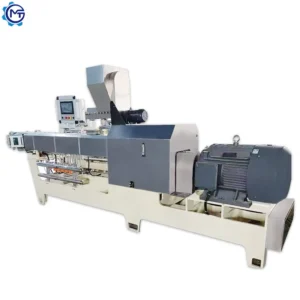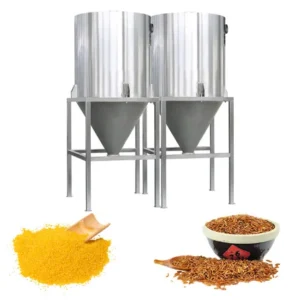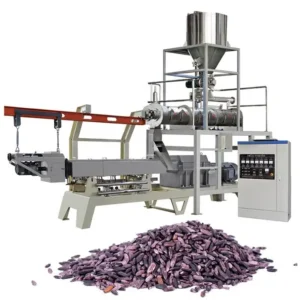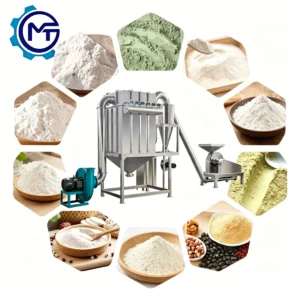
Integrated Line Throughput Matching — Every station from batching through extrusion to packing is sized against your actual formula density and moisture profile, not assembled from standalone catalog pages.
Technical Specifications
| Parameter | Value |
|---|---|
| Product Type | Baby Food Nutrition Powder Production Line |
| Processing Capacity | 200-500 kg/h (basis not stated in source — confirm raw material type and moisture content) |
| Construction Material | Food-Grade 304 Stainless Steel |
| Control System | Automatic PLC Control with Touch Control Panel and Digital System |
| Compatible Heat Sources | Electric, Gas, Steam |
| Assembly State | Complete Production Line (includes mixers, extruder, dryers, and packing stations) |
| Design Features | Low Energy Consumption, High Speed Processing |
| Warranty | 1 Year |
| After-Sales Support | Overseas Engineer Service |
| Standards | CE, ISO |
Application Suitability
| Application | Material or Output |
|---|---|
| Baby food and infant formula manufacturing | Rice, corn, and blended grain powders fortified with trace elements |
| Nutritional porridge production | Pre-gelatinised starch bases from beans and multi-grain mixes |
| Fortified drink powder processing | Vitamin and mineral supplemented cereal formulations |
| Instant weaning food lines | Fine-texture extruded powders from milled legumes and cereals |
What "200 to 500 Kilograms per Hour" Actually Depends On
Quoted capacity figures on any nutrition powder processing line equipment range are only valid once your exact raw material blend and target moisture content have been verified on the screws.
I spent four days on-site in the Middle East last year recalibrating a line that had been tested on standard rice flour at the factory. The buyer’s actual formulation included whey protein isolate and a micro-nutrient premix, which changed the melt viscosity inside the barrel entirely. The expansion ratio and degree of gelatinisation were both outside specification until we re-profiled the barrel temperature zones and adjusted the screw pitch. [NEED_CITE: effect of protein content on extrusion melt viscosity and starch gelatinisation] When the trial run happens only after installation, the buyer absorbs the full cost of that learning curve in lost production time and raw material waste.
Heat Source Selection and Barrel Profile Control
The choice between electric, gas, or steam heating directly determines how quickly each barrel zone responds to temperature corrections during a production run. Electric elements offer precise zone-by-zone control, which matters when a formulation contains heat-sensitive vitamins that degrade above a threshold. Gas and steam systems can be more economical at scale but require careful insulation planning to maintain uniform thermal distribution along the barrel length. The PLC touch panel allows operators to store distinct temperature profiles for each product recipe, reducing changeover time between batches.
Screw Configuration and Nutrient Retention
The length-to-diameter ratio of the twin screws governs how long the material stays in the barrel, which in turn controls the degree of starch gelatinisation and protein denaturation. A shorter residence time preserves more heat-labile nutrients such as certain B vitamins, while a longer dwell improves the digestibility index that infant food regulations often reference. The screw elements and die plate are selected to match the fat content and fibre level of your specific grain blend, ensuring the extrudate exits at the correct density for downstream milling into a fine powder. [NEED_CITE: twin screw extrusion parameters for nutrient retention in infant food processing]
Throughput Verification Against Real Formulations
The processing capacity figure in the specification table is a reference range that shifts depending on bulk density, moisture content, and the proportion of protein or fat in the blend. A formulation heavy in defatted soy flour will behave differently through the die than one based primarily on polished rice grits. This is why the nutrition powder processing line equipment range must be evaluated with a trial run on the buyer’s actual premixed raw material, measuring output weight, moisture loss, and particle size after milling before the line is approved for dispatch.
When Stations Are Mismatched
A line where the dryer capacity falls short of the extruder output creates a bottleneck that forces the operator to throttle the screw speed, negating any throughput advantage the extruder was supposed to deliver. Conversely, an oversized dryer wastes energy on partially filled trays and can over-dry the product, causing case hardening that makes downstream milling difficult. These mismatches are common when equipment is sourced from separate vendors who each quote their own station in isolation. [NEED_CITE: consequences of throughput mismatch between extruder and dryer in food processing lines]
Why Source the Complete Range Here
Every station — mixer, extruder, dryer, flavouring drum, cooler, and packing scale — is specified as a coordinated set, so throughput is balanced from raw material infeed to final bag. Screw configuration and die geometry are documented against your formula sheet before production begins, not copied from a generic build. An in-house testing workshop runs your actual raw material through the assembled line before it is crated for shipment. Food-grade 304 stainless steel contact surfaces are maintained across all stations, and the PLC control system is configured in your preferred language and matched to your factory’s voltage and frequency. Electrical schematics are reviewed and confirmed before the panel is wired, avoiding commissioning delays on site.
Documentation & Verification
- Line layout drawing with station-by-station throughput calculation for your target output
- Screw element arrangement and die orifice record matched to your grain and protein blend
- Electrical schematic with voltage, frequency, and control language confirmed for your market
- Trial run report recording expansion ratio, moisture, and gelatinisation on your raw material
- CE declaration of conformity and ISO certificate for customs and regulatory submission
- Operation manual with preventive maintenance schedule and wear parts replacement intervals
Installation, Commissioning & Support
- Foundation plan accounting for extruder vibration and dryer weight distribution across the line
- Dedicated power circuit sizing based on total connected load of heater zones and main drive motor
- Sequential station assembly from mixer through packing, with utility connections verified per zone
- First-run parameter logging on your raw material to establish baseline PLC recipe settings
- Operator training covering screw speed, barrel temperature, and moisture adjustment procedures
- Wear parts list with lead times for replacement screws, die plates, and dryer belt sections
Before You Send an Inquiry
To configure a line that matches your production target, we need your raw material list with approximate proportions, the target hourly or daily output in finished powder weight, and the voltage and frequency standard at your facility. If you have an existing milling or packing system upstream or downstream, share its capacity so we can size the connecting conveyors accordingly. Let us know whether a trial run on your premixed formula is required before you approve shipment.
Frequently Asked Questions
Q: How is the 200-500 kg/h capacity verified against my specific raw material and formulation?
A: We run your actual premixed formula — including any whey protein, vitamin premix, or fibre additions — through the extruder in our testing workshop. Output weight, moisture loss, expansion ratio, and degree of gelatinisation are recorded. The confirmed throughput figure is then written into the trial run report before the line is approved for packing and shipment.
Q: Which supporting stations are included, and how do you prevent bottlenecks?
A: The line covers mixing, extrusion, drying, cooling, milling, and packing. Each station’s capacity is calculated against the extruder’s confirmed output on your formula, so the dryer belt length, cooler airflow, and packing scale speed are all matched. This prevents situations where one station forces you to throttle the entire line down.
Q: Can the heat source and PLC interface be configured for my factory’s utilities and language?
A: The system is available with electric, gas, or steam heating based on your local utility cost and infrastructure. The PLC touch panel is programmed in your preferred operator language, and the electrical panel is wired to your confirmed voltage and frequency. The schematic is reviewed with you before assembly to avoid commissioning delays.
Q: What spare wear parts ship with the line, and what are replacement lead times?
A: A wear parts kit including replacement screw elements, die plates, and dryer belt sections is included based on the expected running hours before first replacement. The parts list in your documentation specifies each item. Replacement orders are typically fulfilled within standard production lead times, and we keep configuration records on file for repeat orders.
Q: Is a trial run performed before shipment, and what documentation do I receive?
A: Yes. The assembled line processes your raw material in our testing workshop, and a trial run report is generated covering output rate, product density, moisture content, and gelatinisation level. You also receive the line layout, machine specification sheet, screw and die configuration record, electrical schematic, and CE and ISO documentation.