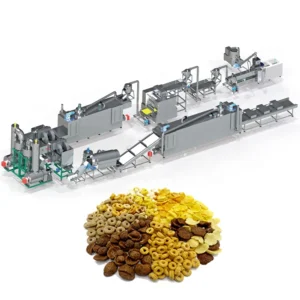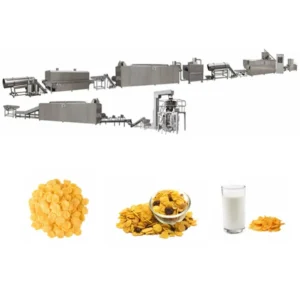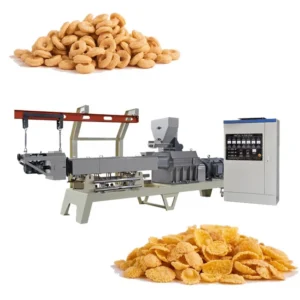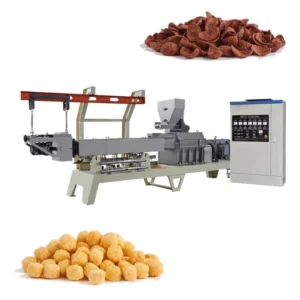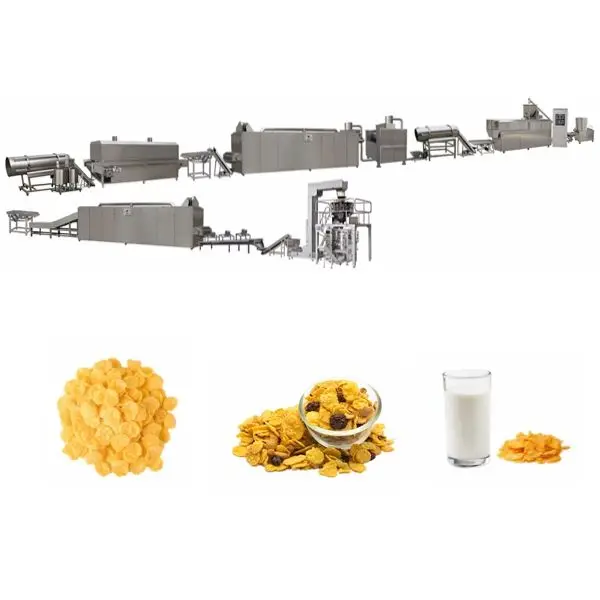
Complete Equipment Coverage — every station from mixing through packing is sourced under one supplier scope so throughput is balanced across the corn flakes production line rather than patched together from separate vendors.
Technical Specifications
| Parameter | Value |
|---|---|
| Product Type | Corn Flakes Production Line |
| Model Options | MT70 / MT85 / MT75 |
| Extruder Type | Twin Screw |
| Installed Power (MT70) | 160 kW |
| Installed Power (MT85) | 190 kW |
| Installed Power (MT75) | 210 kW |
| Power Consumption (MT70) | 120 kW |
| Power Consumption (MT85) | 140 kW |
| Power Consumption (MT75) | 150 kW |
| Output Capacity (MT70) | 150–200 kg/h (basis not stated in source — confirm raw material type and moisture content) |
| Output Capacity (MT85) | 300–400 kg/h (basis not stated in source — confirm raw material type and moisture content) |
| Output Capacity (MT75) | 300–500 kg/h (basis not stated in source — confirm raw material type and moisture content) |
| Overall Dimensions (MT70) | 41 × 1.5 × 2.2 m |
| Overall Dimensions (MT85) | 43 × 1.5 × 3.2 m |
| Overall Dimensions (MT75) | 45 × 1.5 × 3.5 m |
| Line Stations | Mixing → Extruding → Flaking → Drying → Hot Air Roasting → Sugar Coating (optional) → Cooling → Packing |
| Flaking Machinery Control | PLC, hydraulic double-roller system, independent dual-motor drive, infrared sensor temperature control |
| Dryer Heating Source | Gas or Electric |
| Hot Air Roasting Oven | Vibrating pan, high-temperature spraying tubes, conciliation burner, two circulating fans, cyclone dust removal |
| Coating System | Double tumble melter, elevator, coating drum, spraying nozzle |
| Control System | PLC available |
| Raw Materials | Corn, rice, wheat, oat, barley powder |
| Final Products | Natural corn flakes, sugar-coated corn flakes, shaped breakfast cereals |
| Standards | CE, ISO |
Application Suitability
| Application | Material or Output |
|---|---|
| Natural corn flake production | Corn grits and corn flour |
| Sugar-coated breakfast cereal | Corn base with sugar coating module |
| Multi-grain flaked cereal | Rice, wheat, oat, and barley powder blends |
| Shaped breakfast cereal formats | Ball, tube, stick, ring, fruit loop, star, wheel, flower, heart |
Why an Extruder’s Nameplate Capacity Rarely Survives Contact with Your Actual Raw Material
Rated throughput assumes a specific grain type, grind size, and moisture level — none of which match every buyer’s formula.
I once configured a corn flakes line for a Middle Eastern buyer who quoted me 200 kg/h based on a standard corn flour data sheet. When production started, their local corn had noticeably higher fat content, which suppressed expansion and cut actual output in half. The entire line rhythm collapsed because the downstream dryer and flaker were sized for a throughput that never materialized. That is the hidden gap in most corn flakes machine full equipment range quotations — the number on the spec sheet belongs to a reference material, not yours [NEED_CITE: raw material variability impact on extrusion throughput].
Matching Every Station to the Same Throughput Target
A breakfast cereal production line for sale only performs as well as its slowest station. When an extruder is specified at one capacity but the flaking rollers or hot air roasting oven are sized for a different rate, material either piles up or starves downstream. This corn flakes machine full equipment range addresses that mismatch by sourcing every station — mixing, extruding, flaking, drying, roasting, coating, cooling, packing — from a single equipment scope. Throughput calculations are applied across the full chain before any machine is built.
The Flaking and Roasting Stage Where Texture Is Decided
The flaking station uses a PLC-controlled hydraulic double-roller system with independent dual-motor drive, allowing each roller to be adjusted for consistent flake thickness across the web. Infrared sensors monitor temperature at the nip point. After flaking, the hot air roasting oven uses a vibrating pan with high-temperature spraying tubes and two separate circulating fans to deliver uniform surface blistering — the signature crispness and color that consumers associate with quality corn flakes. A cyclone dust removal device pulls fines out of the air stream before they can resettle on the product [NEED_CITE: Maillard reaction temperature thresholds in cereal roasting].
What the Power and Dimension Figures Mean on the Floor
The three extruder tiers — MT70 at 160 kW installed, MT85 at 190 kW, and MT75 at 210 kW — map to different production scales, but the more telling figure is power consumption: 120 kW, 140 kW, and 150 kW respectively. The gap between installed and consumed power reflects the mechanical and thermal headroom available when running denser formulations or higher-moisture grains. Line lengths range from 41 m to 45 m, meaning floor planning must account for the full run including the cooler and packing station, not just the extruder footprint. The twin-screw platform across all three models provides the shear and residence-time flexibility needed for varied grain blends.
The Cost of a Bottleneck That Shows Up After Installation
When the dryer or roaster cannot keep pace with the extruder, operators are forced to reduce screw speed or pause the line, which introduces temperature fluctuations in the barrel and inconsistency in gelatinization. Over time this leads to off-spec flake density, product breakage during coating, and customer complaints about texture. Fixing the bottleneck after commissioning means either replacing a station or re-engineering the layout — both expensive and disruptive [NEED_CITE: post-installation line rework costs in food processing].
Why Procurement Through This Equipment Range Works
Throughput matching is calculated across every station before quotation, so the flaking rollers, dryer belt width, and roasting oven volume are all scaled to the selected extruder output. Screw configuration and die design are specified against the buyer’s actual raw material and target flake geometry. An in-house testing workshop allows trial runs on customer-supplied grain before the line ships, catching formulation mismatches early. The complete equipment range covers breakfast cereal, snack, and aquatic feed applications, so the same engineering team handles cross-category line builds. CE and ISO documentation accompanies each shipment, supporting import compliance in regulated markets.
Documentation & Verification
- Line layout with capacity calculation matched to your grain type and target throughput
- Screw and die configuration record specific to your corn, rice, or oat formulation
- Electrical schematic with voltage and frequency confirmation for your local grid
- Trial run report on your raw material before the line leaves the factory
- CE declaration of conformity and ISO certificate included with shipment
- Wear parts list covering screws, dies, and flaking roller assemblies
Installation, Commissioning & Support
- Foundation plan accounts for the full 41–45 m line length and vibrating pan loads
- Power distribution sized for 160–210 kW installed capacity with dedicated circuits per station
- PLC and MCC panels configured for local voltage, frequency, and operator language
- Flaking station hydraulic system calibrated on-site for target flake thickness
- Hot air roasting oven burner tuned to available gas pressure or electric supply
- Operator training covers screw speed, barrel temperature, and roller gap adjustment
What We Need to Configure Your Line
To specify the right corn flakes machine full equipment range for your facility, share your primary grain type and any secondary grains in the blend, your target hourly output, and the moisture range of your incoming material. We also need your local voltage and frequency, available floor space with ceiling height, and whether you plan to run sugar-coated SKUs. If you have existing upstream milling or downstream packing equipment, let us know so the line interfaces correctly.
Frequently Asked Questions
Q: How is each station’s capacity matched so no single machine bottlenecks the line?
A: Every station — mixer, extruder, flaker, dryer, roaster, coater, cooler — is sized against the same throughput target calculated from your raw material and moisture content. Because the full breakfast cereal production line for sale comes from one supplier, we balance belt widths, roller speeds, and oven volumes before the line is built rather than assembling mismatched machines from separate vendors.
Q: What extruder model is recommended for corn versus rice or oat-based flakes?
A: The MT70, MT85, and MT75 twin-screw models each cover different capacity tiers, but the screw configuration and die geometry are adjusted to the specific grain. Corn typically requires a different compression ratio and barrel temperature profile than oat or rice. We confirm the configuration through a trial run on your material before finalizing the build.
Q: Is the dryer and roaster capacity scaled to the selected extruder output?
A: Yes. The dryer heating source, belt length, and roasting oven volume are all calculated to handle the moisture removal and dwell time required at your confirmed extruder throughput. Undersized drying is a common cause of flake breakage and uneven roasting, so we treat it as a matched component, not an afterthought.
Q: What voltage, frequency, and control language options are available for the full line?
A: The PLC and MCC control systems are configured for your local electrical grid before production. Voltage, frequency, and HMI language are confirmed during the specification stage to avoid commissioning delays. This is documented in the electrical schematic provided with the line [NEED_CITE: international voltage and frequency standards for industrial food machinery].