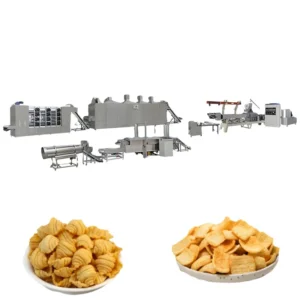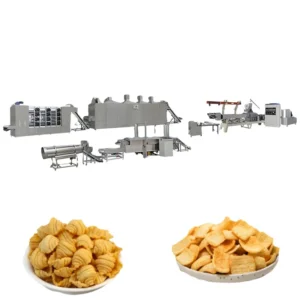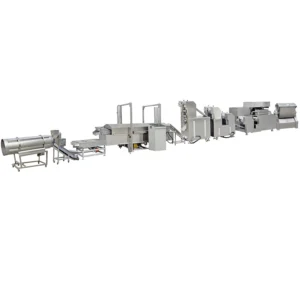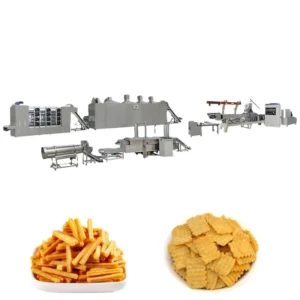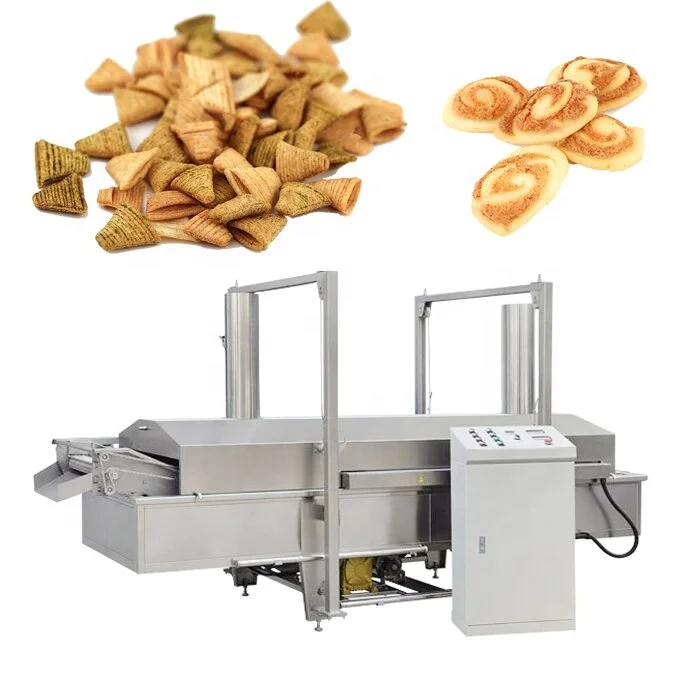
Balanced Throughput Design — Every station in this fried bugles production line is capacity-matched from mixer to flavoring drum, preventing the bottleneck effect that plagues multi-vendor assemblies.
Technical Specifications
| Parameter | Value |
|---|---|
| Product Type | Fried Bugles Snack Production Line (Twin-Screw Extrusion & Frying Line) |
| Model Range | MT65 / MT70 / MT85 / MT75 / MT95 |
| Screw Configuration | Twin-screw |
| Installed Power | 142 kW (MT65) / 185 kW (MT70) / 240 kW (MT85) / 245 kW (MT75) / 370 kW (MT95) |
| Real Power Consumption | 100 kW (MT65) / 130 kW (MT70) / 180 kW (MT85) / 185 kW (MT75) / 280 kW (MT95) |
| Output Capacity | 120–150 kg/h (MT65) / 200–250 kg/h (MT70) / 300–500 kg/h (MT85) / 400–500 kg/h (MT75) / 800–1000 kg/h (MT95) (basis not stated in source — confirm raw material, moisture content, and product shape) |
| Overall Dimensions (L×W×H) | 22000×1200×2200 mm (MT65) to 30000×1500×2800 mm (MT95) |
| Extruder Main Motor | 30 kW (MT70 unit) |
| Mixer Tank Volume | 150 kg |
| Mixer Rotary Speed | 385 rpm |
| Fryer Temperature Range | 0–260 °C |
| Fryer Capacity | 200–300 kg/h (basis not stated in source — confirm product type and frying time) |
| Material | Stainless steel (food-grade contact parts) |
| Standards | CE, ISO |
Application Suitability
| Application | Material or Output |
|---|---|
| Fried bugles and tortilla chips | Corn flour, corn grits, wheat flour blends |
| Corn chips and rice crusts | Rice flour, corn starch, grain mixtures |
| Shaped puffed snacks | Dough-based formulations for triangles, gourd shapes, fish crisps, and Christmas tree forms |
| Small-scale snack production start-ups | Lower-capacity models (MT65, MT70) for market testing and regional distribution |
| Medium-volume snack manufacturers | Higher-capacity models (MT85, MT95) for continuous daily production runs |
What the Labelled Capacity Figures Leave Out About Frying Chips Making Machines
A rated output means nothing when the fryer cannot keep pace with the extruder.
When I first started configuring lines for fried snack producers, I noticed the same pattern: buyers would focus on extruder throughput and overlook the fryer’s actual processing window. The frying chips making machine full equipment range here lists each station with its own capacity band, but these numbers are starting points. The moisture content of your corn flour, the thickness of the extruded sheet, and the frying time required for your target crispness all shift the real output. One Southeast Asian client ran a batch with higher-moisture corn flour than expected and the fryer fell behind, causing uneven expansion across the entire lot. Since then, I insist on a trial run with the buyer’s actual raw material before any line configuration is finalized. [NEED_CITE: impact of raw material moisture on extrusion and frying throughput]
How Each Station Fits Into the Frying Chips Making Machine Full Equipment Range
This catalogue covers every station a buyer needs to evaluate before specifying a fried snack line. The mixer feeds the extruder at a controlled rate, the twin-screw extruder gelatinizes and shapes the dough, the continuous fryer sets the texture and moisture level, and the flavoring drum applies seasoning uniformly. Each station has published dimensions and power data so you can plan your floor layout and electrical infrastructure before committing to a configuration.
Why Throughput Matching Between Stations Matters More Than Peak Numbers
An extruder running at its upper capacity range will push more product than a smaller fryer can handle, creating a backlog that degrades product quality. The fryer temperature range of 0–260 °C allows adjustment for different snack densities, but if the residence time is too short because product is moving too fast, you get uneven color and residual moisture. This frying chips making machine full equipment range is structured so that each model tier pairs an extruder with a fryer and flavor line rated for comparable throughput, reducing the risk of station-to-station mismatch. [NEED_CITE: effects of throughput mismatch on fried snack quality]
Reading the Specs: What the Numbers Actually Mean for Your Floor
The twin-screw configuration across the MT65 through MT95 range handles a broader variety of grain formulations than single-screw alternatives, which is important when you switch between corn-based bugles and wheat-based tortilla chips on the same line. The installed power versus real power consumption gap — for example, 185 kW installed versus 130 kW real on the MT70 — reflects the difference between peak motor draw and typical operating load, which matters for sizing your electrical supply. The fryer dimensions of 4500 × 1350 × 2350 mm tell you the footprint you need to reserve, and the 0–260 °C range covers both light frying for delicate shapes and higher-temperature runs for denser chips. Mixer rotary speed at 385 rpm ensures consistent hydration of the flour blend before it enters the extruder hopper.
The Hidden Cost of Choosing Stations From Separate Vendors
When you source the extruder from one supplier and the fryer from another, nobody takes responsibility for the gap between them. I have seen lines where the extruder output exceeded the fryer belt speed, forcing operators to run the extruder at partial capacity just to keep the line moving. That defeats the purpose of investing in a larger model. Voltage and control language mismatches between vendors add commissioning delays that push back production start dates by weeks. [NEED_CITE: common causes of commissioning delays in multi-vendor food processing lines]
Why Buyers Source the Full Line From One Equipment Range
Every station in this frying chips making machine catalogue is designed to connect mechanically and electrically without custom adapters or interface panels. The screw and die configuration is specified to your raw material and target snack shape, not copied from a generic template. The in-house testing workshop allows trial runs on your actual corn flour or grain blend before the line ships, so you see the product coming off the fryer before it arrives at your facility. Documentation includes a line layout with capacity calculations for each station, ensuring throughput is balanced from mixer to packing. CE and ISO certification applies across the full equipment range rather than individual components.
Documentation & Verification
- Line layout with capacity calculation matched to your selected model tier
- Screw and die configuration record for your specific snack shape and raw material
- Electrical schematic with voltage and frequency confirmation before production
- Trial run report on your corn flour or grain blend conducted in the testing workshop
- CE declaration of conformity covering the complete production line
- Operation and maintenance manual for each station with wear parts list
Installation, Commissioning & Support
- Floor space planning based on overall line dimensions from 22 to 30 meters in length
- Electrical supply sizing using real power consumption figures for your selected model
- Fryer installation with dedicated ventilation and oil filtration connections
- First-run parameter setting for extruder barrel temperature and fryer belt speed
- Operator training on screw configuration changes for different snack shapes
- Wear parts inventory including replacement screws and dies for your die profile
What to Include in Your Inquiry
Send your target snack shape, the raw material formulation you plan to use, and the daily output volume you need to hit. Include your facility’s voltage and frequency standard, the available floor space with ceiling height, and whether you have existing upstream or downstream equipment that this line needs to connect with. If you can ship a sample of your corn flour or grain blend, we can run a trial in the testing workshop before finalizing the line configuration.
Frequently Asked Questions
Q: How do I choose the right extruder model from the range?
A: Start with your target daily output and the specific snack shape you want to produce. The MT65 and MT70 suit smaller production runs or market testing, while the MT85 through MT95 handle continuous medium-volume output. The die design and screw configuration are then matched to your raw material and product shape during the proposal stage.
Q: How is the fryer capacity matched to the extruder to avoid bottlenecks?
A: Each model tier pairs an extruder output band with a fryer rated for comparable throughput. The fryer belt speed and temperature range are calibrated so that product residence time produces consistent color and moisture reduction without forcing the extruder to run below its rated capacity.
Q: What voltage and frequency options are available for different markets?
A: Voltage and frequency are confirmed during the specification stage before production begins. The electrical schematic is prepared to match your local supply standard, and control panel labeling is set to your preferred operating language to avoid commissioning delays.
Q: Which spare wear parts are included with the line?
A: Each line ships with a wear parts list that includes screws and dies matched to your product configuration. Replacement sets can be ordered using the screw and die configuration record provided in your documentation package.
Q: What documentation comes with the production line?
A: You receive a line layout with capacity calculations, machine specification sheets for every station, a trial run report on your raw material, electrical schematics, CE declaration of conformity, and operation and maintenance manuals covering each station in the line.