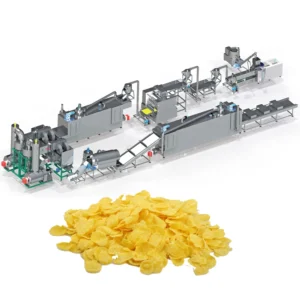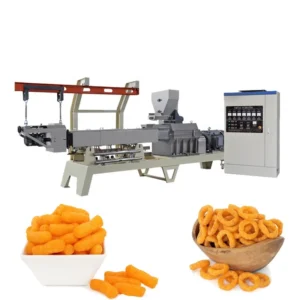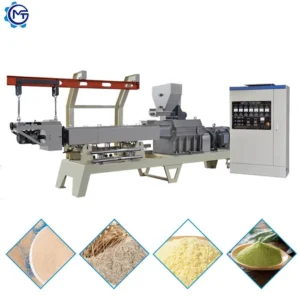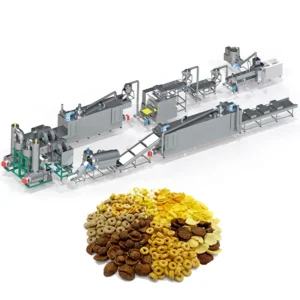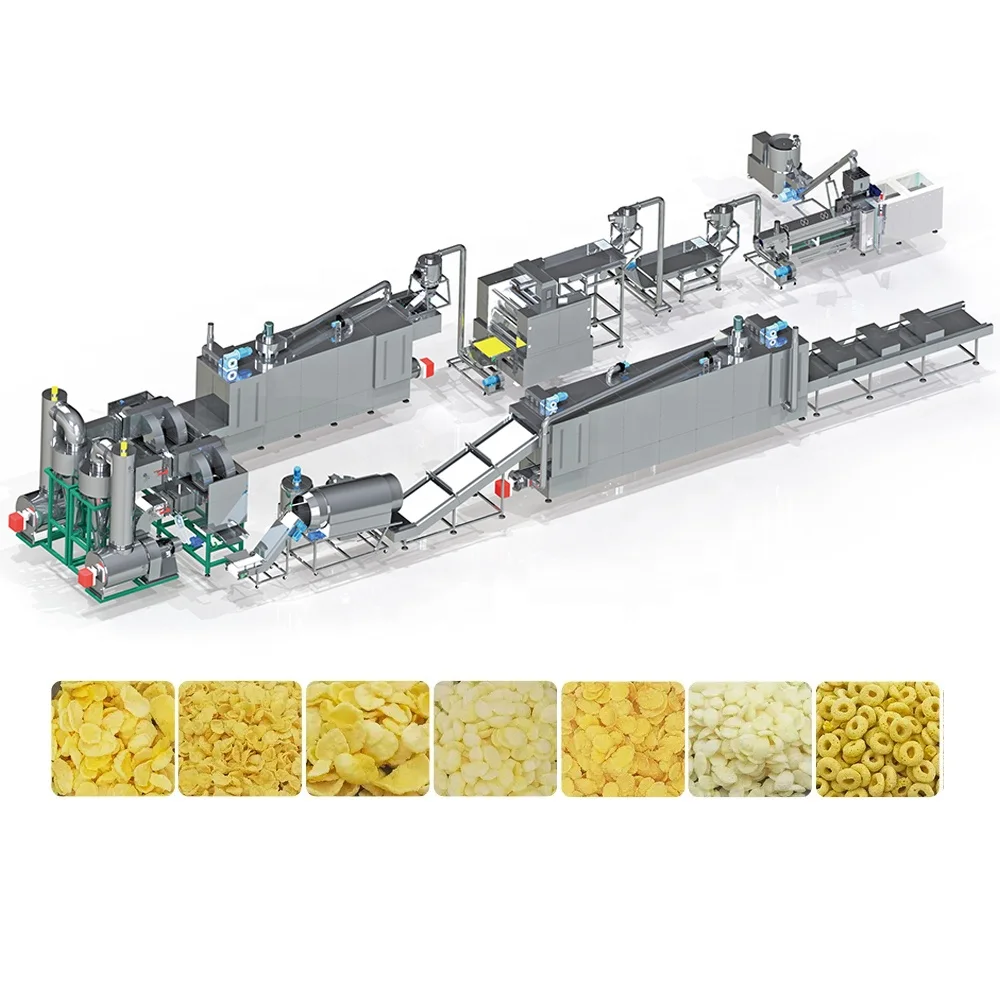
Screw and Die Configuration Specified to Material — Every extruder in this corn flakes line ships with screw elements and die geometry matched to the buyer’s actual cereal blend, not a generic off-the-shelf build.
Technical Specifications
| Parameter | Value |
|---|---|
| Product Type | Corn Flakes Breakfast Cereal Production Line |
| Models Available | MT70 / MT75 / MT85 |
| Extruder Type | Twin Screw |
| MT70 Installed Power | 160 kW |
| MT70 Power Consumption | 120 kW |
| MT70 Output Capacity | 150-200 kg/hr (basis not stated in source — confirm raw material / moisture content) |
| MT70 Overall Dimensions | 41 × 1.5 × 2.2 m |
| MT75 Installed Power | 210 kW |
| MT75 Power Consumption | 150 kW |
| MT75 Output Capacity | 300-500 kg/hr (basis not stated in source — confirm raw material / moisture content) |
| MT75 Overall Dimensions | 45 × 1.5 × 3.5 m |
| MT85 Installed Power | 190 kW |
| MT85 Power Consumption | 140 kW |
| MT85 Output Capacity | 300-400 kg/hr (basis not stated in source — confirm raw material / moisture content) |
| MT85 Overall Dimensions | 43 × 1.5 × 3.2 m |
| Extruder Working Principle | Feeding, extruding, cutting, heating, gearing, controlling systems |
| Extruder Feature | Automatic lubricating and cooling function |
| Flaking Machine Control | PLC control system |
| Flaking Machine Roller Drive | Double motors for separate roller driving; hydraulic system for double rollers |
| Flaking Machine Temperature Control | Infrared sensor for even temperature pipe control |
| Dryer Heating Source | Gas / Electric |
| Roasting Oven | Hot air roasting with vibrating pan, high temperature spraying tubes, conciliation burner, two separate circulating fans, cyclone dust removal device |
| Coating System | Double tumble for sugar melting, elevator, coating drum, spraying nozzle |
| Assembly State | Complete line (Mixing → Extruding → Flaking → Drying → Roasting → Coating → Cooling → Packing) |
| Line Configuration Options | Natural corn flakes line; Sugar-coated corn flakes line |
| Standards | CE; ISO |
Application Suitability
| Application | Material or Output |
|---|---|
| Natural corn flakes production | Corn grits and corn flour blends |
| Sugar-coated corn flakes production | Corn base with sugar syrup coating |
| Shaped breakfast cereals (rings, balls, stars, fruit loops) | Corn, rice, wheat, oat, barley powders |
| Multi-grain cereal formats | Mixed cereal grain formulations |
What the Brochure Capacity Number Will Not Tell You
A rated output figure means nothing unless it was achieved on your specific raw material at your target moisture level.
I learned this the hard way on a Middle East project a few years back. The client signed off on a corn flakes breakfast cereal machine full equipment range based on a capacity figure from our standard brochure. When we started production with their locally sourced corn flour — noticeably coarser than the test material — extrusion expansion dropped and the line could not reach the expected throughput. The extruder was not at fault; the mismatch between material particle size and screw configuration was. Since that project, I do not finalise any line proposal without first running the buyer’s actual raw material through our testing workshop [NEED_CITE: importance of raw material trial runs in extrusion equipment procurement]. This corn flakes breakfast cereal machine full equipment range is configured only after that trial confirms real-world behaviour.
Matching Every Station to the Real Product Flow
The reason a cereal line underperforms is rarely the extruder alone. More often, one downstream station — the flaker, the dryer, or the roaster — becomes a bottleneck because it was sized to a theoretical number rather than the actual product density and moisture curve leaving the die. When you evaluate a corn flakes breakfast cereal machine full equipment range, the critical question is whether throughput has been calculated across every station as a connected system. Here, the flaking mill capacity, dryer residence time, roasting oven volume and coating drum batch size are all specified relative to the extruder output confirmed during the material trial.
How the Flaking Stage Defines Your Final Product
Flake thickness and surface consistency are set at the flaking mill, not the extruder. The PLC-controlled flaking station on this line uses a hydraulic double-roller system with independent motor drives for each roller, allowing gap adjustment under load without stopping production. An infrared sensor monitors roller temperature continuously, keeping the pipe surface even so that flakes do not stick or tear as they pass through. Consistent flake geometry at this stage directly affects how uniformly the product roasts and how it holds up in the milk bowl [NEED_CITE: flaking mill roller pressure and cereal flake integrity].
Reading the Specs Beyond the Nameplate
The twin-screw extruder at the heart of this line carries automatic lubricating and cooling, which matters for continuous multi-shift cereal runs where barrel heat buildup can alter starch gelatinisation mid-shift. Three model tiers — MT70, MT75 and MT85 — cover different production scales, and installed power ranges from 160 kW to 210 kW depending on the model selected. The roasting oven uses two separate circulating fans and a cyclone dust removal device; the dual-fan arrangement creates even hot air distribution across the vibrating pan, preventing the scorching on one side and under-roasting on the other that single-fan ovens produce. Dryer heating is configurable for gas or electric sources, which should be decided early based on local utility costs and availability.
The Cost of Undersizing Downstream Equipment
When a flaker or dryer is specified smaller than the extruder output demands, the line does not simply slow down — product quality degrades in ways that may not appear until the cereal reaches the consumer. Flakes that pass through an overloaded dryer retain uneven moisture, leading to soft spots or premature staling in the package. An undersized roaster forces higher temperatures to compensate for shorter residence time, producing surface colour without the internal crispness the market expects [NEED_CITE: downstream equipment bottleneck effects on cereal shelf life]. These problems are typically diagnosed as extrusion issues, sending technicians to adjust screw speeds when the real constraint sits three stations downstream.
Why Source the Full Range from One Manufacturer
Every station in this corn flakes breakfast cereal machine full equipment range is built under one roof, which means throughput matching happens at the design stage rather than during commissioning. Screw configuration and die design are specified to the buyer’s cereal formulation based on the in-house trial run, not copied from a previous project with different raw material. The PLC control architecture spans extrusion, flaking and coating as an integrated system, so parameter changes at one station can be coordinated with adjustments downstream. Documentation covers the full line — from layout drawings through electrical schematics to trial run reports — rather than arriving as separate packets from multiple vendors. Spare wear parts for screws, dies and flaker rollers are catalogued against your specific configuration from day one.
Documentation & Verification
- Line layout drawing showing station-by-station throughput calculation for your target cereal type
- Screw and die configuration record matched to your raw material particle size and moisture content
- Trial run report produced in the testing workshop using your supplied corn or cereal blend
- Electrical schematic with voltage and frequency confirmed for your facility before production begins
- Factory test record documenting run parameters and output before the line is crated for dispatch
Installation, Commissioning & Support
- Foundation planning accounts for the full line footprint, which spans up to 45 m in length for the MT75 configuration
- Power supply must accommodate installed loads up to 210 kW with dedicated circuits for the extruder and flaker drives
- Line arrives in sectional modules for staged assembly, allowing the extruder to be positioned before downstream stations
- Commissioning includes parameter setting on the PLC for extrusion temperature, flaker roller gap and roasting oven fan balance
- Operator training covers screw and die changeover, flaker hydraulic adjustment and coating drum syrup flow control
- Wear parts list provided at delivery includes screws, dies and flaker roller surfaces specific to your configuration
What We Need to Configure Your Line
To move from a general inquiry to a line proposal that holds up on your factory floor, share the cereal raw material you plan to use — including particle size distribution if available — along with your target daily output and whether you need natural flakes, sugar-coated flakes, or both. Specify the local voltage and frequency, the preferred dryer heating source, and the control language your operators will work with. If you can send a sample of your raw material, we will run it in the testing workshop before finalising the screw and die specification.
Frequently Asked Questions
Q: How is line capacity verified on my actual raw material rather than a generic benchmark?
A: Before any corn flakes breakfast cereal machine full equipment range proposal is finalised, we run your supplied raw material in our in-house testing workshop. The trial documents actual output, expansion behaviour and flake quality under controlled conditions. The line configuration is then adjusted so every station matches the throughput your material actually delivers, not a catalogue figure.
Q: What supporting stations are included and how is throughput matched across them?
A: The line covers mixing, extruding, flaking, drying, roasting, coating, cooling and packing as connected stations. Each downstream unit — flaker roller width, dryer belt length, roaster pan area, coating drum volume — is sized relative to the extruder output confirmed during the material trial, preventing bottlenecks that arise when stations are sourced from separate vendors.
Q: Which heating source options are available for the dryer and roasting oven?
A: The dryer is configurable for gas or electric heating, selected based on your local utility costs and infrastructure. The roasting oven uses a conciliation burner with high temperature spraying tubes and two circulating fans. Heating source selection should be confirmed during the proposal stage so that electrical schematics and gas line specifications match your facility.
Q: Can the same line produce both natural and sugar-coated corn flakes as well as other cereal shapes?
A: Yes. The extrusion platform supports natural corn flakes and sugar-coated variants by adding or bypassing the coating station with its double tumble sugar melting system. By changing the die, the same twin-screw extruder produces shaped cereals including rings, balls, stars, fruit loops and other formats from corn, rice, wheat, oat or barley formulations.
Q: What documentation is provided for line layout, machine specifications and trial run results?
A: You receive a complete documentation package including line layout with capacity calculation, machine specification sheets for every station, screw and die configuration record, electrical schematic with confirmed voltage, trial run report on your raw material, CE declaration of conformity, operation and maintenance manual, and a wear parts list matched to your build.