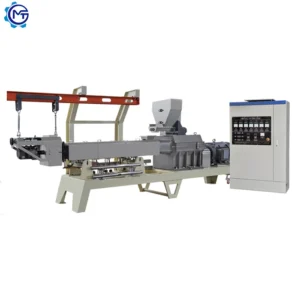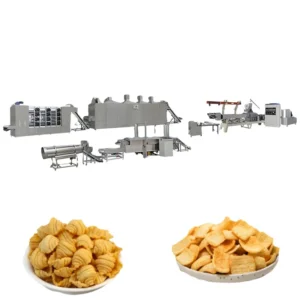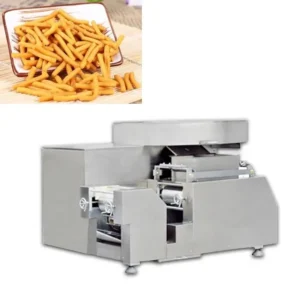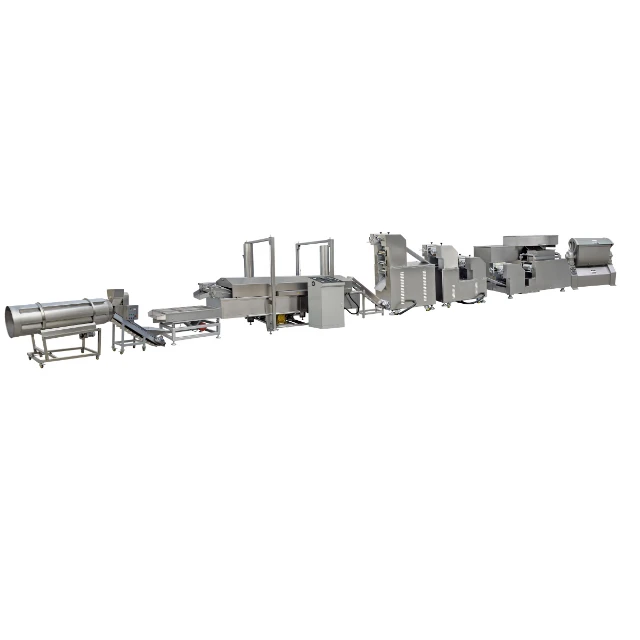
Capacity-Matched Extrusion Lines — Every station from mixer through fryer is throughput-balanced under one manufacturer, preventing the bottleneck where an extruder outpaces its downstream dryer.
Technical Specifications
| Parameter | Value |
|---|---|
| Model | MT-65 / MT-70 / MT-85 / MT-75 / MT-95 |
| Product Type | Fried Pellet Chips Snack Food Production Line |
| Screw Type | Co-rotating twin screw, sectional modules |
| Main Motor (MT-65) | 100 kW |
| Main Motor (MT-70) | 130 kW |
| Main Motor (MT-85) | 180 kW |
| Main Motor (MT-75) | 185 kW |
| Main Motor (MT-95) | 280 kW |
| Output Capacity (MT-65) | 120–150 kg/h (basis not stated in source — confirm raw material / moisture / pellet format) |
| Output Capacity (MT-70) | 200–250 kg/h (basis not stated in source — confirm raw material / moisture / pellet format) |
| Output Capacity (MT-85) | 300–500 kg/h (basis not stated in source — confirm raw material / moisture / pellet format) |
| Output Capacity (MT-75) | 400–500 kg/h (basis not stated in source — confirm raw material / moisture / pellet format) |
| Output Capacity (MT-95) | 800–1000 kg/h (basis not stated in source — confirm raw material / moisture / pellet format) |
| Mixer Power Options | 4 kW / 7.5 kW / 15 kW (matched to line model) |
| Cutting Method | Roller-based forming, interchangeable rollers |
| Cutting Machine Dimension | 2500×600×1100 mm |
| Fryer Belt Width | 600 mm stainless steel belt |
| Drying Method | Gas / Electric / Diesel heating |
| Fryer Energy Options | Electricity / fuel gas |
| Voltage & Frequency | Customizable (e.g., 3ph 380V 50Hz, 3ph 415V 60Hz, 3ph 220V 60Hz) |
| Contact Materials | Food-grade stainless steel for all product-contact parts |
| Standards | CE certified (electronic edition certificates for export) |
Application Suitability
| Application | Material or Output |
|---|---|
| Fried pellet snack production (Bugles, corn chips) | Corn powder, wheat flour, corn starch blends |
| 3D pellet formats (shell, screw, square tube, wave) | Potato starch, potato powder, rice flour mixtures |
| Pillow shapes, diamond chips, wavy chips | Multi-grain formulations with varying moisture profiles |
| Crispy pea and round tube snacks | Legume-based and composite starch raw materials |
| 2D sheet and rib chip formats | Single or blended grain inputs with tailored gelatinisation requirements |
What "Nominal Output" Actually Means for Your Fried Chips Line
A capacity figure is only as reliable as the raw material and moisture condition behind it.
I have watched snack producers sign off on a fried chips making machine manufacturer quotation that promised a certain hourly throughput, only to find the extruder could not sustain that rate on their specific corn-starch blend. The die pressure builds differently, the gelatinisation window shifts, and suddenly the cutter is starving while the dryer runs half-empty. Before any line leaves the workshop, the formulation must be trialled under real conditions [NEED_CITE: importance of raw material trial runs in extrusion equipment procurement]. That single step separates a line that runs at nameplate capacity from one that quietly underperforms every shift.
How the Full Station Sequence Eliminates Throughput Gaps
When you survey equipment for a fried pellet snack food production line, the temptation is to compare extruders in isolation. The real risk lies between stations. An MT-85 extruder pushing material at its upper range needs a dryer with enough residence time and a fryer belt wide enough to handle the volume without pile-up. This line range is configured so that mixer batch size, extruder output, cutting speed, dryer length and fryer belt width are calculated together before the layout is drawn. The fried chips making machine manufacturer supplies every station, which means the throughput match is one supplier’s responsibility rather than a dispute between three vendors.
Screw Configuration and Die Design as Product Variables
The co-rotating twin-screw extruder uses sectional modules, meaning the screw profile can be rearranged to suit different starch sources and target textures. A corn-dominant formulation gelatinises at a different barrel temperature profile than a potato-starch-heavy blend. The die opening and land length are specified alongside the screw build, controlling expansion ratio and pellet wall thickness before the product ever reaches the cutter. Getting this combination wrong produces pellets that fracture during frying or absorb oil unevenly [NEED_CITE: twin-screw extrusion screw configuration principles for starch-based snacks].
Reading the Specs That Actually Matter
Motor power across the five models scales from 100 kW on the MT-65 to 280 kW on the MT-95, which reflects the mechanical energy input available for shear and cooking inside the barrel. Higher kilowatt ratings allow longer barrel sections and more aggressive screw elements, directly influencing the degree of starch gelatinisation achievable at higher throughputs. The fryer’s 600 mm stainless steel belt width sets the physical ceiling on how much product can pass through the oil bath in a single layer; a narrower belt forces thicker product beds and uneven frying. Drying method options across gas, electric and diesel heating let the line adapt to whichever utility is cheapest or most reliable at the installation site, a decision that affects both operating cost and temperature control precision.
The Hidden Cost of Mismatched Upstream and Downstream Stations
I once visited a plant where a 3D pellet line had been assembled from separate suppliers. The extruder was rated higher than the dryer could handle, so half-cut pellets queued up on trays, absorbing ambient moisture and turning gummy before frying. The resulting chips were soft-centred and unsaleable. When the dryer and fryer come from the same source as the extruder, the supplier carries the burden of proving the balance, not the buyer [NEED_CITE: line integration risks in snack food extrusion projects]. That accountability is what makes a fried chips making machine manufacturer responsible for the entire output, not just one machine in the sequence.
Why Procurement Through a Single Equipment Range Matters
Every station from batching through frying is built and tested within the same facility, so dimensional tolerances between conveyor discharge and the next station’s infeed are verified before crating. Screw and die configurations are recorded against your specific raw material blend, not copied from a generic build sheet. The in-house testing workshop runs trial production on buyer-supplied formulations, producing a report that documents actual texture, density and output before shipment. Voltage and frequency are confirmed against your site supply, and the electrical schematic reflects that specification. Post-installation support covers the full line rather than fragmenting across separate warranties.
Documentation & Verification
- Line layout drawing showing throughput calculation between each station
- Screw and die configuration record matched to your raw material formulation
- Trial run report on buyer-supplied raw material documenting product texture and density
- Electrical schematic reflecting confirmed voltage, frequency and control language
- CE declaration of conformity for export compliance
- Wear parts list specifying screws, dies and cutting rollers included with shipment
Installation, Commissioning & Support
- Foundation and floor space planning based on the MT model’s overall dimensions and station sequence
- Dedicated electrical circuit sized to the line’s total connected load, from 100 kW to 280 kW extruder motor
- Station-by-station alignment verified during assembly, from mixer discharge through fryer belt tracking
- First-run parameter setting covering barrel temperature zones, screw speed and fryer belt speed
- Operator training on roller changeover for switching between Bugles, shell and tube chip formats
- Scheduled replacement intervals for twin-screw modules and cutting rollers documented in the manual
Before You Request a Quotation
To configure a fried pellet snack food production line that actually matches your situation, share your target chip format and the raw material blend you intend to run, including moisture content if known. Confirm your site voltage, frequency and phase, as well as the available heating energy for the dryer and fryer. If you have existing upstream mixing or downstream packing equipment, provide their throughput ratings so the new line can be balanced to them.
Frequently Asked Questions
Q: How is output capacity verified before the line ships?
A: Each line undergoes a trial run in the testing workshop using the buyer’s own raw material formulation. The trial documents actual throughput, product density, texture and expansion ratio under controlled conditions. A written report accompanies shipment, so capacity claims are tied to a specific recipe rather than a generic benchmark.
Q: Can the line be built for my country’s voltage and frequency?
A: Voltage and frequency are confirmed during the specification stage. Options include 3-phase 380V 50Hz, 415V 60Hz, 220V 60Hz and other configurations. The electrical schematic, motor nameplates and control panel labeling all reflect the confirmed supply before production begins.
Q: How are extruder, dryer and fryer capacities balanced?
A: Throughput is calculated across every station based on your target product format and raw material. The dryer residence time, fryer belt speed and cutting machine cycle rate are all sized relative to the extruder’s verified output on your formulation, preventing bottlenecks or idle stations.
Q: What spare wear parts ship with the line?
A: Free wearing parts are included with initial delivery, typically covering an initial production period. Additional spare screws, dies and cutting rollers for extended operation are recommended and can be ordered alongside the line to avoid downtime when first replacements are due.
Q: Is a packing machine included in the line?
A: Packing is handled through a partner supplier rather than built in-house. The line layout accounts for packing station footprint and infeed conveyor alignment, and the supplier coordinates integration so the packing interface matches the fryer discharge rate.