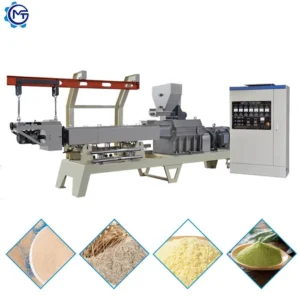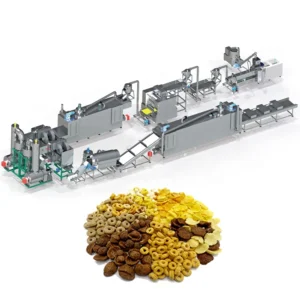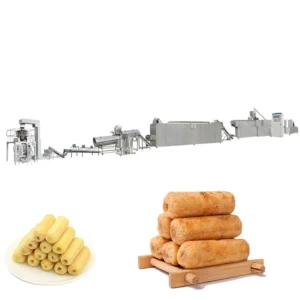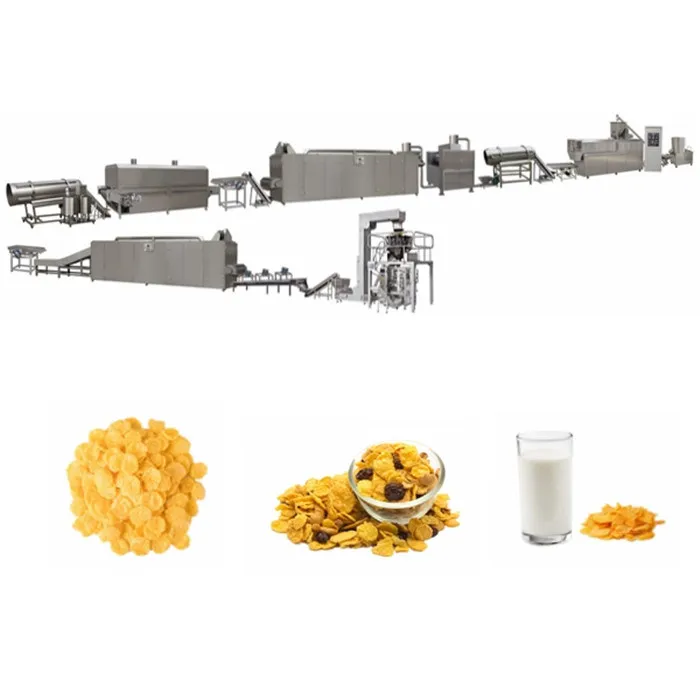
Capacity-Matched Engineering — Every station from mixing through roasting is sized to the extruder’s actual output on your specific grain blend, preventing the hidden bottlenecks that stall lines assembled from separate vendors.
Technical Specifications
| Parameter | Value |
|---|---|
| Product Type | Corn Flakes Breakfast Cereal Production Line |
| Installed Power | 160 kW (MT70) / 190 kW (MT85) / 210 kW (MT75) |
| Power Consumption | 120 kW (MT70) / 140 kW (MT85) / 150 kW (MT75) |
| Output Capacity | 150-200 kg/h (MT70) / 300-400 kg/h (MT85) / 300-500 kg/h (MT75) (basis not stated in source) |
| Extruder Capacity (MT75) | 200-300 kg/h (basis to be confirmed) |
| Overall Dimensions | 41 × 1.5 × 2.2 m (MT70) / 43 × 1.5 × 3.2 m (MT85) / 45 × 1.5 × 3.5 m (MT75) |
| Screw Configuration | Twin-screw extruder (MT75 detail); configuration matched to raw material |
| Control System | PLC control (flaking machine); MCC/PLC available for full line |
| Flaking Mechanism | Hydraulic double-roller system with separate motors and infrared sensor temperature control |
| Dryer Heating Source | Gas or electric (configurable) |
| Roasting Oven | Hot air roasting with conciliation burner, dual circulating fans, cyclone dust removal, vibrating pan with high-temperature spraying tubes |
| Coating System | Double tumble for sugar melting, elevator, coating drum, spraying nozzle |
| Line Workflow (Natural) | Mixing → Extruding → Flaking → Drying → Hot Air Roasting → Cooling → Packing |
| Line Workflow (Sugar Coated) | Mixing → Extruding → Flaking → Drying → Hot Air Roasting → Sugar Spraying → Sugar Coating → Drying → Cooling → Packing |
| Raw Materials | Corn, rice, wheat, oat, barley powder |
| Final Products | Natural corn flakes, sugar-coated corn flakes, shaped breakfast cereals (ball, tube, stick, ring, fruit loop, star, wheel, flower, heart via die adjustment) |
| Standards | CE certified (since 2014); ISO certified |
Application Suitability
| Application Scenario | Material or Output |
|---|---|
| Natural corn flakes production for breakfast cereal manufacturers | Pure corn or corn-dominant blends |
| Sugar-coated flakes with consistent glaze adhesion | Corn, rice, or multi-grain bases with sugar or honey coating |
| Multi-grain cereal lines using oat, barley, wheat alongside corn | Blends requiring adjusted screw configuration and barrel temperature profiling |
| Shaped cereal formats (rings, loops, stars, hearts) | Same extrusion platform with die change for format diversification |
| Pilot or mid-scale production with format flexibility | Smaller capacity ranges for testing market response before scaling |
What "300 kg/h Output" Hides About Your Raw Material
Quoted capacity figures assume a specific grain blend, moisture content, and flake density that rarely match your actual formulation.
I have watched lines that ran flawlessly during supplier trials collapse in the first week of real production. One Northern European buyer tested with pure corn grits, then switched to a recipe containing thirty percent oat flour on-site; the starch gelatinisation dropped, and the flaking rollers crushed the dough into fragments instead of pressing flat flakes. The line sat idle for two weeks while engineers recalibrated [NEED_CITE: starch gelatinisation behaviour across multi-grain blends]. The corn flakes production line full equipment range only performs when every station is configured for what you actually intend to extrude.
Extruder Screw and Die Matching to Your Grain Formula
The twin-screw extruder ships with a screw configuration and die design specified to your raw material blend and target flake texture. Changing from a pure corn base to a multi-grain recipe alters viscosity, shear response, and expansion behaviour inside the barrel. The screw pitch, kneading block arrangement, and die aperture are selected to hold consistent dough density across those variables, so the corn flakes production line full equipment range delivers uniform flakes regardless of whether you run straight corn or a blend incorporating wheat, oat, or barley.
Flaking and Roasting Precision for Surface Blistering
The hydraulic double-roller flaking machine uses separate motors for each roller and an infrared sensor to regulate surface temperature, maintaining even sheet thickness as dough moisture and composition shift between batches. Downstream, the hot air roasting oven employs a conciliation burner with two independent circulating fans and a cyclone dust removal device. This configuration produces the controlled surface blistering and crispness that distinguish breakfast-quality flakes from under-toasted material, while the vibrating pan with high-temperature spraying tubes prevents product clumping during the roast cycle [NEED_CITE: thermal profiling requirements for cereal flake roasting].
Reading the Specs: Power, Footprint, and Line Throughput
The installed power figures — 160 kW for the MT70 up to 210 kW for the MT75 — reflect the combined draw of extruder drive motors, flaking hydraulics, dryer heating, and roasting burners at full load. Power consumption values run roughly twenty-five to thirty percent below installed capacity under steady-state operation, which matters for sizing your facility’s electrical supply. The line footprint stretches from 41 meters to 45 meters depending on model, requiring clear access on both sides for maintenance and sanitation. The extruder capacity listed for the MT75 detail table reads 200-300 kg/h, while the overall line capacity states 300-500 kg/h; this discrepancy highlights why throughput must be confirmed against your specific raw material moisture and target flake density before the line is built. Control architecture spans PLC on the flaking station and MCC/PLC options for the broader line, and voltage, frequency, and HMI language must be locked in before production starts to avoid commissioning delays in your target market [NEED_CITE: IEC voltage and frequency standards for food processing equipment by region].
The Cost of Mismatched Station Capacity
When the flaking press, dryer, or roasting oven is undersized relative to the extruder, dough piles up at the bottleneck station. Flake thickness becomes inconsistent, moisture content entering the roaster varies batch to batch, and product either emerges under-dried or scorched. I have seen buyers source an extruder from one vendor and a dryer from another, only to discover the dryer’s belt speed could not keep pace, forcing the extruder to run at half capacity. Those hidden losses compound across every shift [NEED_CITE: throughput mismatch consequences in multi-vendor food processing lines].
Why Source the Full Line from One Supplier
Every station in this corn flakes production line full equipment range — mixing, extruding, flaking, drying, roasting, sugar coating, cooling, and packing — is throughput-matched during engineering so no single machine throttles the rest. Screw configuration and die design are documented against your raw material before the extruder is assembled. The in-house testing workshop runs trial production on your actual grain blend before shipment, so product development is not deferred to your factory floor. Sugar coating capacity, including the double tumble melting system and spraying nozzle, is sized to the extruder’s verified output rather than a generic rating. Pre-sales consultation carries through engineer design, on-site installation, commissioning, and operator training.
Documentation & Verification
- Line layout and capacity calculation showing station-by-station throughput matching
- Screw and die configuration record matched to your grain blend and target flake density
- Trial run report on your raw material produced in the testing workshop before dispatch
- Electrical schematic with voltage, frequency, and control language confirmation
- Factory test record and CE declaration of conformity for your destination market
Installation, Commissioning & Support
- Foundation and utility planning based on the 41-45 m line footprint and 160-210 kW installed power requirement
- Dedicated electrical circuits sized to your confirmed voltage and frequency before the line ships
- Hydraulic flaking system commissioning with roller pressure and infrared sensor calibration on your dough formulation
- Hot air roasting oven burner tuning and circulating fan balance for consistent flake blistering
- Operator training covering PLC interface navigation, screw change procedures, and sugar coating drum adjustment
- Wear parts list including screws, dies, and flaking roller surfaces with recommended replacement intervals
What to Include in Your Inquiry
Provide your raw material blend ratios, target moisture content, and desired flake density so the extruder configuration can be matched before quotation. Confirm your facility’s available floor length and ceiling height against the line dimensions, along with local voltage, frequency, and preferred control language. If you plan to run both natural and sugar-coated formats, specify which products will share the same extrusion platform.
Frequently Asked Questions
Q: How is output capacity verified, and what assumptions underpin the quoted kg/h?
A: Output figures are based on specific raw material types, moisture levels, and product formats. The MT70, MT85, and MT75 ratings must be validated against your actual grain blend and target flake density through a trial run in the testing workshop before the capacity is confirmed for your production environment.
Q: How are stations throughput-matched to prevent line bottlenecks?
A: The extruder, flaking press, dryer, and roasting oven are engineered together so each station’s maximum throughput aligns with the extruder’s verified output on your material. This prevents the accumulation or starvation that occurs when stations are sourced independently.
Q: What screw and die configuration will my line ship with?
A: Screw pitch, kneading block arrangement, and die aperture are specified to your raw material blend and target flake texture. A configuration record is provided with the documentation package, and adjustments are validated during the pre-shipment trial run.
Q: Is a trial run on my raw material performed before shipment?
A: Yes. Your grain blend is processed through the extruder, flaking press, and roasting oven in the testing workshop. The trial report covers flake thickness consistency, surface blistering quality, and throughput achieved under your formulation.