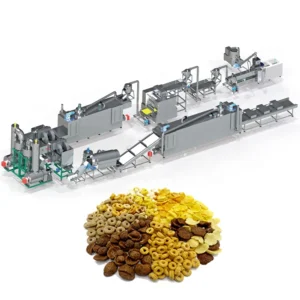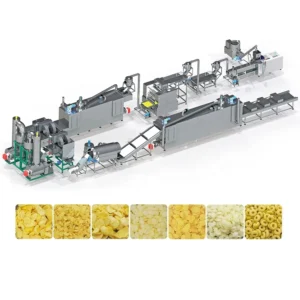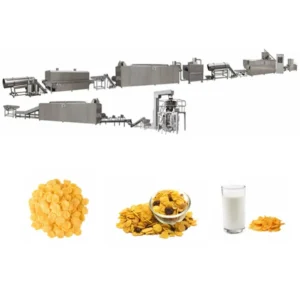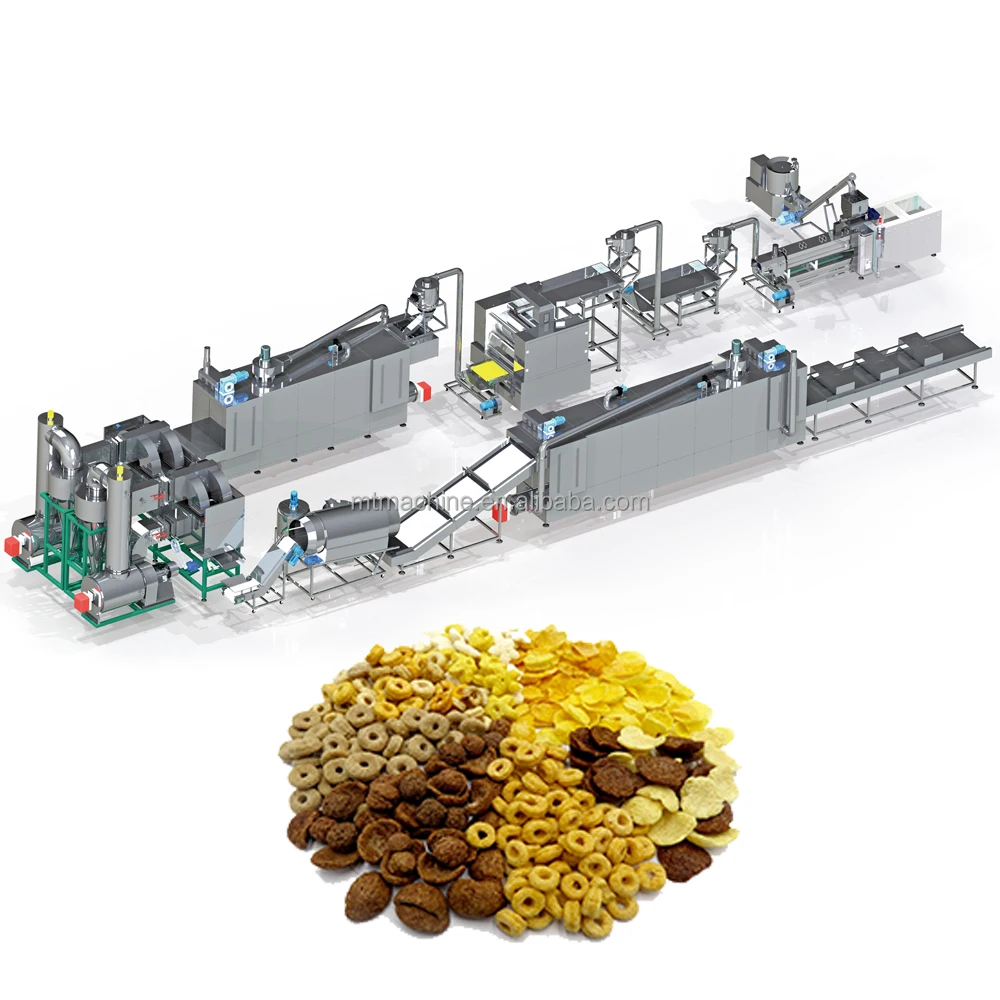
Matched Line Throughput — Every station on the MT70 corn flakes line is sized to the same raw material feed rate, so the extruder, flaker, and roaster never starve or choke each other during continuous runs.
Technical Specifications
| Parameter | Value |
|---|---|
| Model | MT70 |
| Product Type | Corn Flakes Making Machine |
| Screw Type | Twin Screw |
| Installed Power | 160 kW |
| Power Consumption | 120 kW |
| Capacity | 150–200 kg/h (basis not stated in source — confirm raw material and moisture) |
| Overall Dimensions | 41 × 1.5 × 2.2 m |
| Control System | PLC |
| Dryer Heating Source | Gas or Electric (configurable) |
| Flaking Drive | Double motors, independent roller drive |
| Flaking Control | PLC with hydraulic roller pressure system |
| Flaking Temperature Monitoring | Infrared sensor for even temperature pipe control |
| Roasting Oven | Hot air with vibrating pan, high-temp spray tubes, dual circulating fans, cyclone dust removal |
| Coating System | Double tumble sugar melter, elevator, coating drum, spray nozzles |
| Assembly State | Complete line: Mixing → Extruding → Flaking → Drying → Hot Air Roasting → Sugar Spraying → Sugar Coating → Drying → Cooling → Packing |
| Certifications | CE, ISO |
Application Suitability
| Application | Material or Output |
|---|---|
| Natural corn flakes | Corn grits or corn flour, toasted without coating |
| Sugar-coated corn flakes | Corn, rice, or wheat base with sugar or honey glaze |
| Multigrain breakfast flakes | Blends of oat, barley, rice, and wheat powder |
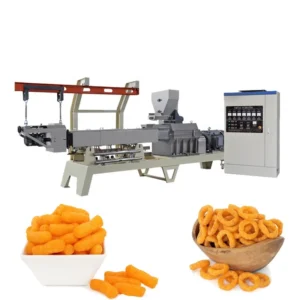
| Shaped cereal pieces | Ball, tube, ring, star, wheel, flower, heart, and fruit loop forms via interchangeable dies |
| Fortified cereal production | Vitamin- or mineral-enriched grain blends for institutional nutrition programs |
Why the Dryer Capacity Question Beats the Extruder Price Question
The extruder sets the pace, but the dryer decides whether you actually ship product that day.
I once watched a corn flakes line where the twin-screw extruder ran smoothly at nameplate output while flakes piled up ahead of a hot air roaster that was undersized for the moisture load. The vibrating pan could not carry the volume, and by mid-shift the cooling conveyor was buried. The fix was not a bigger extruder — it was re-matching every downstream station to the actual water evaporation rate of the buyer’s recipe [NEED_CITE: typical moisture reduction targets in breakfast cereal drying]. When you evaluate a breakfast cereal corn flakes machine full equipment range, the first number to verify is not peak extruder output but the grams of water each downstream unit can remove per hour.
How Twin-Screw Geometry Shapes the Flake
The MT70 uses a co-rotating twin-screw configuration that controls residence time and shear inside the barrel. For corn grits, this means starch gelatinisation happens uniformly before the dough reaches the die. Changing screw element spacing lets the operator shift between a fully cooked, low-moisture pellet for thin, crisp flakes and a higher-moisture pellet for thicker, chewier cereal pieces. The breakfast cereal corn flakes machine full equipment range ships with a die plate matched to the target shape, and the PLC logs barrel temperature zones so each batch repeats the last.
Flaking and Roasting: Where Density Is Won or Lost
After extrusion, pellets pass through the hydraulic double-roller flaker. Independent motors on each roller keep the gap even across the full width, and the infrared sensor continuously reads surface temperature to prevent scorching or under-heating. Downstream, the hot air roasting oven uses two separate circulating fans and a cyclone dust removal device so fine particles never settle back onto the flakes [NEED_CITE: food safety requirements for particulate control in cereal roasting]. The vibrating pan advances product in a thin, single layer, which is what gives each flake a consistent toast colour and crunch.
Reading the Spec Sheet Like a Process Engineer
Installed power of 160 kW and running consumption of 120 kW tell you the line draws serious current; confirming local voltage and phase balance before the panel is built avoids rewiring on arrival. The PLC control across both the extruder and the flaker means one operator can adjust roller gap and barrel temperature from the same HMI, cutting reaction time when raw material moisture drifts between batches. Overall line length of 41 metres is the straight-run footprint — U-layout or split-room arrangements require the layout drawing before foundation work starts. Gas-heated dryers lower per-hour energy cost in regions with cheap natural gas, while electric heating simplifies utility approvals where gas permits are slow.
The Hidden Cost of a Copied Configuration
Taking a screw and die setup from a different supplier’s brochure and dropping it onto your corn formula often means the extrudate leaves the die too wet or too dry for the flaker. Flakes that enter the roaster above target moisture come out soft and flexible instead of crisp, and the sugar coating drum then turns them into a sticky mass. I have seen entire first-week production runs scrapped because nobody verified the die orifice diameter against the buyer’s specific corn grit particle size [NEED_CITE: particle size influence on extrudate expansion in twin-screw processing]. The cost is not just raw material — it is the week of line downtime while new screw elements are machined and shipped.
Why Buyers Source the Full Line Here
Every station from the batching mixer to the packing conveyor is engineered under one roof, so throughput calculations are cross-checked before metal is cut. The in-house testing workshop runs your actual corn, rice, or oat recipe on the MT70 before the line ships, producing a trial report you can review before acceptance. Screw configuration records and die drawings are handed over at delivery, so replacement wear parts are ordered by part number instead of guesswork. Electrical schematics arrive with confirmed voltage and frequency for your facility, and the PLC program is loaded in the language your operators read. Ongoing support covers remote troubleshooting and on-site commissioning so the first production day is a scheduled event, not an experiment.
Documentation & Verification
- Line layout drawing scaled to your factory floor with utility drop points marked
- Machine specification sheet listing every motor rating and sensor type on the MT70
- Screw and die configuration record tied to your tested raw material formula
- Electrical schematic with confirmed voltage, frequency, and control language
- Trial run report on your corn or oat recipe showing flake density and moisture at each station
- CE declaration of conformity and ISO certificate for customs and import compliance
Installation, Commissioning & Support
- 41-metre line footprint requires levelled floor with anchor points mapped to the layout drawing
- 160 kW installed load needs a dedicated breaker panel sized for starting current on the extruder main motor
- Gas or electric dryer option must be decided before assembly so ductwork or bus bars are pre-fitted
- PLC and HMI configured to local language and operator access levels during on-site commissioning
- Twin-screw elements and flaking roller surfaces inspected; wear parts list handed over with first spare set
- Training covers barrel temperature profiling, hydraulic roller gap adjustment, and daily cleaning of the cyclone dust collector
What to Include in Your First Inquiry
Share your primary grain type, typical moisture content at the mixer outlet, and the daily tonnage you plan to run. Tell us your factory ceiling height and available floor length so the 41-metre line can be arranged without cutting through walls. Confirm local supply voltage, phase, and frequency, and let us know if your operators need the PLC interface in a specific language.
Frequently Asked Questions
Q: How do I pick the right extruder model for my target corn flakes output?
A: Model selection starts with your raw material formula and desired hourly throughput. The MT70 suits mid-range capacities, while larger or smaller lines exist for different volumes. We run your recipe in the testing workshop to confirm which screw configuration and die combination holds steady output, then recommend the model that matches without oversizing.
Q: What supporting equipment comes with the full corn flakes line?
A: The complete range covers mixing, twin-screw extrusion, flaking, drying, hot air roasting, sugar coating, cooling, and packing. Each station is throughput-matched to the extruder so no single unit bottlenecks the line. Utility connections and control wiring between stations are included in the scope.
Q: Can the line layout be adapted to my factory dimensions?
A: Yes. The standard straight-run footprint is 41 metres, but we produce U-shaped or split-room layouts based on your floor plan. Ceiling height, column positions, and utility drop locations are factored into the layout drawing before any foundation work begins on your site.
Q: What changes between natural and sugar-coated corn flakes production?
A: Natural flakes skip the sugar melter and coating drum, going straight from roasting to cooling. Sugar-coated flakes pass through the double tumble melter and spray nozzles after roasting, then enter a second drying stage to set the glaze. The line is supplied with or without the coating section depending on your product plan.
Q: How does the twin-screw extruder handle different grains like rice or oat?
A: Corn, rice, wheat, oat, and barley each gelatinise at different temperatures and moisture levels. The operator adjusts barrel zone temperatures and screw speed via the PLC, and we supply die plates matched to the target cereal shape. A trial run on your specific grain blend confirms settings before the line leaves our workshop.