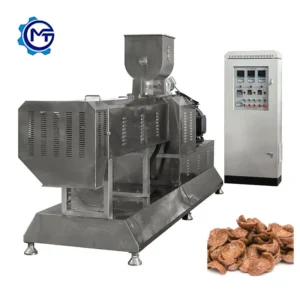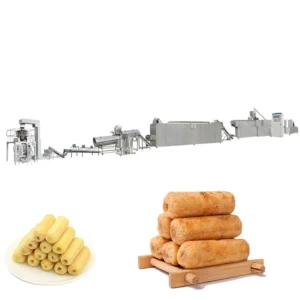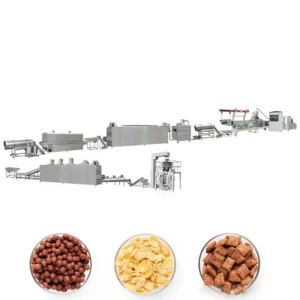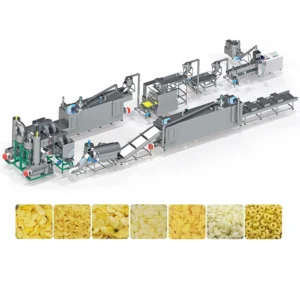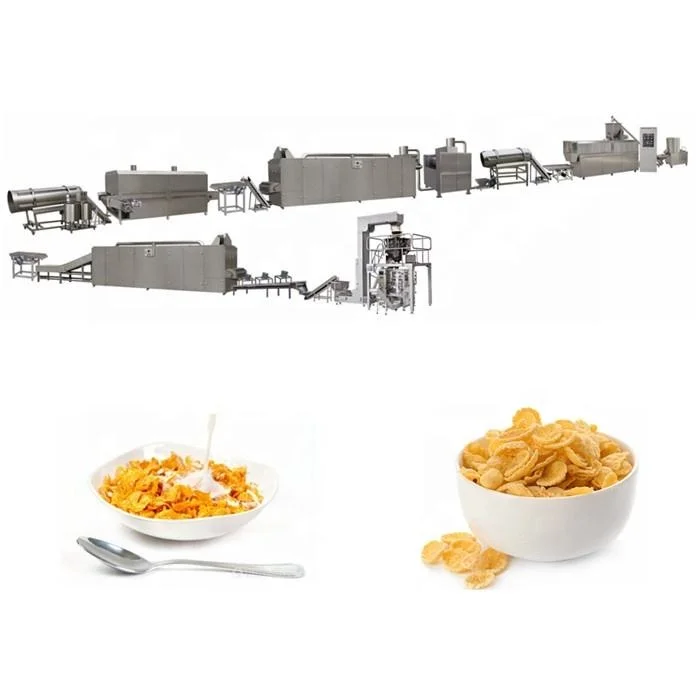
Screw Configuration Matched to Your Recipe — Every unit in this breakfast cereals corn flakes machine full equipment range is specified around the buyer’s actual raw material, preventing the texture and density failures we have seen when lines are copied from generic builds.
Technical Specifications
| Parameter | Value |
|---|---|
| Product Type | Breakfast Cereals Corn Flakes Production Line |
| Available Models | MT70 / MT85 / MT75 |
| Extruder Type | Twin Screw |
| Installed Power | 160 kW (MT70) / 190 kW (MT85) / 210 kW (MT75) |
| Power Consumption | 120 kW (MT70) / 140 kW (MT85) / 150 kW (MT75) |
| Line Capacity | 150–200 kg/h (MT70) / 300–400 kg/h (MT85) / 300–500 kg/h (MT75) (basis to be confirmed — dependent on raw material and moisture content) |
| Overall Dimensions (L×W×H) | 41×1.5×2.2 m (MT70) / 43×1.5×3.2 m (MT85) / 45×1.5×3.5 m (MT75) |
| Flaking Machine Control | PLC with hydraulic double rollers, dual independent motors, infrared temperature sensing |
| Dryer Heating Source | Gas or Electric |
| Roasting Oven | Hot air with vibrating pan, conciliation burner, dual circulating fans, cyclone dust removal |
| Coating System | Double tumble sugar melting, elevator, coating drum, spray nozzle |
| Key Features | Automatic lubrication and cooling, wear-resistant screws, CE and ISO certified |
Application Suitability
| Application | Material or Output |
|---|---|
| Natural corn flakes production | Corn powder, maize grits |
| Sugar-coated breakfast cereals | Corn, rice, wheat base with sugar or honey coating |
| Shaped cereal snacks | Oat, barley, rice blends — ball, tube, ring, star, fruit loop, wheel, heart formats |
| Fortified breakfast cereal lines | Multi-grain formulations with added nutritional premix |
| Pilot-scale cereal product development | Small-batch runs on MT70 for recipe validation before scaling to MT85 or MT75 |
Why the Full Equipment Range Matters More Than the Extruder Alone
A breakfast cereals corn flakes machine full equipment range that is sourced station-by-station almost always bottlenecks at the weakest link.
I once watched a European producer install a high-output twin-screw extruder paired with an undersized flaking unit from a different vendor. The extruder pushed material faster than the flaker could press it, and the backlog of hot dough cooled and hardened before it reached the rollers. The result was uneven flakes and frequent line stoppages. When every station — mixing, extruding, flaking, drying, roasting, coating, cooling, packing — comes from a single supplier who has calculated throughput across the entire chain, that kind of mismatch does not happen [NEED_CITE: throughput balancing principles in multi-station food processing lines].
How Each Station Connects to the Next
The twin-screw extruder discharges cooked, gelatinised dough directly into the flaking machine. The hydraulic double-roller system on the flaker is sized so its 200–300 kg/h throughput window aligns with the extruder output range, meaning the dough arrives at the rollers at the correct temperature and moisture level. If the flaker were slower, the dough would skin over; if faster, the rollers would run starved and produce thin, brittle flakes that shatter during roasting.
Downstream, the dryer performs a pre-drying pass immediately after flaking to bring surface moisture down before the roasting oven. This step prevents flakes from sticking to the vibrating pan inside the roaster. The roasting oven then uses its conciliation burner and dual circulating fans to deliver uniform hot-air exposure, creating the characteristic surface blistering that consumers expect on a quality corn flake [NEED_CITE: corn flake surface blistering and moisture removal stages].
The Control Layer That Holds It Together
PLC control on the flaking machine manages roller gap, roller speed, and temperature independently through the infrared sensor system. Dual independent motors drive each roller separately, so differential speed adjustments are possible without mechanical linkage compromise. This level of control matters because even a slight variation in roller gap across the width of the sheet produces flakes that toast unevenly in the roasting oven — some arrive over-dried and scorched while others remain doughy in the centre.
The entire breakfast cereals corn flakes machine full equipment range operates under a single control architecture, so an operator adjusting extruder screw speed can see the downstream effect on flaker load and dryer temperature in real time rather than discovering the problem two stations later.
Reading the Numbers Behind the Line
The installed power figures — 160 kW on the MT70, scaling to 210 kW on the MT75 — reflect the combined draw of the extruder drive motors, barrel heaters, flaker hydraulics, dryer elements, and roaster fans. Power consumption values run roughly 70–75% of installed capacity under normal operating load, which is typical for lines where heating and mechanical work share the electrical burden. The MT-75 twin-screw extruder uses an automatic lubrication and cooling circuit that keeps barrel temperatures within a tight band during continuous runs, reducing the thermal cycling that causes screw wear.
The overall line dimensions stretching to 45 metres in length on the MT75 configuration tell you this is not a compact unit — it requires a dedicated production hall with clear ceiling height to accommodate the 3.5-metre maximum equipment height and sufficient floor space for operator walkways on both sides of the line [NEED_CITE: industrial food line layout and clearance standards].
What Happens When Stations Are Mismatched
A flaking machine with insufficient hydraulic pressure produces flakes that are too thick, and those thick flakes retain internal moisture through the roasting stage. The roaster then has to run longer or hotter to drive that moisture out, which scorches the flake surface before the core is fully dried. The final product snaps instead of crunches, and the packing line receives a mix of broken fragments and under-toasted pieces. We have seen producers blame the extruder for this problem when the root cause was a flaker that was never specified for the actual dough viscosity coming off a high-oat recipe.
Why Source the Full Range Here
Every station in this breakfast cereals corn flakes machine full equipment range is designed and manufactured under one roof, which means throughput calculations account for real material behaviour rather than nominal ratings. The screw configuration and die design are matched to your specific grain formulation — corn, oat, barley, wheat, or rice blends — before the line is built, not after it arrives at your facility.
An in-house testing workshop runs trial production on your actual raw material before shipment, so the screw combination, barrel temperature profile, and flaker settings are validated on your recipe rather than on standard corn flour. The complete documentation package — line layout, capacity calculation, screw and die configuration record, electrical schematic, trial run report — travels with the shipment, giving your installation team every reference they need. CE and ISO certification cover the full line rather than individual machines, simplifying compliance paperwork for your target market.
Documentation & Verification
- Line layout and capacity calculation matched to your factory footprint and target output
- Machine specification sheet with screw and die configuration record for your grain formulation
- Electrical schematic with voltage and frequency confirmation for your local power supply
- Factory test record and trial run report on your raw material before dispatch
- Operation and maintenance manual covering every station from mixer to packing conveyor
- CE declaration of conformity and ISO certificate covering the complete line
Installation, Commissioning & Support
- Floor plan with 41–45 m line length and 1.5 m width clearance requirements for foundation planning
- Power supply matching 160–210 kW installed load with dedicated circuit breakers per station
- Pre-assembled extruder and flaker modules shipped with flanking dryer and roaster sections for staged installation
- On-site commissioning includes PLC parameter upload, hydraulic pressure calibration, and roller gap alignment
- Operator training covers screw speed, barrel zone temperatures, flaker roller gap, and roaster fan balance
- Wear parts list specifying screw segments, die inserts, and flaking roller surfaces for first reorder cycle
- Lubrication and cooling circuit maintenance schedule for continuous twin-screw operation
Preparing Your Inquiry
Share your target grain formulation — whether pure corn, an oat blend, or a multi-grain mix — along with the daily output you need and the available floor space in your production hall. Include your local voltage and frequency, the control language your operators require, and whether your facility already has upstream milling or downstream packing equipment that the line must integrate with. If you are developing a new recipe, let us know so we can schedule a trial run in the testing workshop before finalising the screw and die configuration.
Frequently Asked Questions
Q: How is each station’s capacity matched so no unit bottlenecks the line?
A: Every station from the mixer through to packing is sized using a throughput calculation based on your specific raw material, target moisture at each stage, and final product weight. The flaker, dryer, and roaster are all specified to handle the extruder’s actual output on your recipe rather than a generic nominal rating, so material flows continuously without backlog or starvation at any point.
Q: What voltage, frequency, and control language options are confirmed before production?
A: Before the line enters production, we confirm your local voltage and frequency, the plug and breaker standards in your market, and the language for the PLC interface and operation manuals. The electrical schematic is then drawn to match, so your electricians can connect the 160–210 kW load without rewiring or transformer issues at commissioning.
Q: Can the flaking machine and dryer be sized independently to the extruder model chosen?
A: Yes. The flaker’s hydraulic roller system and the dryer’s heating capacity are selected based on the extruder model you choose and the dough characteristics of your recipe. A high-oat formulation, for instance, may require different roller gap settings and a longer pre-drying pass than a pure corn recipe, and the equipment is adjusted accordingly before shipment.
Q: Is a factory trial run on the buyer’s raw material included before shipment?
A: Yes. Your raw material is run through the extruder and flaker in our testing workshop before the line ships. The trial run validates screw configuration, barrel temperature profile, and flake thickness, and a full report with process parameters is provided so your team can replicate the results immediately at installation.