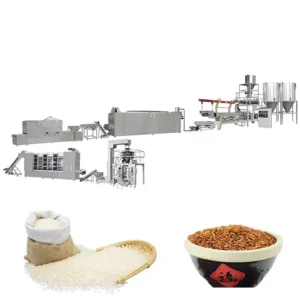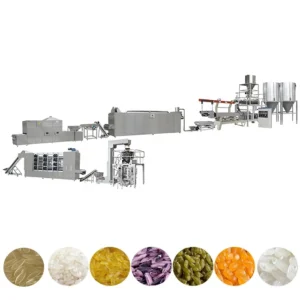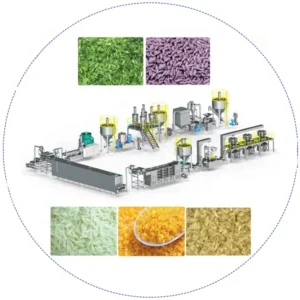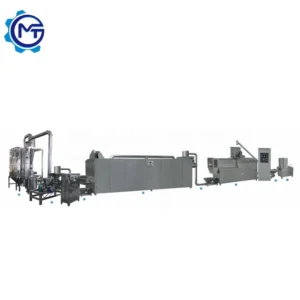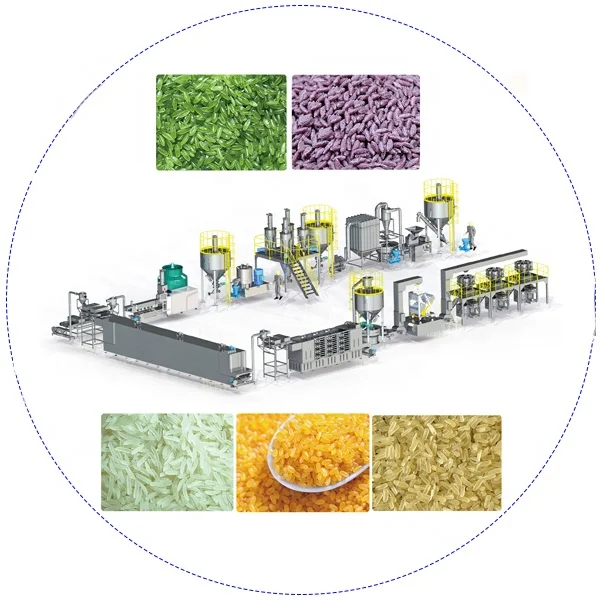
Matched Throughput — Every station from mixing to packing is calculated against the extruder’s actual discharge rate, preventing the dryer or cooler from becoming the line’s hidden choke point.
Technical Specifications
| Parameter | Value |
|---|---|
| Product Type | Fortified Artificial Rice Processing Line |
| Extruder Models | MT65, MT70, MT85, MT75, MT95 |
| Screw Type | Twin-screw (single or double screw feeding system selectable per material) |
| Control System | Frequency speed controlling |
| Lubrication | Automatic lubricating and cooling |
| MT65 Installed Power | 85 kW |
| MT65 Power Consumption | 60 kW |
| MT65 Output Capacity | 80–100 kg/hr (basis not stated in source — confirm raw material type and moisture content) |
| MT65 Overall Dimensions | 28 × 1.2 × 2.2 m |
| MT70 Installed Power | 120 kW |
| MT70 Power Consumption | 85 kW |
| MT70 Output Capacity | 100–120 kg/hr (basis not stated in source — confirm raw material type and moisture content) |
| MT70 Overall Dimensions | 30 × 1.5 × 2.2 m |
| MT85 Installed Power | 235 kW |
| MT85 Power Consumption | 165 kW |
| MT85 Output Capacity | 200–300 kg/hr (basis not stated in source — confirm raw material type and moisture content) |
| MT85 Overall Dimensions | 34 × 3.5 × 4.3 m |
| MT75 Installed Power | 180 kW |
| MT75 Power Consumption | 135 kW |
| MT75 Output Capacity | 300–500 kg/hr (basis not stated in source — confirm raw material type and moisture content) |
| MT75 Overall Dimensions | 32 × 3.5 × 4.3 m |
| MT95 Installed Power | 260 kW |
| MT95 Power Consumption | 195 kW |
| MT95 Output Capacity | 800–1000 kg/hr (basis not stated in source — confirm raw material type and moisture content) |
| MT95 Overall Dimensions | 36 × 3.5 × 4.3 m |
| Drying Oven Heating Source | Electric or gas |
| Drying Oven Feature | Circulation drying, frequency motor controls mesh belt speed |
| Line Stations | Mixing, Extruding, Vibrating, Low temperature drying, Cooling, High temperature roasting, Cooling, Packing |
| Raw Materials | Broken rice, rice, corn, millet, wheat, oats, buckwheat, bean, starch as main ingredient; vitamin and mineral as part ingredient |
| Assembly State | Complete processing line |
| Standards | CE, ISO |
Application Suitability
| Application | Material or Output |
|---|---|
| Nutritional programme suppliers producing vitamin- and mineral-enriched kernels for institutional distribution | Broken rice and rice bran blended with micro-nutrient premix |
| Grain processors converting low-value mill by-products into high-value retail rice | Corn, millet, wheat, oats, buckwheat, bean starch |
| Food manufacturers diversifying into extruded grain products | Whole and broken rice, starch-based formulations |
| Fortified food producers targeting school feeding and relief programmes | Rice grits with iron, folic acid, vitamin A, zinc premix |
What "Rated Capacity" Leaves Out When Stations Are Not Balanced
The extruder sets the ceiling, but the dryer usually sets the floor.
Over the years running equipment projects across Latin America, I have watched buyers compare Artificial Rice Processing Line equipment for sale on extruder output alone — only to discover during commissioning that the drying oven cannot keep pace. The extruder is forced to run below its rated frequency, and the line that was supposed to deliver full throughput ends up producing a fraction of that. The mismatch is rarely caught until raw material is already in the hopper and the buyer is standing next to a backed-up vibrating conveyor [NEED_CITE: common throughput bottlenecks in extruded food lines]. When every station from the mixer through the cooling belt is specified under one equipment range, the belt speeds, oven length, and residence times are calculated together before the quotation is issued.
How Station-by-Station Matching Works Across the Line
An Artificial Rice Processing Line equipment for sale starts at the batching and mixing station, where raw materials — broken rice, corn flour, starch, and micro-nutrient premix — are blended to a uniform moisture level before entering the feeder. The twin-screw extruder then subjects the mix to controlled shear and temperature, gelatinising the starch matrix and forming a continuous dough that is cut into rice-shaped kernels at the die face. The vibrating conveyor separates the freshly extruded kernels so they enter the drying oven as a single layer rather than clumped masses, which is critical for uniform moisture reduction.
The drying stage itself uses circulation hot air with a frequency-controlled mesh belt, meaning the belt speed can be adjusted to extend or shorten residence time depending on the moisture content leaving the extruder. After drying, the kernels pass through a cooling conveyor and then a high-temperature roasting section that sets the final texture and colour before a second cooling stage prepares them for packing. Each of these stations has a defined throughput envelope, and the Fortified Rice Extruder complete machine range lists every one of them so the buyer can see the full picture before committing.
Why Screw Configuration and Die Design Matter for Grain-Based Formulations
Different grain blends behave very differently inside the barrel. A formulation heavy in broken rice and rice starch gelatinises at a lower shear threshold than one loaded with buckwheat or bean flour, which contain more fibre and protein. The screw elements must be arranged to deliver the right combination of conveying, mixing, and shear zones for that specific blend — a generic screw build copied from a snack application will either under-cook the starch or generate excessive wear [NEED_CITE: twin-screw element configuration for varying starch and protein ratios]. The die orifice diameter and land length then determine the expansion ratio and the density of each kernel, which directly affects how the product cooks in the end consumer’s pot.
This is why the Fortified Rice Extruder complete machine range specifies screw configuration and die design against the buyer’s actual raw material and target product, rather than shipping a standard barrel assembly and leaving adjustments to the operator on site.
Reading the Power and Capacity Figures Across Five Extruder Models
The MT65 at 85 kW installed power targets small-batch and pilot production, while the MT70 at 120 kW steps into continuous commercial runs. Both models share compact footprints — under 30 m in line length — making them suitable for facilities with limited floor space. The MT85 and MT75 occupy a similar physical envelope at roughly 34 m and 32 m in line length respectively, yet their installed power jumps to 235 kW and 180 kW, reflecting different screw diameters and barrel volumes that change the throughput class entirely. The MT95 at 260 kW and 36 m in line length serves industrial-scale programmes where large volumes of fortified rice kernels must be produced in continuous shifts.
Across all five models, the automatic lubricating and cooling system maintains barrel temperature stability during extended runs, and the frequency-controlled drive allows the operator to fine-tune screw speed to the viscosity of the particular grain blend being processed. The drying oven is available with electric or gas heating, which is a consequential choice in markets where gas tariffs are significantly lower than industrial electricity rates.
The Hidden Cost of Sourcing Extruder and Dryer from Separate Vendors
When the extruder and the drying oven come from different suppliers, neither party is contractually responsible for the throughput gap between them. The extruder vendor points to the nameplate output, the oven vendor points to the rated evaporation capacity, and the buyer is left financing the idle time while both sides negotiate [NEED_CITE: liability gaps in multi-vendor food processing lines]. The vibrating conveyor speed, the oven mesh belt width, and the cooling belt length all need to match the extruder’s discharge rate — a detail that is easy to overlook when each machine is quoted on its own data sheet.
Why the Full Equipment Range Is Specified Under One Catalogue
The Artificial Rice Processing Line equipment for sale covers every station — mixing, extruding, vibrating, low-temperature drying, cooling, high-temperature roasting, second cooling, and packing — so that throughput is matched across the entire line rather than assembled from disconnected purchase orders. Screw configuration and die design are recorded against the buyer’s raw material formulation before production begins, not guessed from a generic template. The in-house testing workshop runs the buyer’s actual grain blend through the extruder before shipment, generating a trial run report that documents product texture, density, and nutritional retention. Electrical schematics and voltage specifications are confirmed against the target market’s grid standards before the control cabinet is wired. And the CE and ISO certified manufacturing process provides a documented quality trail from raw steel to packed crate.
Documentation & Verification
- Line layout and capacity calculation showing matched throughput at every station
- Machine specification sheet with screw and die configuration matched to your grain blend
- Electrical schematic and voltage confirmation for your local grid before production
- Trial run report on your raw material verifying kernel texture and nutrient retention
- CE declaration of conformity and ISO certificate for customs and regulatory clearance
- Wear parts list with recommended first-order spare screws and dies
Installation, Commissioning & Support
- Foundation plan based on the selected model’s overall dimensions, up to 36 × 3.5 × 4.3 m for the MT95
- Dedicated power circuit sized to the installed power rating, up to 260 kW for the MT95
- Frequency drive and control panel configured to local voltage and operational language before dispatch
- On-site extruder start-up with screw speed and barrel temperature profile set to your grain formulation
- Operator training covering die changes, automatic lubrication checks, and mesh belt speed adjustment
- First-order spare screws, dies, and wear parts shipped with the line to cover the initial replacement cycle
What to Include in Your Inquiry
Send the specific grain blend or recipe you plan to run, including the ratio of broken rice, starch, and micro-nutrient premix. Provide your target hourly output and the available workshop floor area and ceiling height, as line lengths range from 28 m to 36 m depending on the extruder model. Confirm your local voltage, frequency, and preferred control panel language so the electrical package is built correctly before the Artificial Rice Processing Line equipment for sale leaves the factory.
Frequently Asked Questions
Q: How do I choose the right extruder model for my target capacity and raw material mix?
A: Start with your target output and the specific grain formulation — broken rice, corn, buckwheat, or a blend — because different materials gelatinise at different shear levels. The MT65 through MT95 models span from pilot-scale to industrial volumes. We match the screw configuration and die design to your material and run a trial on your raw blend before confirming the final model selection.
Q: What supporting equipment stations are needed to avoid line bottlenecks?
A: The dryer capacity, vibrating conveyor speed, and cooling belt length must all match the extruder’s discharge rate. If any station is undersized, the extruder is forced to slow down and the entire line underperforms. We calculate throughput at every station and specify the full Fortified Rice Extruder complete machine range as a matched set.
Q: Can the screw configuration and die design be specified for my grain formulation?
A: Yes. Screw elements are arranged into conveying, mixing, and shear zones based on your raw material’s starch, protein, and fibre content. The die orifice and land length are selected to achieve the target kernel density and expansion. Both are documented in the configuration record before production starts.
Q: What voltage, frequency, and control language options are confirmed before shipment?
A: We confirm your local grid voltage, frequency, and the preferred language for the frequency drive interface before the control cabinet is wired. The electrical schematic is shared with you for approval, ensuring the line can be powered up immediately on arrival without transformer delays.
Q: How does the drying oven match the extruder output to maintain continuous throughput?
A: The drying oven uses circulation hot air and a frequency-controlled mesh belt whose speed is set to the extruder’s discharge rate. Residence time is calculated so that kernels reach the target moisture content without backing up on the vibrating conveyor, keeping the entire Artificial Rice Processing Line equipment for sale running at steady state.