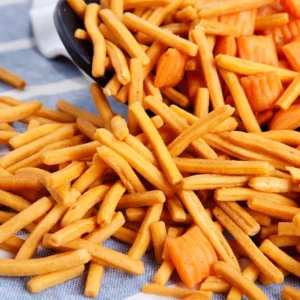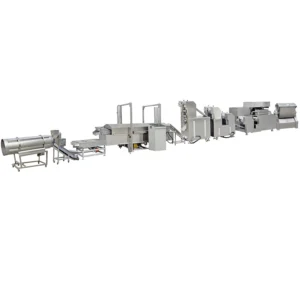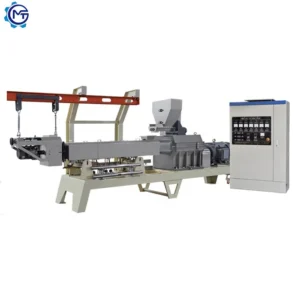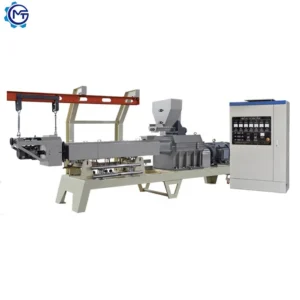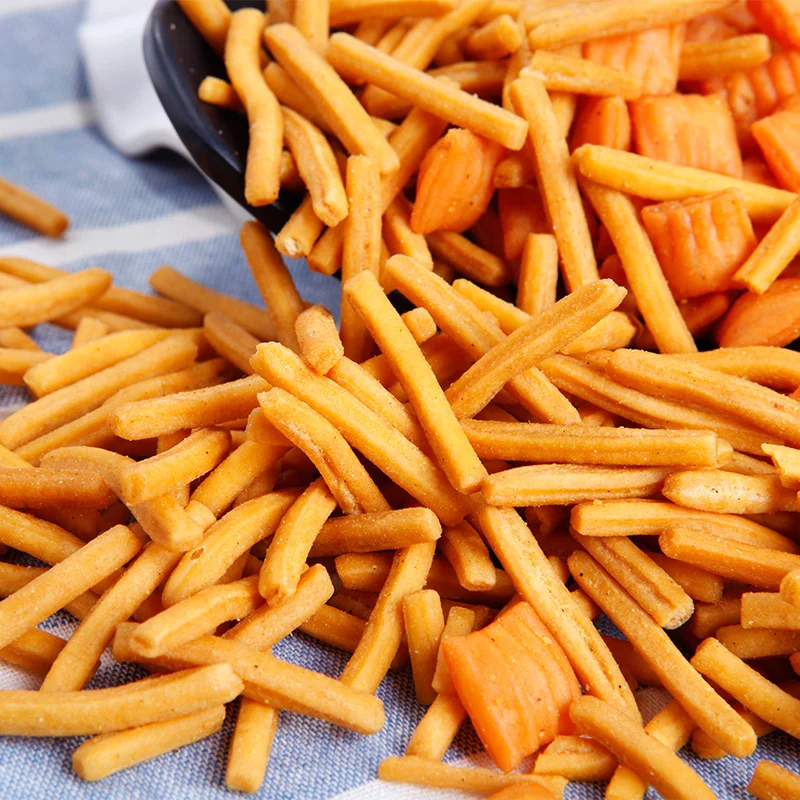
Integrated Frying Station — Throughput matched to upstream extruders and downstream coating equipment to prevent line bottlenecks.
Technical Specifications
| Parameter | Value |
|---|---|
| Product Type | Continuous Deep Fryer for Snack Food Processing Line |
| Rated Power | 60 kW heating tube power (electric heating); 2.6 kW drive/auxiliary power |
| Voltage & Frequency | 380V / 50Hz |
| Control System | PLC control panel |
| Overall Dimensions (L×W×H) | 6700 × 2200 × 1200 mm |
| Net Weight | 2000 kg |
| Oil Capacity | 320 L |
| Output Capacity | 100–1000 kg/h (basis not stated in source — confirm product type, moisture, frying time) |
| Heating Method | Electricity heating / Gas heating (dual option) |
| Conveyor Type | Upper and lower double-layer mesh belt, frequency conversion stepless speed regulation |
| Oil Filtration | Oil circulation filtration system (continuous residue removal) |
| Lifting System | Automatic lifting system for upper hood and mesh belt |
| Slag Discharge | Bottom slag discharge system |
| Construction Material | Food-grade 304 stainless steel |
| Key Features | Complete unit with belt conveying, lifting, oil filling, filtering, and temperature control systems |
Application Suitability
| Application | Material or Output |
|---|---|
| Deep frying extruded snack products | Fried sticks, wheat flour snacks, puffed pellets, chips |
| Automatic snack food processing line integration | Upstream extruders, downstream de-oiling and flavouring stations |
| Food and beverage factory production | Snack food shops, commercial food processing facilities |
Why the Voltage Question Should Come Before the Price
Voltage mismatch delays commissioning by weeks and requires expensive on-site transformer retrofits.
I have watched production lines sit idle because the fryer was wired for a 50Hz grid while the factory ran on 60Hz. The continuous frying machine for snack production line requires precise electrical integration. When a buyer in Southeast Asia received a unit configured for European standards, the motor speeds ran incorrectly, the heating elements cycled erratically, and the PLC threw fault codes that took days to diagnose. [NEED_CITE: voltage and frequency standards by export market]
The heating tube power draw alone demands a dedicated circuit with proper breaker sizing. Without confirming local electrical standards during the quotation phase, you risk receiving equipment that cannot legally or safely connect to your facility’s power distribution. This continuous frying machine for snack production line must match your plant’s existing infrastructure or you face costly modifications before the first product run.
How Line Throughput Matching Prevents Bottlenecks
An extruder running at capacity feeds product faster than an undersized fryer can process it, creating a bottleneck that backs up the entire line. The fryer station must be specified against your actual extruder output on your specific product format, not nominal catalog numbers. When wheat flour density varies from trial samples, frying time requirements shift, and the mesh belt speed must adjust accordingly.
The frequency conversion stepless speed regulation allows operators to dial in residence time based on real-time product behavior rather than fixed settings. This flexibility matters when you run multiple SKUs through the same line—puffed pellets require different oil exposure than direct-expanded wheat sticks, and the ability to adjust without mechanical changeover keeps production flowing.
Oil Management and Product Consistency
Residue accumulation in frying oil increases acid value and degrades product flavor over extended runs. The oil circulation filtration system continuously removes particulate matter, extending oil service life and maintaining consistent heat transfer to the product surface. Without this continuous filtration, operators must halt production to manually skim or replace oil, creating downtime and waste.
The 320-liter oil capacity provides thermal mass that stabilizes temperature when cold product enters the fryer. Temperature recovery between batches affects expansion and color uniformity. [NEED_CITE: CE machinery directive requirements for industrial equipment] When the heating system cannot maintain setpoint during continuous loading, some product emerges undercooked while later pieces overbrown, creating quality variance across the same production run.
Understanding the Core Parameters
The 60 kW heating tube power determines how quickly the system recovers temperature after product loading. Higher thermal input means shorter recovery cycles, but it also demands robust electrical infrastructure. For gas heating configurations, the burner rating must match local gas pressure standards and ventilation requirements.
The double-layer mesh belt conveyor sandwiches product to prevent floating, which is critical for low-density extruded snacks that would otherwise ride the oil surface and fry unevenly. The upper belt holds product submerged while the lower belt provides transport, ensuring all surfaces receive equal oil exposure.
The automatic lifting system for the hood and mesh belt enables rapid cleaning between product changeovers. Without this feature, maintenance crews must manually disassemble components, extending changeover time and increasing the risk of cross-contamination between different snack formulations.
The food-grade 304 stainless steel construction withstands continuous oil exposure and high-temperature cleaning protocols. Lower-grade materials corrode in this environment, introducing metal particulates into the product and requiring premature component replacement.
The Hidden Cost of Undersized Supporting Equipment
A fryer specified without matching de-oiling and cooling capacity creates downstream congestion. Product emerges hot and oil-saturated, requiring immediate centrifugal de-oiling and cooling before packaging. If the de-oiler cannot handle the fryer’s output rate, product piles up, cools unevenly, and absorbs excess oil that should have been removed while still hot. [NEED_CITE: snack food processing line integration standards]
When the coating and seasoning drum receives product that has already cooled, flavoring adhesion drops and you waste seasoning material. The entire line sequence must be calculated as a system, not as individual stations with nominal capacities that do not account for real-world throughput losses between stages.
Why Procurement Decisions Extend Beyond the Fryer
Complete line integration from a single supplier means the fryer throughput is calculated against your specific extruder model and product recipe, not assembled from independent vendors who each guarantee only their own station. When something fails between stations, you have one point of accountability rather than multiple suppliers pointing at each other.
Screw configuration and die design on the upstream extruder determine the product density and moisture content entering the fryer, which directly affects frying time and oil absorption rates. This fryer is specified knowing those upstream parameters rather than treating them as unknowns.
In-house testing on your actual raw material before shipment means the fryer parameters are validated on your product format, not generic samples. You receive a trial run report showing that the configured system holds your target output on your actual ingredients.
Pre-sales engineering consultation through installation and commissioning ensures the fryer integrates with your existing utility planning—gas lines, electrical panels, ventilation hoods, and floor drainage all need coordination before the equipment arrives.
Documentation & Verification
- Line layout and capacity calculation showing fryer throughput matched to upstream extruder output
- Machine specification sheet with electrical schematic and voltage confirmation for target market
- Trial run report on customer’s actual extruded product format before shipment
- Machinery test report and video outgoing inspection provided
- Operation and maintenance manual with wear parts list and cleaning protocols
- CE declaration of conformity and ISO certificate documentation
Installation, Commissioning & Support
- Dedicated 60 kW electrical circuit with proper breaker sizing for heating tube power requirements
- Floor drainage planning for oil spill containment and cleaning runoff from the 6700 mm footprint
- Gas line pressure verification and ventilation hood installation for gas heating option configurations
- PLC control panel language configuration and operator training on frequency conversion speed adjustment
- Oil circulation filtration system setup and initial oil fill procedures for the 320-liter capacity
- Spare mesh belt sections and heating element inventory planning for preventive maintenance cycles
What to Include in Your Inquiry
Provide your target product specifications—extruded pellet dimensions, wheat stick density, moisture content after extrusion—so the fryer can be sized against your actual upstream output rather than nominal values. Specify your local voltage and frequency standards, and confirm whether your facility has gas infrastructure available for the dual heating option.
Include your existing line equipment if you are adding a frying station to an established process, or your planned extruder model if building a new line from scratch. Share your daily production target and available floor space dimensions so the layout can account for the de-oiling and cooling stations that must follow the fryer.
Frequently Asked Questions
Q: How is fryer capacity matched to upstream extruder output on my specific product?
A: We calculate required fryer throughput based on your extruder’s actual output rate on your specific recipe, accounting for product density and moisture content. The mesh belt speed and oil residence time are then configured to match that flow rate, preventing bottlenecks or product backlog between stations.
Q: What voltage and frequency options are available for my target market?
A: The standard configuration runs on 380V/50Hz, but electrical systems can be configured for different regional standards. We confirm your facility’s electrical infrastructure during quotation to ensure the heating elements, motors, and PLC receive correct power without requiring external transformers.
Q: Where does the fryer sit in the line sequence, and what supporting stations are needed?
A: The fryer follows the extruder and any pre-drying or forming stations. Downstream, you need a de-oiling centrifuge to remove surface oil while product is still hot, followed by a cooling conveyor before the flavouring drum and packaging station. Each station’s capacity must match the fryer output.
Q: Can the fryer handle both extruded pellets and direct-expanded snack formats?
A: Yes, the frequency conversion stepless speed control allows operators to adjust residence time for different product densities and moisture levels. Extruded pellets typically require longer frying times than direct-expanded products, and the double-layer mesh belt accommodates both formats without mechanical changeover.
Q: What oil heating options are available, and how does that affect line utility planning?
A: Electric heating uses 60 kW of heating tube power and requires dedicated electrical circuits with appropriate breaker sizing. Gas heating requires gas line infrastructure, pressure regulation, and ventilation hood installation. Your facility’s existing utility availability determines which option integrates more cost-effectively.