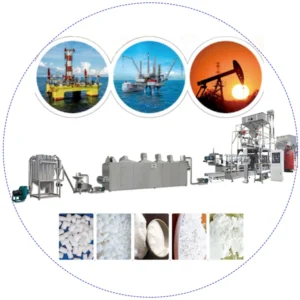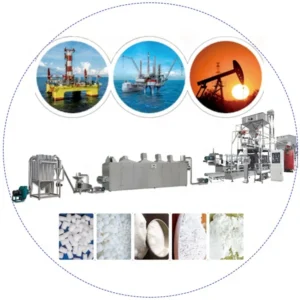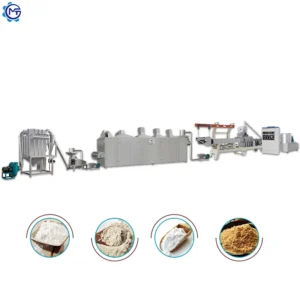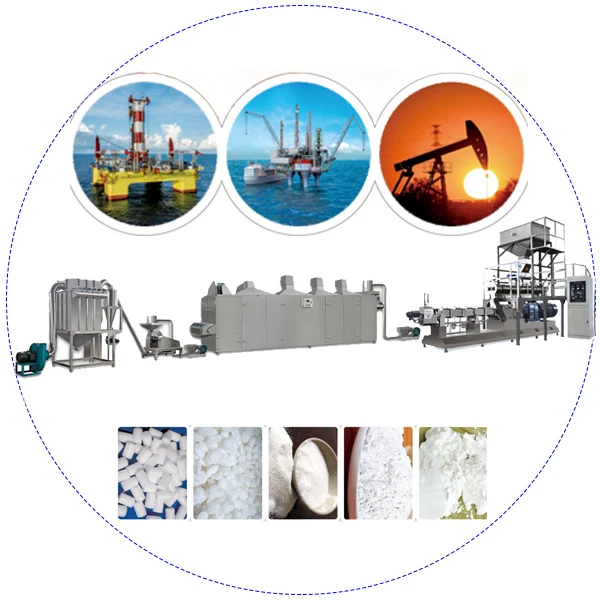
Process-Matched Extrusion — every station from batching through packing is sized to the same starch throughput so the line holds its rated output without bottlenecks.
Technical Specifications
| Parameter | Value |
|---|---|
| Product Type | Modified and Pregelatinized Starch Extrusion Line |
| Line Configuration | Twin-screw extrusion with full downstream integration |
| Raw Materials | Corn starch, cassava starch, potato starch, maize starch, tapioca starch, rice flour, soybean flour |
| Capacity Range | 150 kg/h to 2 ton/h (basis not stated in source — confirm raw material type and moisture content) |
| End Products | Modified starch, pregelatinized starch, oil drilling starch |
| Process Flow | Mixing → Extrusion → Drying → Grinding → Blending → Packing |
| Die Mechanism | High pressure double crank for controlled die opening and closing |
| Structural Design | Linear layout, sanitation-focused enclosure, no powder dust leakage |
| Pneumatic Components | Advanced world-famous brand components (specific brand to be confirmed) |
| Integration Option | Linker available to connect with air conveyor for inline filling machine |
| Control System | High automation, intellectualized operation (PLC / MCC to be confirmed) |
| Certification | CE |
Application Suitability
| Application | Material or Output |
|---|---|
| Food-grade modified starch production | Corn starch and cassava starch for bakery and sauce thickening |
| Pregelatinized starch for nutrition products | Maize starch and rice flour for instant porridge and infant formula |
| Oil drilling starch manufacturing | Tapioca starch and potato starch requiring consistent gelatinisation degree |
| Textile sizing starch processing | Modified corn and maize starch for warp yarn treatment |
| Paper making starch preparation | Cationic and oxidized starch from cassava and corn sources |
| Chemical industry starch modification | Cross-linked and esterified starch for adhesive applications |
Why the Dryer Matters More Than the Extruder Rating
A modified starch processing line that cannot dry what it extrudes will never reach its quoted output.
I worked with a buyer who invested in a pregelatinized starch extrusion machine rated for a certain throughput on paper. The extruder ran fine, but the downstream dryer was undersized for the moisture load coming off the barrel. Material backed up, residence time shortened, and the gelatinisation degree dropped below specification. The buyer spent weeks troubleshooting the screw speed and barrel temperature before anyone looked at the dryer capacity [NEED_CITE: starch gelatinisation degree measurement standards]. The root cause was a line assembled from mismatched stations rather than engineered as a single throughput-matched system. This is the hidden risk when a supplier quotes the extruder independently and leaves the drying and grinding to separate vendors.
Matching Every Station to Your Starch Type
Different starch sources behave differently under twin-screw extrusion. Corn starch gelatinises at a different temperature window than cassava starch, and potato starch carries more inherent moisture that changes the drying load downstream. A modified starch processing line must account for these raw material variables at every station, not just the extruder barrel. When the mixing system delivers inconsistent moisture distribution, the extruder receives fluctuating feed and the die output varies in density. Our approach is to calculate the water evaporation load from the extruder exit and size the dryer to handle that specific thermal duty, rather than selecting a standard dryer model from a catalogue.
Screw Configuration and Die Design for Starch Modification
The screw profile determines shear intensity, residence time, and the degree of starch granule disruption inside the barrel. For pregelatinized starch destined for instant food applications, the screw elements must generate enough mechanical energy to fully rupture the granules without degrading the polymer chains. For modified starch used in oil drilling, the requirement shifts toward controlled cross-linking that demands a different temperature profile along the barrel zones [NEED_CITE: twin-screw extrusion shear and temperature control in starch processing]. The die mechanism on this line uses a high pressure double crank system to control die opening and closing, which maintains consistent pressure at the die face and prevents surging that would create uneven particle size after grinding.
How the Barrel and Die Parameters Translate to Product Quality
The twin-screw configuration allows operators to rearrange screw elements for different starch sources without replacing the entire screw assembly. When processing tapioca starch, which has a lower gelatinisation onset temperature than corn starch, the barrel heating zones can be set to a gentler gradient to avoid premature gelatinisation before the material reaches the die. The linear structural design keeps all stations accessible for cleaning between product changeovers, which is critical when a single line runs both food-grade and industrial-grade starch grades. The sanitation-focused enclosure prevents powder dust leakage during the grinding and blending stages, protecting both the product and the workshop environment. Control automation allows recipe parameters — screw speed, barrel temperature zones, feed rate — to be stored and recalled for repeatable batch-to-batch consistency across different starch formulations.
The Cost of Skipping the Trial Run
Buyers who skip raw material trials before shipment often discover after installation that their specific starch source — perhaps a local cassava variety with higher fibre content — does not behave like the supplier’s test material. The screw configuration that worked perfectly at the factory produces incomplete gelatinisation on the buyer’s actual feedstock. Commissioning stretches from days into weeks while the supplier ships replacement screw elements overseas [NEED_CITE: industrial equipment commissioning delays from raw material mismatch]. In some cases the dryer cannot handle the higher moisture content of the local starch, and the entire line must be re-balanced. These are not warranty issues; they are specification gaps that a pre-shipment trial would have exposed and resolved.
Why Procurement Starts with the Process Flow
Every modified starch processing line we configure begins with the buyer’s raw material sample and target product specification, not a catalogue selection. The twin-screw extrusion expertise across starch applications means the screw profile and die geometry are specified to match the buyer’s corn, cassava, potato, or tapioca source rather than copied from a generic build. The in-house testing workshop runs the buyer’s actual starch through the extruder before shipment, generating a trial run report that confirms gelatinisation degree, throughput, and product texture. Complete documentation covers line layout, capacity calculation, screw configuration record, electrical schematic with voltage confirmation, and CE declaration of conformity. The process flow from mixing through packing is engineered as a single system so that no station bottlenecks another, and the air conveyor linker enables inline connection to filling equipment when required.
Documentation & Verification
- Line layout and throughput calculation showing matched capacity at every station for your starch type
- Screw and die configuration record specific to your raw material and target starch application
- Trial run report on your actual starch sample from our in-house testing workshop before dispatch
- Electrical schematic with confirmed voltage, frequency, and control language for your facility
- CE declaration of conformity and factory test record documenting pre-shipment performance
Installation, Commissioning & Support
- Linear layout design allows staged installation aligned with your workshop floor plan and utility routing
- Electrical schematic provided for local electrician to prepare dedicated circuits matching confirmed voltage and frequency
- Barrel zones and die mechanism calibrated during commissioning using your raw material for target gelatinisation degree
- PLC or MCC control parameters set and recipe storage configured for your starch formulations during on-site training
- Wear parts list including screw elements and die plates supplied with recommended replacement intervals
What We Need to Configure Your Line
To engineer a modified starch processing line that performs on your actual material, please share the starch source you will be processing, the target end-product specification including required gelatinisation degree or modification type, and your expected hourly output. We also need to know the voltage and frequency at your facility and whether you have existing upstream mixing or downstream packing equipment that the new line must integrate with. If you can send a sample of your raw starch material, we will run it in our testing workshop and provide a trial report before any commitment.
Frequently Asked Questions
Q: How is the capacity of a modified starch extrusion line verified?
A: Capacity depends on the specific starch source, its moisture content, and the target gelatinisation degree. We verify throughput by running the buyer’s actual raw material in our testing workshop, measuring output at the extruder die and confirming that every downstream station — dryer, grinder, blender — can handle that volume without creating a bottleneck.
Q: How are screw and die configurations selected for different starch types?
A: Corn, cassava, potato, and tapioca starches each have distinct gelatinisation temperatures and shear sensitivity. We select screw element arrangements and die geometry based on the buyer’s specific starch source and the required end-product properties, then validate the configuration during the pre-shipment trial run on the actual material.
Q: What supporting equipment is matched to the extruder?
A: The dryer is sized to the moisture evaporation load exiting the extruder, the grinder is selected for the target particle size distribution, and the blender handles additive incorporation. An air conveyor linker is available for inline connection to filling machines. Every station is throughput-matched to prevent bottlenecks across the line.
Q: What electrical and control details are confirmed before shipment?
A: We confirm voltage, frequency, and control language with the buyer before production begins. The electrical schematic reflects the target market’s standards, and the control system — whether PLC or MCC — is configured with stored recipes for the buyer’s specific starch formulations to ensure repeatable operation from day one.
Q: Can I send my raw material for a trial run before the line ships?
A: Yes. Our in-house testing workshop is equipped to process customer-supplied starch samples through the configured extruder and downstream equipment. The trial run report documents throughput, gelatinisation degree, and product texture on your actual material, allowing any screw or temperature adjustments to be made before the line leaves the factory.