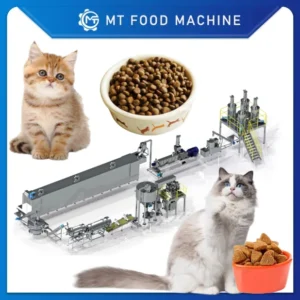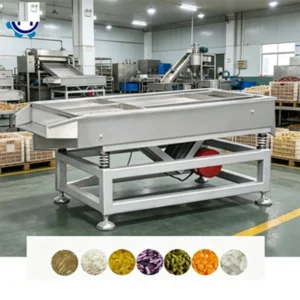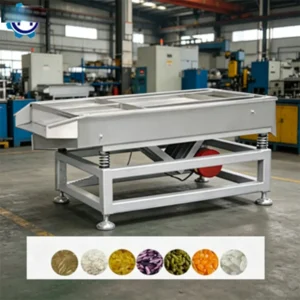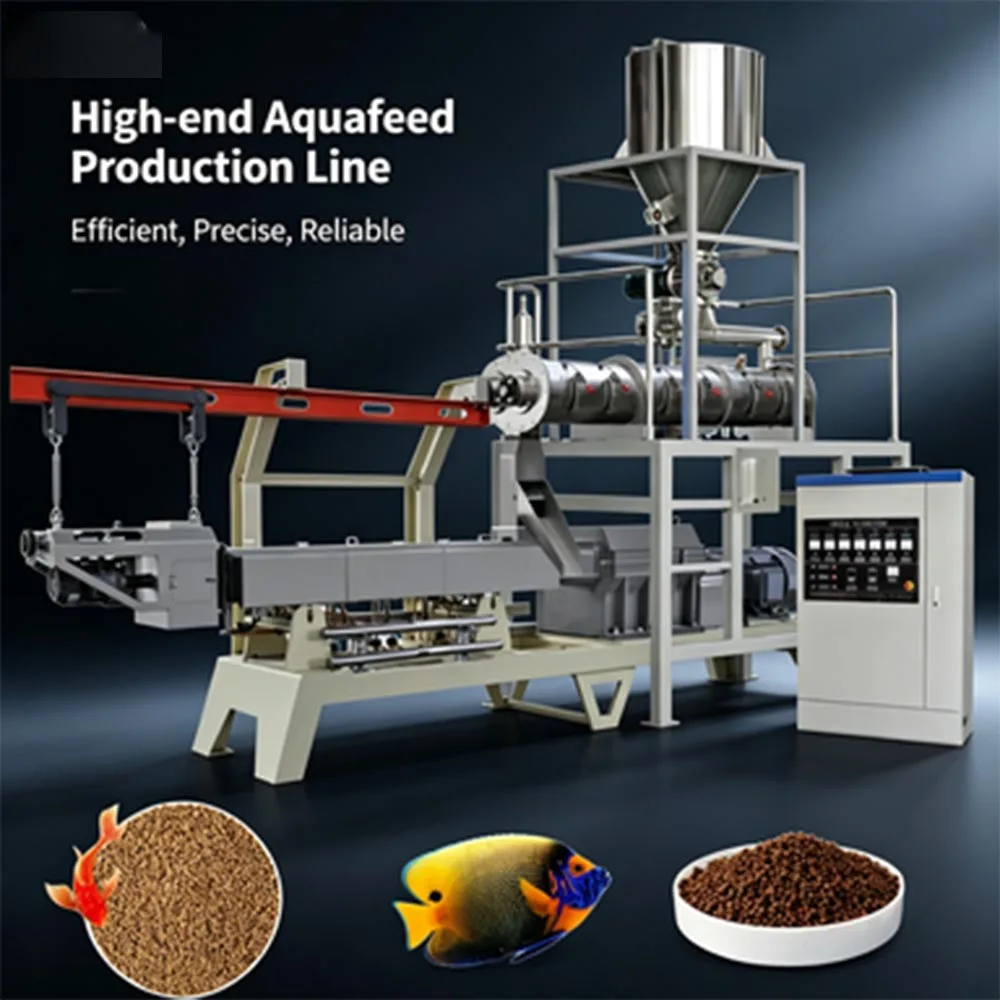
Throughput Matched Across Stations — every mixing, extrusion, drying, flavoring, and conveying unit is calculated against the same target output, so no single station bottlenecks the rest of your aquatic feed line.
Technical Specifications
| Parameter | Value |
|---|---|
| Product Type | Fish Feed Flavoring and Coating Machine |
| Control System | PLC automatic control system |
| Construction Material | Food grade 304 stainless steel (machine body and material contact parts) |
| Assembly State | Complete matched production line configuration (raw material mixer, extruder, dryer, seasoning coating machine, vibrating sieve, conveyor equipment) |
| Automation Level | Full continuous automatic production from raw material mixing to finished product discharging |
| Output Capacity | Large stable processing capacity for medium to large scale industrial production (basis not stated in source — confirm pellet size / formulation / moisture content) |
| Operating Mode | Continuous long time uninterrupted operation |
| Energy Design | Optimized energy saving transmission structure and heating system |
| Maintenance Design | Humanized operation interface, quick replacement of vulnerable parts |
| Standards | CE, ISO |
Application Suitability
| Application | Material or Output |
|---|---|
| Floating aquatic feed pellet seasoning and oil coating | Fish meal, soybean meal, corn powder, compound additives |
| Sinking aquatic feed pellet flavoring | Formulated compound feed for catfish, tilapia, shrimp |
| Ornamental and freshwater fish feed production | Pellets for koi, goldfish, tropical fish species |
| Medium to large scale commercial fish feed mass production | Continuous industrial output matched to extruder and dryer throughput |
Why Coating Capacity Must Match the Extruder Before You Sign Anything
A flavoring drum that cannot keep pace with upstream output creates a choke point that stalls the entire line.
I spent years running installation and commissioning across Latin America, and one of the most common failures I witnessed was a seasoning station that simply could not swallow what the extruder and dryer were pushing toward it. In Colombia, an aquaculture feed producer added a standalone coating unit to an existing line without recalculating throughput ratios. On the first production day, pellets backed up at the drum inlet, the line shut down, and it took two days to re-engineer the material flow. That kind of mismatch is not a mechanical defect — it is a planning failure. When you specify a Fish Feed Flavoring Coating Machine full equipment range, the calculation has to start from the extruder’s actual output on your specific raw material, not a nameplate number. [NEED_CITE: throughput matching principles for continuous extrusion lines]
How Throughput Matching Works Across the Coating Sequence
The extruder pushes wet, expanded pellets into the dryer, and the dryer releases them at a steady mass flow rate that depends on moisture reduction and residence time. The seasoning and oil spraying station must accept that exact flow rate continuously, neither starving nor overflowing. A PLC automatic control system ties every station’s motor speed and conveyor rate together so that when the extruder ramps up, the coating drum and downstream vibrating sieve follow in sequence. This is the core logic behind specifying a Fish Feed Flavoring Coating Machine full equipment range as a coordinated set rather than assembling individual units from separate vendors.
What Happens Inside the Seasoning and Oil Spraying Zone
Pellets enter the rotating drum where atomized oil and liquid flavoring are applied through calibrated spray nozzles. The food grade 304 stainless steel construction ensures that contact surfaces resist corrosion from fish oils and acidic flavoring compounds, which is critical when running high-fat aquatic formulations over long shifts. The drum’s rotational speed and tilt angle determine coating uniformity, and the PLC system stores recipes so operators can switch between floating and sinking pellet formulations without manual recalibration. Consistent coating coverage matters because uneven oil distribution changes pellet buoyancy and palatability in the water column — a parameter that aquaculture buyers check on every delivery. [NEED_CITE: oil absorption uniformity standards for extruded aquaculture feed]
Reading the Specs That Actually Affect Your Line
The PLC automatic control system is not just a screen — it governs the interlock logic between the mixer, extruder, dryer, and coating drum, meaning a fault at any station triggers a sequenced shutdown rather than a pile-up. Food grade 304 stainless steel in all material contact zones is a baseline requirement for feed destined for export markets with strict contamination thresholds. The optimized energy saving transmission structure reduces the continuous power draw during long production runs, which matters when a facility operates two or three shifts daily. Quick replacement design for vulnerable parts — spray nozzles, drum liners, conveyor belts — means maintenance windows stay measured in minutes rather than hours.
The Hidden Cost of Specifying Stations Independently
When a buyer sources the extruder from one supplier and the coating drum from another, nobody owns the throughput gap between them. The extruder vendor quotes a nominal capacity that assumes ideal downstream conditions, and the coating vendor rates the drum on a generic pellet that may not match your formulation’s density or surface porosity. The result is a line that technically runs but never reaches the output either machine promised on paper. In my field experience, resolving this after installation costs far more in lost production time and retrofit engineering than getting the line layout and capacity calculation right before the purchase order is signed. [NEED_CITE: industrial line integration failures from mismatched station throughput]
Why Procurement Through This Equipment Range Differs
Every station from raw material mixing through extrusion, drying, seasoning, screening, and conveying is specified under one supplier, which eliminates the throughput gap problem at the design stage rather than on your factory floor. Screw configuration and die design are matched to your raw material before the extruder is built, so the pellets arriving at the coating drum already meet the density and surface texture the seasoning process requires. An in-house testing workshop runs trial production on your actual raw material before shipment, generating a report that confirms coating behavior under real conditions. Pre-sales consultation covers line layout and utility planning, so floor space, power drops, and material flow paths are resolved before equipment arrives. Ongoing maintenance support includes a documented wear parts list specific to your line configuration.
Documentation & Verification
- Line layout and capacity calculation confirming throughput matching from mixer to coating station
- Machine specification sheet with screw and die configuration matched to your aquatic feed formulation
- Trial run report produced on your raw material in the testing workshop before shipment
- Electrical schematic with voltage, frequency, and control language confirmed for your facility
- CE declaration of conformity and ISO certificate included with shipping documentation
Installation, Commissioning & Support
- Foundation and floor space planning based on the full line footprint including the coating drum and vibrating sieve
- Power supply verification for PLC control system voltage and frequency before electrical connection
- Assembly and alignment of all conveyor transfer points between dryer discharge and seasoning drum inlet
- First-run parameter setting for oil spray rate, drum speed, and coating residence time on your formulation
- Operator training covering PLC interface navigation, recipe storage, and fault response sequences
- Wear parts list identifying spray nozzles, drum liners, and belt sections with reorder intervals
What to Include in Your Inquiry
Provide the specific aquatic feed formulation you intend to run, including raw material percentages and target pellet diameter, so the line can be configured around actual material behavior rather than generic assumptions. State your facility’s voltage, frequency, and preferred control language to avoid commissioning delays. Share your available floor space and ceiling height so the line layout accounts for every station from mixer to packing, and indicate whether you want a trial run on your raw material before shipment.
Frequently Asked Questions
Q: How is throughput matched between extruder, dryer, and flavoring coating stations?
A: Each station’s capacity is calculated against the extruder’s actual output on your raw material, not a nameplate figure. The PLC control system links motor speeds and conveyor rates across all stations so material flow remains balanced during continuous operation, preventing bottlenecks at the seasoning drum or vibrating sieve.
Q: What raw material formulations have been tested on this line configuration?
A: The testing workshop runs trial production on formulations containing fish meal, soybean meal, corn powder, and compound additives. The trial run report documents pellet density, coating absorption, and buoyancy behavior so you can verify performance against your market specification before the line ships.
Q: Which stations are included and where does each fit in the production sequence?
A: The full range covers raw material mixing, twin-screw extrusion, drying, seasoning and oil coating, vibrating screening, and conveying to packing. Each station is positioned in the layout so material transfers without manual intervention, and throughput is matched at every transfer point.
Q: How do I verify capacity claims against my specific pellet size and formulation?
A: Request the line layout and capacity calculation document, which states throughput based on your pellet diameter, formulation, and target moisture content. A trial run on your raw material in the testing workshop provides physical evidence before you commit to shipment.
Q: What supporting equipment options are available for different production scales?
A: The line can be configured with different extruder sizes, dryer lengths, and coating drum diameters to match your target output. The PLC control system scales across configurations, and the quick replacement design for vulnerable parts remains consistent regardless of line size.