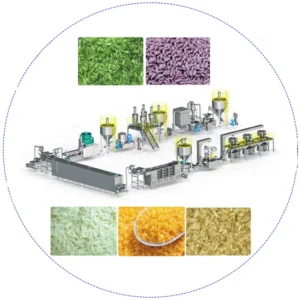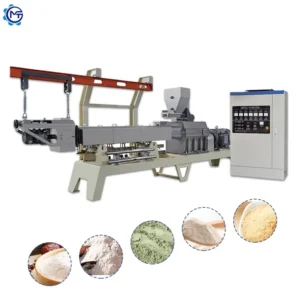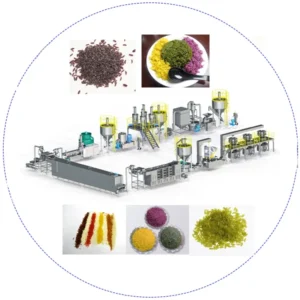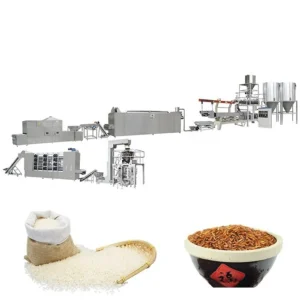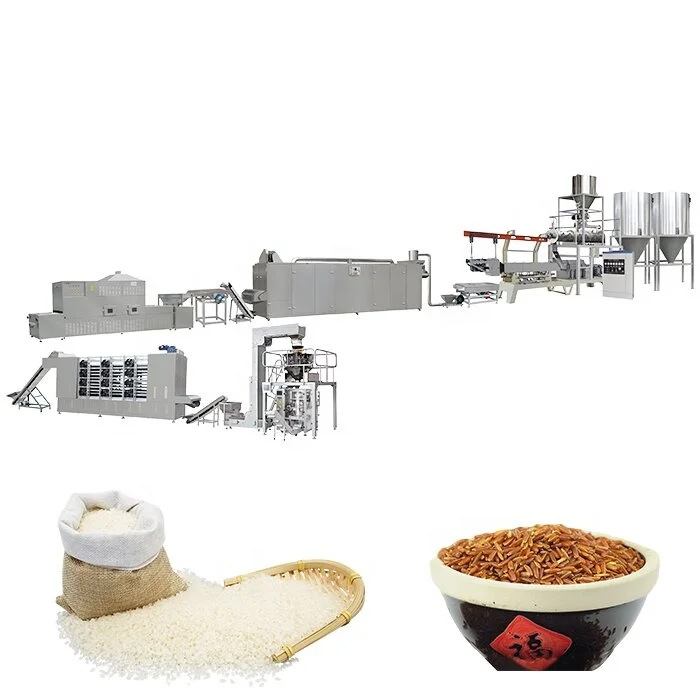
Throughput-Matched Stations — Every machine in the fortified artificial rice processing line, from mixer to packer, is sized against the extruder’s actual output on your grain formulation rather than assembled from a generic catalog.
Technical Specifications
| Parameter | Value |
|---|---|
| Model | MT65 |
| Product Type | Fortified Artificial Rice Extrusion Line |
| Screw Type | Twin-screw |
| Installed Power | 85 kW |
| Power Consumption | 60 kW |
| Output Capacity | 80–100 kg/h (basis not stated in source — confirm raw material and moisture) |
| Overall Dimensions (L×W×H) | 28 × 1.2 × 2.2 m |
| Control System | Frequency speed control with high automation |
| Lubrication | Automatic lubricating and cooling system |
| Feeding System | Single or double screw feeding (matched to material) |
| Heating Source (Dryer) | Electric or gas |
| Dryer Feature | Circulation drying with mesh belt speed controlled by frequency motor |
| Line Capacity Range | 100–1000 kg/h across model series (basis not stated in source — confirm raw material and formulation) |
| Certification | CE |
Application Suitability
| Application | Material or Output |
|---|---|
| Fortified rice kernel production | Broken rice, rice flour, corn, millet with vitamin and mineral additives |
| Artificial rice manufacturing | Wheat, oats, buckwheat, bean, starch-based formulations |
| Institutional nutrition programmes | Grain blends enriched with micro-nutrients for government and NGO distribution |
| Value-added grain processing | Rice bran and broken rice converted into uniform, reconstitutable kernels |
Why Dryer Capacity Decides Your Real Output
A 100 kg/h extruder fed into an undersized dryer is a 60 kg/h line.
I have watched buyers focus every negotiation hour on extruder throughput, only to discover during commissioning that the drying oven cannot pull moisture down fast enough. The mesh belt piles up, kernels stick together, and the line stalls while product backs up on the vibrating conveyor. With a fortified artificial rice machine full equipment range, the dryer, cooler, and packing station are each calculated against the extruder’s actual discharge rate on your specific grain blend, so the bottleneck stays where you designed it — nowhere. [NEED_CITE: moisture removal rate and residence time correlation in mesh belt dryers]
Station-by-Station Equipment Overview
The fortified artificial rice machine full equipment range begins with a batching and mixing station where base grains and micro-nutrient premix are blended to a uniform moisture content before entering the extruder feed hopper. The frequency-controlled feeding system — available as single or double screw depending on material flow characteristics — meters material into the barrel at a consistent rate, which is critical when working with vitamin-fortified blends that segregate if handled roughly.
Downstream, the twin-screw extruder discharges shaped kernels onto a vibrating conveyor that separates them before they enter the circulation drying oven. The mesh belt speed is adjusted through a frequency motor, letting operators fine-tune residence time to hit the target final moisture without case-hardening the kernel surface.
How the Drying and Cooling Sequence Protects Kernel Integrity
After the initial low-temperature drying stage, kernels pass through a cooling section before entering a high-temperature roasting zone, followed by a second cooling pass. This four-stage thermal profile prevents internal stress cracking that would cause kernels to shatter during packing and transport. Each cooling station uses ambient or forced air matched to the product temperature leaving the preceding stage, so thermal shock is avoided.
The entire thermal sequence is sized so that the cumulative residence time across dryer and cooler matches the extruder discharge rate. When a buyer specifies a higher-output model from the series, the dryer belt width and length, as well as the cooler conveyor dimensions, scale proportionally. [NEED_CITE: thermal stress cracking in extruded grain kernels during rapid cooling]
Reading the Specs That Actually Matter
The 85 kW installed power and 60 kW operating consumption reflect the combined load of the extruder main motor, feeding system, lubrication pump, and dryer heating elements under typical running conditions. When you compare across model sizes in the series, the ratio of installed to consumed power indicates how much headroom the drive system has for denser formulations — a line running high-fiber oat blends will draw closer to installed capacity than one processing pure rice flour.
The automatic lubricating and cooling system circulates oil through the gearbox and barrel jacket independently. This matters for fortified rice production because the mineral premix is abrasive; inadequate lubrication accelerates screw and barrel wear, shifting the clearance and changing kernel density over a production run. The twin-screw configuration itself provides self-wiping action, reducing residue buildup between batches of different formulations.
The Hidden Cost of Mismatched Stations
When stations are sourced from different vendors, nobody owns the throughput calculation. The extruder supplier quotes based on their machine alone, the dryer vendor sizes to their standard catalog, and the packing line arrives rated for a completely different speed. I have seen lines where the packing station sat idle half the shift because the upstream dryer could not deliver dry product fast enough. The result is not just lost output — operators start and stop the extruder repeatedly, which creates off-spec kernels during each ramp-up. [NEED_CITE: production loss from repeated extruder start-stop cycles]
Why Source the Full Range From One Supplier
Every station in the fortified artificial rice machine full equipment range is configured under a single line layout, meaning throughput, utility connections, and control signals are reconciled before fabrication begins. Screw and die configurations are selected against your actual grain formulation, not copied from a standard build file. The in-house testing workshop runs your raw material before shipment, so parameters like barrel temperature profile and moisture addition rate are locked in rather than discovered on your floor. Electrical schematics confirm voltage, frequency, and control language for the destination market before the panel is wired. Pre-sales consultation, on-site installation, commissioning, and ongoing maintenance are handled by the same technical team that built the line.
Documentation & Verification
- Line layout and capacity calculation confirming throughput match across mixing, extrusion, drying, and packing stations
- Screw and die configuration record specifying geometry matched to your grain and premix formulation
- Electrical schematic with voltage and frequency confirmed for destination market
- Trial run report on customer raw material documenting moisture, temperature, and output data
- CE declaration of conformity covering the complete assembled line
- Operation and maintenance manual with lubrication intervals and wear part replacement procedures
Installation, Commissioning & Support
- Floor plan and utility layout provided based on the 28 × 1.2 × 2.2 m line footprint and local building constraints
- Dedicated electrical circuit sized for 85 kW installed load with correct voltage and frequency for the target market
- Stations shipped in modular sections for assembly on-site, with alignment verified during commissioning
- First-run parameter setting on your grain formulation, locking screw speed, barrel temperature, and dryer belt speed
- Operator training covering feeding system adjustment, lubrication system monitoring, and mesh belt tensioning
- Wear parts list specifying screws, dies, and mesh belts with lead times for reorder
Before You Request a Quote
Share your base grain type, the specific vitamin or mineral premix you intend to add, and your target daily output so we can recommend the correct model from the series. Confirm your facility voltage, frequency, and preferred control language. If you have existing upstream milling or downstream packing equipment, provide model details so the line interfaces correctly. Let us know whether you can ship a sample of your raw material for a pre-shipment trial run in our testing workshop.
Frequently Asked Questions
Q: Which model size fits my target output and raw material formulation?
A: The series covers a broad capacity range, but actual throughput depends on your grain type, moisture content, and premix ratio. We calculate the correct model by running your formulation data through our line capacity sheet and, when possible, confirming with a trial run on your actual material before final recommendation.
Q: How is dryer capacity matched to the extruder to avoid line bottlenecks?
A: We size the dryer belt length, width, and airflow volume against the extruder’s discharge rate on your specific formulation. The circulation drying oven uses a frequency-controlled mesh belt, so residence time is adjustable within a designed window, but the physical oven dimensions are set to handle peak extruder output without product buildup.
Q: What voltage, frequency, and control language options are available for each station?
A: Every station’s electrical panel is built to match the destination market’s supply standard. Voltage, frequency, and control interface language are confirmed during the specification stage before wiring begins. This prevents commissioning delays caused by incompatible motor ratings or unreadable HMI screens on the factory floor.
Q: Can individual stations be ordered separately, or only as a complete line?
A: Individual stations can be supplied, but throughput matching and control integration are designed around the full line. When a single station is ordered, we still verify compatibility with your existing upstream and downstream equipment to ensure it fits the production rate without creating a new bottleneck.
Q: What spare wear parts are included and how are replacements sourced?
A: The initial shipment includes a wear parts list covering screws, dies, and dryer mesh belts specific to your configuration. Replacement parts are manufactured to the same specification and can be ordered directly. We recommend stocking critical wear items based on your annual operating hours and material abrasiveness.