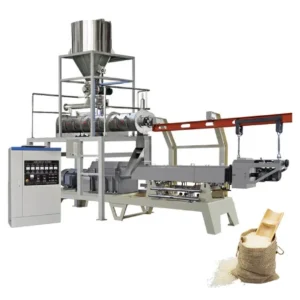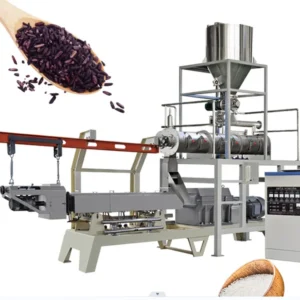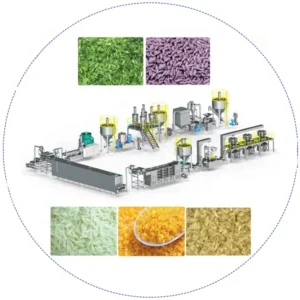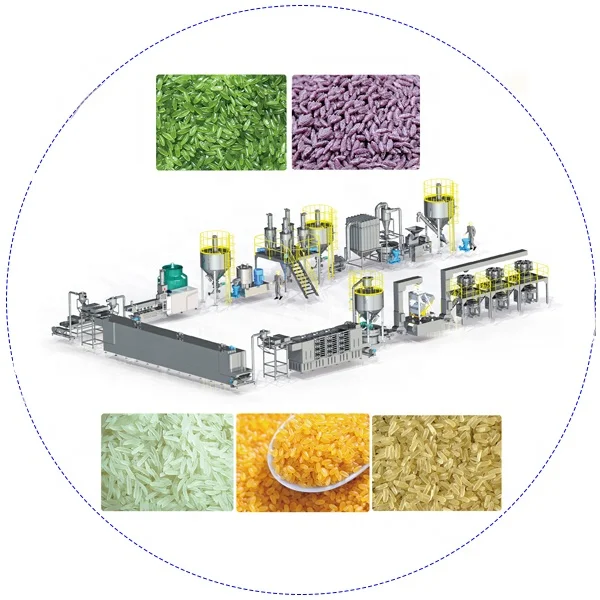
Matched Throughput Across Stations — Every mixer, extruder, dryer and packing unit in the fortified rice kernel extrusion line full equipment range is sized so no single machine chokes the output of another.
Technical Specifications
| Parameter | Value |
|---|---|
| Product Type | Fortified Rice Kernel Extrusion Line |
| Model Range | MT65 / MT70 / MT85 / MT75 / MT95 |
| Installed Power | 85 kW (MT65) / 120 kW (MT70) / 180 kW (MT75) / 235 kW (MT85) / 260 kW (MT95) |
| Power Consumption | 60 kW (MT65) / 85 kW (MT70) / 135 kW (MT75) / 165 kW (MT85) / 195 kW (MT95) |
| Output Capacity | 80–100 kg/h (MT65) / 100–120 kg/h (MT70) / 300–500 kg/h (MT75) / 200–300 kg/h (MT85) / 800–1000 kg/h (MT95) (basis not stated in source — confirm raw material formulation, moisture content and kernel size) |
| Overall Dimensions (L×W×H) | 28×1.2×2.2 m (MT65) / 30×1.5×2.2 m (MT70) / 32×3.5×4.3 m (MT75) / 34×3.5×4.3 m (MT85) / 36×3.5×4.3 m (MT95) |
| Screw Type | Twin-screw |
| Feeding System | Single or double screw feeding selectable |
| Screw Material | Wear-resistant alloy |
| Dryer Type | Circulation mesh-belt drying oven |
| Dryer Heating Source | Electric or gas |
| Control System | Frequency speed control, automatic lubricating and cooling |
| Certifications | CE, ISO |
Application Suitability
| Application | Material or Output |
|---|---|
| Nutritional rice kernel production | Broken rice, rice flour, corn, millet blended with vitamin and mineral premix |
| Artificial rice for food aid programmes | Rice bran and cereal grains reconstituted into uniform grain-shaped kernels |
| Fortified rice for commercial retail | Wheat, oats, buckwheat and bean flour with micro-nutrient additives |
| Reconstituted rice for institutional catering | Starch-based formulations shaped into consistent rice kernels |
Why Dryer Capacity Matters More Than Extruder Output on a Fortified Rice Kernel Extrusion Line Full Equipment Range
An undersized dryer turns a high-output extruder into a very expensive bottleneck.
I have watched lines where the extruder was pushing product faster than the mesh-belt dryer could reduce moisture, and within an hour the conveyor was piling up wet kernels that clumped together and cracked during roasting. The crew ended up running the extruder at half speed just to keep the dryer from jamming, which means you paid for capacity you never actually use. Matching throughput at every station — mixer, extruder, vibrating screen, dryer, roaster, cooler and packing — is what keeps a fortified rice kernel extrusion line full equipment range running at its rated output without constant intervention [NEED_CITE: matching station throughput in continuous food processing lines].
Every Station Sized to the Same Throughput Target
The fortified rice kernel extrusion line full equipment range is laid out so that each piece of equipment — from the batching mixer through the twin-screw extruder, vibrating separator, low-temperature dryer, high-temperature roaster, cooler and packing scale — handles the same mass flow rate. When one station is undersized, it dictates the speed of the entire line. The specification sheet for each model lists extruder output alongside the matched dryer belt area and roaster dwell time, so you can verify alignment before the order is placed rather than discovering a mismatch during commissioning.
Feeding Configuration Matched to Material Behaviour
Different formulations behave differently in the hopper. A blend heavy in broken rice and starch tends to bridge and rat-hole in a standard single-screw feeder, while a formulation with added oils or liquid vitamins may flood through too quickly. The option to select single or double screw feeding on this line addresses that variability. Double-screw feeding provides positive displacement for sticky or cohesive blends, keeping material flow into the extruder barrel steady. When flow fluctuates, the extruder motor load swings, which changes shear and temperature inside the barrel — and that shows up as inconsistent kernel density and shape downstream.
How Extruder Power and Screw Design Shape the Final Kernel
The installed power across the model range scales with barrel volume and screw diameter, from 85 kW on the MT65 to 260 kW on the MT95. In twin-screw extrusion of rice-based formulations, the mechanical energy input determines the degree of starch gelatinisation, which directly controls how well the extrudate holds its rice-grain shape after cutting. Insufficient gelatinisation produces fragile kernels that shatter during drying; excessive shear can over-expand the dough so the kernels look puffed rather than rice-like. The wear-resistant alloy screws maintain their flight profile over extended runs, which matters because even small changes in the gap between screw flights and barrel liner alter the shear history of the material [NEED_CITE: twin-screw extrusion shear and starch gelatinisation in cereal processing].
The Cost of Skipping Trial Runs Before Shipment
When a fortified rice line arrives at your factory and the first production run comes out wrong — kernels splitting open in the dryer, or moisture content too high after the roasting stage — the clock starts ticking on your launch deadline. Adjusting screw combinations, die geometry and drying temperatures on-site takes time you did not budget for. A pre-shipment trial on your actual formulation, run in the manufacturer’s testing workshop, surfaces these issues before the machines are crated. The trial run report gives you a documented baseline of screw configuration, barrel temperature profile and drying parameters that matched your material, so installation day starts with settings that already work.
What Makes Sourcing the Full Line from One Supplier Different
Every station on the fortified rice kernel extrusion line full equipment range is selected and matched by the same engineering team, so the dryer belt width, roaster chamber volume and cooler airflow are calculated against the extruder output for each specific model. The screw configuration and die design are specified to your raw material formulation rather than copied from a generic build. An in-house testing workshop allows your formulation to be run before shipment. Electrical schematics and voltage are confirmed against your factory supply before production begins, reducing the chance of commissioning delays. Documentation covers line layout, capacity calculation, trial run report and wear parts list — everything needed for your own quality records and import clearance [NEED_CITE: CE machinery directive documentation requirements for food processing equipment].
Documentation & Verification
- Line layout drawing showing station sequence and footprint dimensions for your factory floor plan
- Capacity calculation sheet matching each extruder model to its paired dryer and roaster
- Screw and die configuration record tied to your specific raw material blend
- Trial run report produced on your formulation in the testing workshop before dispatch
- Electrical schematic with voltage and frequency confirmed for your local supply
- Wear parts list identifying screws, dies and mesh belts with reorder references
Installation, Commissioning & Support
- Foundation load and floor space based on the overall line dimensions of your selected model configuration
- Dedicated power circuit sized to the installed power draw, from 85 kW to 260 kW depending on model
- Frequency-controlled motors on feeder, extruder and dryer require stable voltage and frequency supply
- Initial barrel temperature and screw speed parameters set from trial run baseline during commissioning
- Operator training covers feeding system selection, screw wear inspection and mesh-belt tension adjustment
- Wear parts stock includes screws, dies and dryer belts matched to your model
What to Include With Your Inquiry
Provide your raw material formulation — including the ratio of broken rice, cereal grains and any vitamin or mineral premix — along with your target kernel size and daily output requirement. Share your factory voltage, frequency and available floor area so the line layout can be drawn to fit. If you have existing upstream milling or downstream packing equipment, note the connection points so the new stations can be matched to your current material handling.
Frequently Asked Questions
Q: How is capacity verified for each extruder model and what conditions must be stated?
A: The output figures for each model are tied to specific raw material formulations, moisture content and kernel dimensions. Before a capacity commitment is made, your actual blend is run in the testing workshop and the result is documented in a trial run report. This ensures the quoted throughput reflects your material, not a generic rice flour benchmark.
Q: Which supporting stations are matched to each extruder model?
A: Each extruder model is paired with a dryer, roaster and cooler sized to handle the same mass flow. The mesh-belt dryer area, roaster chamber volume and cooler airflow are calculated from the extruder output so that no station becomes a bottleneck. The line layout proposal shows these pairings clearly.
Q: What voltage and frequency options are available for different markets?
A: Voltage and frequency are confirmed during the specification stage before production begins. The control system and all frequency-controlled motors are configured to match your factory supply. Electrical schematics are provided with the confirmed values so your electrical contractor can prepare the connection before the machines arrive.
Q: Can the feeding system be adjusted to our material characteristics?
A: The feeding system is available in single or double screw configuration. Cohesive blends with high starch or added oils typically require double-screw feeding for consistent material flow into the extruder barrel. The selection is made based on your formulation during the line design phase and confirmed during the pre-shipment trial run.