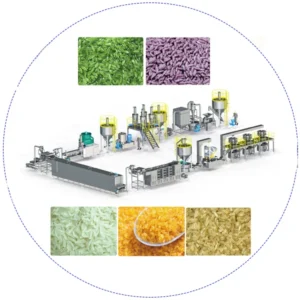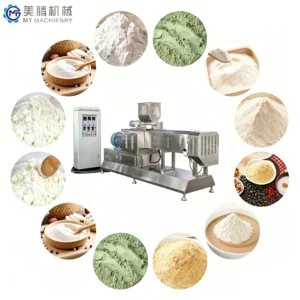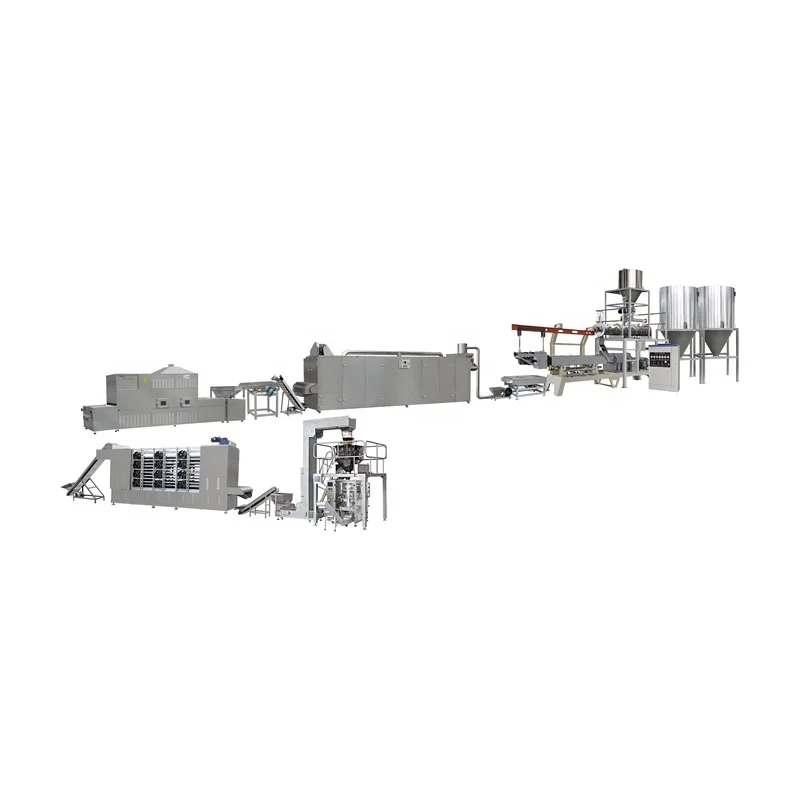
Screw configuration matched to your grain formulation — Every fortified rice kernel making machine full equipment range ships with screw and die geometry specified against the buyer’s actual starch-to-protein ratio, not pulled from a generic build sheet.
Technical Specifications
| Parameter | Value |
|---|---|
| Product Type | Fortified Rice Kernel Production Line |
| Models Available | MT65, MT70, MT85, MT75, MT95 |
| Screw Type | Twin-screw with single or double screw feeding system based on material |
| MT65 Installed Power | 85 kW |
| MT65 Actual Power Consumption | 60 kW |
| MT65 Capacity | 80–100 kg/h (basis not stated in source — confirm raw material formulation and moisture) |
| MT65 Dimensions (L×W×H) | 28 × 1.2 × 2.2 m |
| MT70 Installed Power | 120 kW |
| MT70 Actual Power Consumption | 85 kW |
| MT70 Capacity | 100–120 kg/h (basis not stated in source — confirm raw material formulation and moisture) |
| MT70 Dimensions (L×W×H) | 30 × 1.5 × 2.2 m |
| MT85 Installed Power | 235 kW |
| MT85 Actual Power Consumption | 165 kW |
| MT85 Capacity | 200–300 kg/h (basis not stated in source — confirm raw material formulation and moisture) |
| MT85 Dimensions (L×W×H) | 34 × 3.5 × 4.3 m |
| MT75 Installed Power | 180 kW |
| MT75 Actual Power Consumption | 135 kW |
| MT75 Capacity | 300–500 kg/h (basis not stated in source — confirm raw material formulation and moisture) |
| MT75 Dimensions (L×W×H) | 32 × 3.5 × 4.3 m |
| MT95 Installed Power | 260 kW |
| MT95 Actual Power Consumption | 195 kW |
| MT95 Capacity | 800–1000 kg/h (basis not stated in source — confirm raw material formulation and moisture) |
| MT95 Dimensions (L×W×H) | 36 × 3.5 × 4.3 m |
| Control System | Frequency speed control with PLC and MCC available |
| Screw Construction | Wear-resistant special processing |
| Lubrication | Automatic lubricating and cooling system |
| Drying System | Circulation drying oven with frequency motor-controlled mesh belt; electric or gas heating |
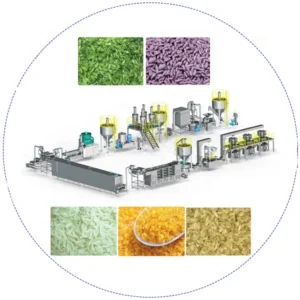
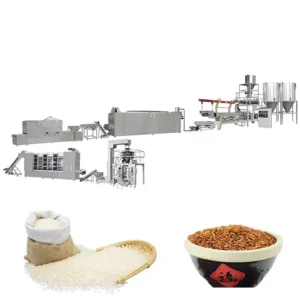
| Line Stations | Mixing → Extruding → Vibrating → Low Temperature Drying → Cooling → High Temperature Roasting → Cooling → Packing |
| Certification | CE (since 2014), ISO |
Application Suitability
| Application | Material or Output |
|---|---|
| Nutritional food programs | Fortified rice kernels from broken rice and rice bran with added vitamins and minerals |
| Grain value-added processing | Artificial rice reformed from broken rice, corn, millet, and wheat blends |
| Infant and toddler supplementation | Micronutrient-enriched rice kernels from starch-based formulations with supplemental ingredients |
| Instant and convenience food | Extruded rice kernels from buckwheat, oat, and bean mixtures for rapid-cook applications |
Why Quoted Capacity Rarely Survives Your Actual Formulation
Output figures are meaningless without the raw material recipe and moisture baseline attached to them.
A few years back I configured a line for a client doing fortified rice with a heavy pre-gelatinised starch ratio. The extruder was quoted at its nominal capacity, but the moment that high-viscosity formulation hit the barrel, die pressure spiked and we spent more time clearing blockages than running product. The actual throughput was barely half the brochure number. That gap between quoted and real output is where most grain processing projects bleed money, and it almost always traces back to a fortified rice kernel making machine full equipment range that was spec’d on a generic material profile rather than the buyer’s specific blend. When pre-gelatinised starch or added micronutrients change the rheology inside the barrel, screw element sequencing and die orifice sizing must be recalculated from scratch [NEED_CITE: starch gelatinisation behaviour under twin-screw extrusion conditions].
Every Station Sized Against the Same Throughput Target
A fortified rice kernel making machine full equipment range only holds its rated output when the dryer belt width, cooling conveyor length, and packing speed all match the extruder’s real throughput, not just its nameplate figure. On this line, the circulation drying oven runs a frequency-controlled mesh belt so residence time can be tuned to the moisture profile leaving the die. If the downstream cooler is undersized, kernels trap residual heat and crack during packing; oversize it and you burn floor space for no gain.
How the Die Plate and Moisture Profile Define Kernel Integrity
The final shape, density, and cooking behaviour of a fortified rice kernel are set at the die plate and in the first few seconds of drying. Die orifice diameter and land length control the expansion ratio, which in turn determines whether the kernel sinks or floats in a cooking pot and whether it holds its shape in a rice cooker. Moisture content entering the barrel affects starch gelatinisation uniformity across the cross-section of each kernel. Frequency speed control on the main extruder drive lets operators fine-tune screw RPM to hold consistent shear energy input batch after batch [NEED_CITE: die geometry influence on extruded rice kernel density].
Screw Geometry and Barrel Zones Decoded
Twin-screw construction gives this line the self-wiping action that single-screw extruders lack, which matters when high-starch formulations tend to stick and degrade on stagnant screw surfaces. The automatic lubricating and cooling system circulates through the gearbox continuously, reducing the thermal drift that shortens bearing service life in hot workshop environments. Wear-resistant screw processing extends the interval between element replacements, important because replacing a full screw set on a larger model like the MT95 involves significant downtime. The choice between single and double screw feeding depends on whether the raw material blend is free-flowing (broken rice grits) or cohesive (pre-mixed starch and micronutrient slurry), and this must be confirmed before production starts.
The Hidden Cost of Skipping the Trial Run
Buyers who accept shipment without a trial run on their own formulation often discover die clogging, uneven kernel colour, or poor rehydration only after installation. Reconfiguring screw elements on a machine already bolted to a factory floor takes considerably longer than doing it in the supplier’s testing workshop where spare die plates and barrel sections are on hand. When the wrong screw profile ships with the line, the buyer absorbs the cost of replacement elements, shipping delays for spares, and lost production days while the correct configuration is manufactured and dispatched [NEED_CITE: common causes of extruder die blockage in starch-rich formulations].
Why This Supplier Configuration Works
Complete line stations from mixing through packing come under one engineering responsibility, so the vibrating feeder capacity, dryer belt speed, and cooler airflow are all calculated against the selected extruder model rather than sourced independently and hoped to match. Screw and die configuration records are generated against the buyer’s specific grain formulation and documented before metal is cut. An in-house testing workshop allows trial runs on the customer’s actual raw material, meaning product development happens before the line ships rather than after it arrives. PLC and MCC control systems are specified with the target market’s voltage, frequency, and operator language confirmed in writing before production begins, avoiding commissioning delays caused by mismatched electrical standards.
Documentation & Verification
- Line layout drawing showing station-by-station throughput matching for your selected extruder model
- Screw and die configuration record tied to your specific grain and micronutrient formulation
- Electrical schematic confirming voltage, frequency, and control language for your facility
- Trial run report produced on your raw material before dispatch approval
- Factory test record with actual output measured under documented moisture and formulation conditions
- Operation and maintenance manual covering wear part replacement intervals
Installation, Commissioning & Support
- Foundation must accommodate the MT85 footprint of 34 × 3.5 m with clearance for dryer maintenance access
- Dedicated power circuit rated for the selected model’s installed power up to 260 kW on the MT95
- PLC and MCC panels arrive pre-wired; on-site connection limited to utility hook-up and sensor verification
- First-run parameter logging covers barrel temperature zones, screw RPM, and mesh belt frequency settings
- Operator training includes screw element removal sequence and die plate changeover procedure
- Wear parts list with reorder codes for screw segments, die inserts, and feeder augers
Before You Send an Inquiry
Share your grain formulation including the percentage of pre-gelatinised starch, broken rice ratio, and any micronutrient premix you plan to add. Specify the target hourly output and the moisture content range of your incoming raw material. Confirm your facility’s voltage, frequency, and preferred control interface language so the electrical package is built correctly from the start.
Frequently Asked Questions
Q: How is the output capacity of a fortified rice kernel making machine verified before purchase?
A: Capacity figures are based on specific raw material formulations and moisture levels, which vary between grain blends. We run your actual recipe through the extruder in our testing workshop and document the measured throughput, die pressure, and kernel quality in a trial run report. This gives you a verified capacity number tied to your own formulation rather than a generic estimate.
Q: What voltage and control language options are available for different markets?
A: The control system is configurable for the voltage and frequency standards of your target market, and the PLC interface language is confirmed before production. This prevents the common problem of equipment arriving with controls in an unsupported language or wired for the wrong electrical standard, which otherwise delays commissioning by weeks.
Q: How are screw elements and die plates matched to my grain formulation?
A: Screw configuration is designed around the starch-to-protein ratio, moisture content, and viscosity behaviour of your specific blend. Die orifice diameter and land length are selected to achieve the target kernel density and expansion ratio. Both are documented in a configuration record provided before production begins.
Q: What prevents downstream stations from bottlenecking the extruder?
A: Every station in the line, from the vibrating feeder through the circulation drying oven to the cooling conveyor and packing system, is sized against the same verified throughput target. The dryer mesh belt speed and cooling conveyor length are calculated to handle the extruder’s real output on your formulation, not just its nameplate capacity.
Q: Is a trial run conducted on the buyer’s raw material before shipment?
A: Yes. The buyer’s actual grain blend and micronutrient premix are run through the configured extruder in our in-house testing workshop. The trial run report documents throughput, kernel appearance, die pressure, and any screw or die adjustments made. Shipment is approved only after the buyer reviews and accepts these results.