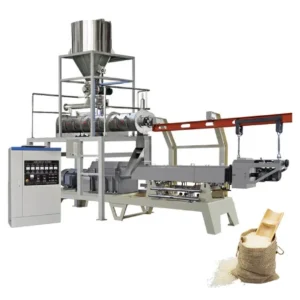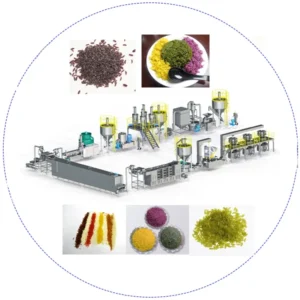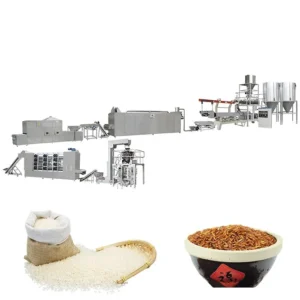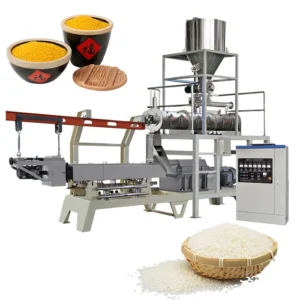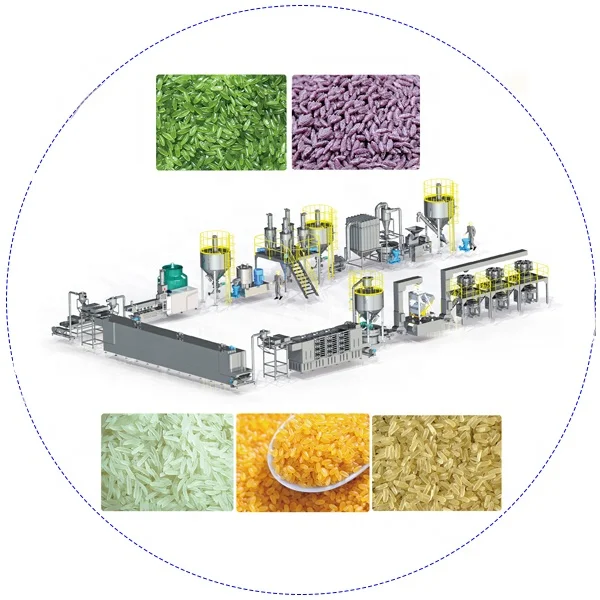
Precision-Matched Line Design — Every station from batching to packing is configured around your raw material formulation and target kernel density rather than a generic catalog build.
Technical Specifications
| Parameter | Value |
|---|---|
| Product Type | Fortified Rice Kernel Extrusion Line |
| Model Options | MT65 / MT70 / MT85 / MT75 / MT95 |
| Screw Type | Twin-screw |
| Installed Power | MT65: 85 kW; MT70: 120 kW; MT85: 235 kW; MT75: 180 kW; MT95: 260 kW |
| Power Consumption | MT65: 60 kW; MT70: 85 kW; MT85: 165 kW; MT75: 135 kW; MT95: 195 kW |
| Output Capacity | MT65: 80–100 kg/h; MT70: 100–120 kg/h; MT85: 200–300 kg/h; MT75: 300–500 kg/h; MT95: 800–1000 kg/h (basis not stated in source — confirm raw material formulation and moisture content) |
| Overall Dimensions (L×W×H) | MT65: 28×1.2×2.2 m; MT70: 30×1.5×2.2 m; MT85: 34×3.5×4.3 m; MT75: 32×3.5×4.3 m; MT95: 36×3.5×4.3 m |
| Control System | Frequency speed controlling with high automation (PLC / MCC option to be confirmed) |
| Line Stations | Mixing → Extruding → Vibrating → Low-temperature drying → Cooling → High-temperature roasting → Cooling → Packing |
| Heating Source (Dryer) | Electric or gas |
| Screw Material | Wear-resistant special alloy |
| Feeding System | Single or double screw feeding, selected based on material characteristics |
| Lubrication | Automatic lubricating and cooling system |
| Assembly State | Complete line with all stations included |
| Standards | CE certified, ISO certified |
Application Suitability
| Application | Material or Output |
|---|---|
| Fortified rice for nutrition programmes | Broken rice, corn, millet blended with vitamin and mineral premixes |
| Artificial rice from grain by-products | Rice bran, wheat, oats, buckwheat reconstituted into whole-kernel form |
| High-protein nutritional rice | Bean flour and starch bases with added protein isolates |
| Multi-grain functional rice | Mixed grain formulations including corn, millet, and oats with micro-nutrient fortification |
What "Rated Capacity" Actually Means on a Fortified Rice Kernel Production Line
The number on the quotation only holds if the screw configuration, die geometry, and dryer throughput are all matched to your specific formulation.
I once watched a nutrition programme supplier lose nearly a month of production because their line was quoted at a nominal output that assumed a standard rice-flour base. Their actual recipe included high-fibre bran and a lipid-based vitamin carrier, which changed the melt viscosity inside the barrel entirely. The extruder could not push material through the die at the rated speed, and the downstream dryer had excess capacity sitting idle. The fortified rice kernel production line equipment manufacturer had sized each station independently instead of balancing the entire chain around one formulation [NEED_CITE: extrusion throughput dependency on raw material rheology]. That mismatch between nameplate capacity and real-world output is the single most common dispute I see in grain processing line installations.
How Twin-Screw Geometry Handles Variable Grain Formulations
The twin-screw configuration on this fortified rice kernel production line provides positive displacement feeding, which matters when your blend includes ingredients with different particle sizes and flow characteristics. Broken rice, bean flour, and mineral premixes do not feed uniformly through a single-screw throat. The intermeshing screw flights wipe each other clean at every rotation, preventing material stagnation that would otherwise degrade heat-sensitive vitamins. Frequency speed controlling allows the operator to adjust screw RPM in response to real-time torque feedback when switching between formulations.
Die Design and Kernel Density Control
The final kernel shape and cooking behaviour are determined at the die plate. A fortified rice kernel production line must produce kernels that match natural rice in both appearance and density so they blend invisibly with conventional rice during distribution. Die orifice diameter, land length, and face geometry are specified to the buyer’s target kernel dimensions. The cutting mechanism at the die face must operate at a speed synchronized with extrudate velocity to maintain consistent kernel length across the production run [NEED_CITE: die land length influence on extrudate density in food extrusion].
Reading the Power and Capacity Data Across the Range
The installed power spread across the MT65 through MT95 models reflects different barrel volumes and screw diameters, not simply larger motors on the same frame. A higher installed power on the MT85 and MT95 corresponds to greater shear energy available for starch gelatinisation of dense, multi-grain formulations. Power consumption figures being lower than installed power indicates the drives are not operating at full load during steady-state running, which is normal for extrusion where peak torque occurs only during start-up and formulation changeover. The overall dimensions grow in both width and height at the MT85 and above, reflecting wider dryer belts and larger roasting chambers needed to handle increased throughput without reducing residence time.
When Station Mismatches Bottleneck the Entire Line
A line where the extruder runs at full output but the dryer cannot remove moisture fast enough forces the operator to reduce feed rate, making the actual throughput lower than any single station’s nameplate rating. I have seen installations where the roasting stage was undersized for the moisture load coming off the low-temperature dryer, causing kernels to crack from residual internal steam during packing. These problems are not visible during a factory test on standard material because the test formulation may have lower moisture content than the buyer’s actual recipe [NEED_CITE: moisture migration and kernel cracking in dried extruded grain products]. Every station must be re-checked against the specific water addition rate and drying curve your formulation demands.
Why Procurement From a Single Line Supplier Matters Here
Every station from the mixer through the packing end is supplied under one responsibility, so throughput calculations account for actual transfer losses between conveyors rather than assuming ideal conditions. Screw configuration and die design are documented against the buyer’s raw material sample rather than copied from a generic reference build. The in-house testing workshop runs your specific formulation before the line ships, catching gelatinisation and density issues at the factory instead of on your production floor. Electrical schematics and voltage specifications are confirmed against your facility’s supply before manufacturing begins, preventing commissioning delays. Wear parts lists include screw elements and die plates with replacement intervals based on the abrasiveness of your grain blend.
Documentation & Verification
- Line layout drawing showing throughput balance between extruder, dryer, and roasting stations
- Screw and die configuration record matched to your grain formulation and kernel dimensions
- Trial run report produced on your raw material sample before shipment authorization
- Electrical schematic with voltage and frequency confirmed to your facility supply
- Factory test record documenting steady-state output and kernel quality parameters
- Operation manual covering formulation changeover procedures and screw speed adjustment
Installation, Commissioning & Support
- Foundation plan based on the MT model’s overall dimensions and vibration isolation requirements
- Dedicated power circuit sized to the model’s installed power rating with correct voltage and frequency
- Modular station delivery with on-site assembly sequence for dryer and roasting chamber alignment
- First-run parameter setting including screw RPM, barrel temperature zones, and dryer residence time
- Operator training on frequency speed adjustment and die cutting synchronization for kernel consistency
- Wear parts inventory with replacement schedule for screw elements and die plates based on your grain blend
Preparing Your Inquiry for Accurate Line Sizing
To get a line configuration that reflects your actual production conditions rather than a generic quotation, share your base grain materials and their ratios, the type and percentage of vitamin or mineral premix you intend to add, your target daily output, and the voltage and frequency at your facility. If you have an existing packing system upstream or downstream that the line must integrate with, include its throughput range and connection dimensions.
Frequently Asked Questions
Q: How is output capacity verified against my specific grain blend?
A: We run your raw material sample in our testing workshop before shipment. The trial records actual throughput, kernel density, and gelatinisation degree on your formulation. Capacity figures quoted without this step are nominal only and may not hold under your production conditions.
Q: What electrical configurations are available for different export markets?
A: Voltage, frequency, and control panel language are confirmed during the specification stage before manufacturing. The electrical schematic is reviewed with your facility engineer to match local supply standards and ensure compatibility with your existing power infrastructure.
Q: How are screw and die configurations determined for my kernel specification?
A: Screw element arrangement and die orifice geometry are designed around your raw material’s rheology and your target kernel dimensions. The configuration record is documented and included with your shipment so replacements can be ordered with exact specifications.
Q: What wear parts should I plan for in the first year?
A: Screw elements and die plates are the primary wear items, with replacement intervals depending on the abrasiveness of your grain blend. A wear parts list with recommended stock quantities is provided based on your formulation’s mineral content and fibre level.
Q: Can the line handle formulation changes without major reconfiguration?
A: The frequency speed controlling system allows screw RPM and barrel temperature adjustment for different recipes. Die changes are required when kernel shape changes, but transitions between grain blends of similar density can be managed through parameter adjustment alone.