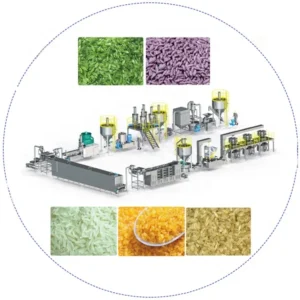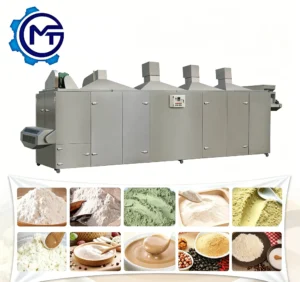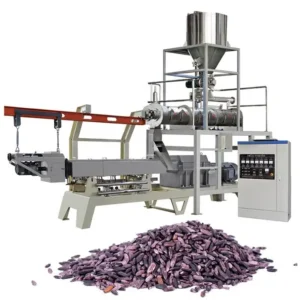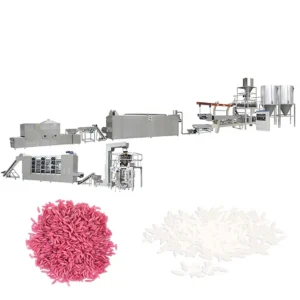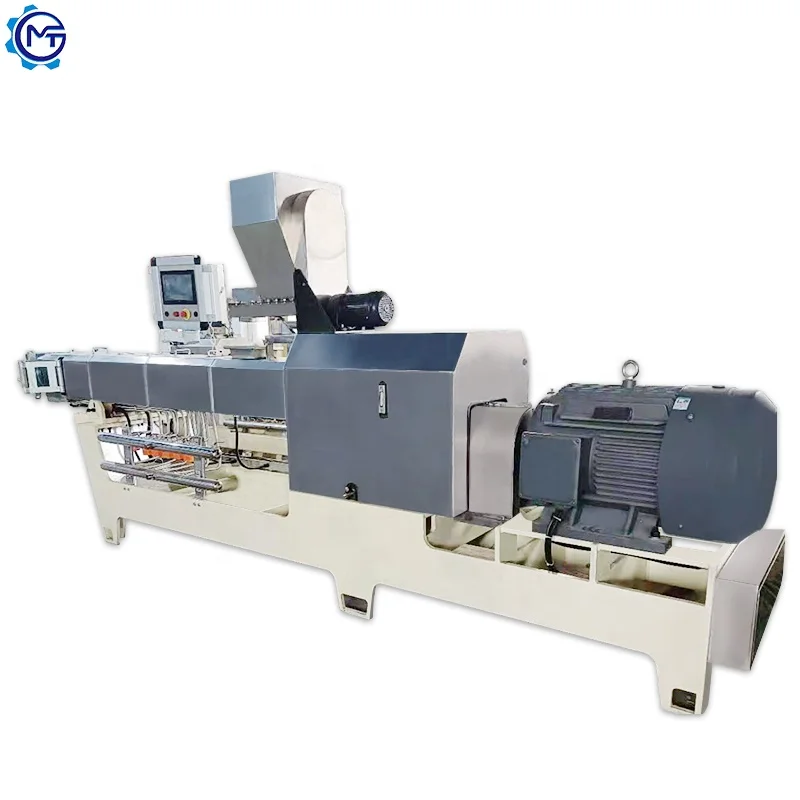
Throughput-Matched Station Design — Every mixer, extruder, dryer and roaster in a Fortified Rice Processing Line for sale is sized against the others so no single unit chokes the line when your grain blend changes mid-shift.
Technical Specifications
| Parameter | Value |
|---|---|
| Product Type | Fortified Rice Processing Line |
| Extruder Models Available | MT65, MT70, MT85, MT75, MT95 |
| Screw Type | Twin-screw |
| Feeding System | Single or double screw feeding selectable based on material uniformity requirement |
| Control System | Frequency speed control with high automation |
| Lubrication | Automatic lubricating and cooling system |
| Screw Material | Wear-resistant special alloy |
| Drying Oven Heating Source | Electric or gas |
| Drying Method | Circulation drying with variable mesh belt speed |
| MT65 Installed Power | 85 kW |
| MT65 Power Consumption | 60 kW |
| MT65 Output Capacity | 80–100 kg/h (basis to be confirmed on raw material formulation and moisture) |
| MT65 Overall Dimensions (L×W×H) | 28 × 1.2 × 2.2 m |
| MT70 Installed Power | 120 kW |
| MT70 Power Consumption | 85 kW |
| MT70 Output Capacity | 100–120 kg/h (basis to be confirmed on raw material formulation and moisture) |
| MT70 Overall Dimensions (L×W×H) | 30 × 1.5 × 2.2 m |
| MT85 Installed Power | 235 kW |
| MT85 Power Consumption | 165 kW |
| MT85 Output Capacity | 200–300 kg/h (basis to be confirmed on raw material formulation and moisture) |
| MT85 Overall Dimensions (L×W×H) | 34 × 3.5 × 4.3 m |
| MT75 Installed Power | 180 kW |
| MT75 Power Consumption | 135 kW |
| MT75 Output Capacity | 300–500 kg/h (basis to be confirmed on raw material formulation and moisture) |
| MT75 Overall Dimensions (L×W×H) | 32 × 3.5 × 4.3 m |
| MT95 Installed Power | 260 kW |
| MT95 Power Consumption | 195 kW |
| MT95 Output Capacity | 800–1000 kg/h (basis to be confirmed on raw material formulation and moisture) |
| MT95 Overall Dimensions (L×W×H) | 36 × 3.5 × 4.3 m |
| Line Stations | Mixing → Extruding → Vibrating → Low-temperature drying → Cooling → High-temperature roasting → Cooling → Packing |
| Standards | CE, ISO |
Application Suitability
| Application | Material or Output |
|---|---|
| Nutritional fortified rice kernel production | Broken rice and rice bran with micro-nutrient reinforcement |
| Artificial rice manufacturing | Grain-based formulations using corn, millet, wheat, oats, buckwheat, bean and starch |
| Food nutrition programme and staple food fortification | Vitamin and mineral blended rice kernels for government and NGO distribution |
| Grain reprocessing and value-added rice products | Crushed and milled grains converted into uniform fortified kernels |
What "Rated Capacity" Leaves Out When Buying a Fortified Rice Processing Line for Sale
Capacity figures only hold true against the exact raw material blend and moisture content used during testing.
I remember a buyer who received a quotation listing a steady hourly output for a fortified rice line. When they arrived on site and started running their own broken-rice formulation with a thirty-percent millet supplement, the extruder output dropped and the dryer could not keep pace. The mismatch was not in any single machine — it was in how the grain blend behaved under heat and shear. That is why a Fortified Rice Processing Line for sale must be evaluated against your specific formulation, not a generic rice flour baseline. [NEED_CITE: raw material moisture and formulation impact on extruder throughput]
Extruder Series and Throughput Matching Across Stations
The MT65 through MT95 series covers five capacity tiers, each with dedicated installed and running power figures. The selection determines not just extruder output but also how the downstream dryer, cooler and roaster must be sized. A Fortified Rice Processing Line for sale that pairs a high-output extruder with an undersized drying oven creates a bottleneck that forces operators to idle the extruder or let wet kernels accumulate on the belt. Every station in this range is specified to balance with the extruder tier you select.
Screw Configuration and Grain Blend Behaviour
Twin-screw extrusion handles the varied starch profiles found in broken rice, millet, buckwheat and bean blends. The screw configuration and die design are set to the buyer’s raw material and target kernel density. When the formulation shifts — for instance, adding a higher proportion of oat flour — the screw profile may need adjustment to maintain kernel shape and internal structure. The automatic lubricating and cooling system supports continuous operation across long production runs without manual intervention on the barrel. [NEED_CITE: twin-screw extrusion principles for multi-grain formulations]
Reading the Power and Dimension Data
The installed power across the series ranges from 85 kW on the MT65 to 260 kW on the MT95, while actual power consumption runs lower — typically around seventy to seventy-five percent of installed capacity during steady-state production. The line footprint grows with each tier: the MT65 occupies a 28-metre length, while the MT95 extends to 36 metres with a wider and taller profile to accommodate larger drying and roasting stations. Buyers planning factory layout should account for the full station chain from mixing through packing, including clearance for maintenance access on both sides of the extruder barrel and the drying oven mesh belt. Frequency speed control governs both the extruder and the dryer belt, allowing operators to adjust throughput and moisture removal in coordination. The drying oven supports electric or gas heating, and the choice affects both utility planning and running cost in the target market.
The Cost of Overlooking Station Balance
When an extruder is sourced from one supplier and the dryer from another, throughput mismatches surface only after installation. Kernels that leave the extruder at a rate the dryer cannot handle will retain excess moisture, leading to clumping during the roasting stage and inconsistent final texture. I have seen lines where the roaster ran well below its rated load because the upstream dryer limited what reached it. Those imbalances compound into daily downtime that no single machine specification sheet reveals. [NEED_CITE: production line throughput balancing principles]
Why Source the Full Equipment Range From One Supplier
Having every station from mixing through packing under one equipment range means throughput is calculated across the entire chain, not assumed at each individual machine. Screw configuration and die design are specified against the buyer’s actual grain blend and target kernel shape before production starts. The in-house testing workshop runs trial batches on customer-supplied raw material so that formulation behaviour is documented before the line ships. Electrical schematics confirm voltage, frequency and control language for the destination market. Wear parts lists cover screws, dies and other consumables with a defined availability schedule so the first replacement set arrives before it is needed.
Documentation & Verification
- Line layout and capacity calculation showing throughput balance across every station
- Machine specification sheet with screw configuration record matched to your grain formulation
- Electrical schematic with voltage and frequency confirmation for your local power supply
- Trial run report on your actual raw material before dispatch from the testing workshop
- Wear parts list covering screws, dies and consumables with availability schedule
- Operation and maintenance manual with station-by-station service intervals
Installation, Commissioning & Support
- Foundation and floor loading plan sized to the selected extruder tier and full line footprint
- Dedicated power circuit matching the installed power draw of your chosen model from 85 kW to 260 kW
- Station-by-station assembly sequence from mixing through packing with alignment checkpoints
- First-run parameter setting on your grain blend including screw speed, barrel temperature and dryer belt speed
- Operator training covering frequency speed control adjustment and automatic lubrication system monitoring
- Spare screw and die sets scheduled for delivery before the first wear replacement window
Preparing Your Inquiry
To specify the right equipment range for your project, share your primary grain ingredients and any supplementary vitamin or mineral premix ratios, along with your target daily production volume. Include your local voltage and frequency standard and preferred control language. If you have existing upstream milling or downstream packing equipment, note the connection points so the line layout accounts for integration.
Frequently Asked Questions
Q: How is output capacity verified against my specific grain formulation?
A: Output capacity depends on the raw material blend, moisture content and target kernel density. Before shipment, a trial run is conducted in the testing workshop using your actual formulation. The results are documented in a trial run report that records the achievable throughput, screw speed, barrel temperature profile and dryer settings for your specific grain mix.
Q: Which extruder model fits my grain blend and target kernel size?
A: Model selection depends on your required output range, grain blend composition and kernel density target. The MT65 through MT95 series covers five tiers. Screw configuration and die design are then matched to your formulation during the trial run phase, ensuring the extruder produces the correct kernel shape and internal structure for your market.
Q: How do I confirm voltage and control language before production begins?
A: Voltage, frequency and control panel language are confirmed during the specification review stage before manufacturing starts. An electrical schematic is provided showing all motor ratings, circuit protection and control wiring. This prevents commissioning delays that occur when power supply standards differ between the factory and the installation site.
Q: What supporting equipment is sized to match the extruder I choose?
A: The drying oven, cooler and roasting station are each sized to handle the output of your selected extruder tier. The dryer uses circulation drying with variable mesh belt speed controlled by frequency drive, and the roaster capacity is matched so kernels move through every station without accumulation or idle time between stages.
Q: What spare wear parts should I order with the initial line?
A: A wear parts list is provided covering screws, dies and other consumables specific to your extruder model. The first replacement set should be ordered before the initial wear window, which is determined during the trial run. Lead times for spare parts are confirmed at quotation stage so replacements arrive before production continuity is affected.