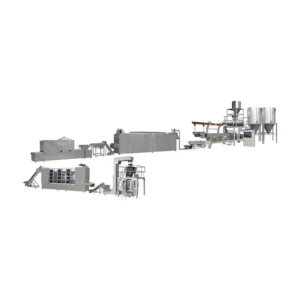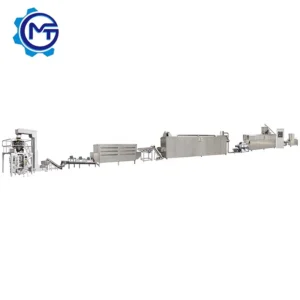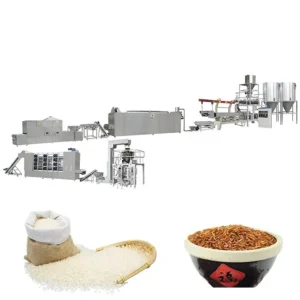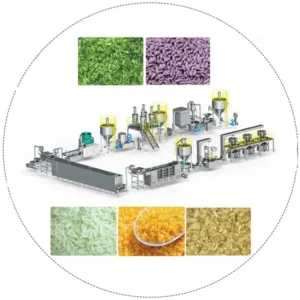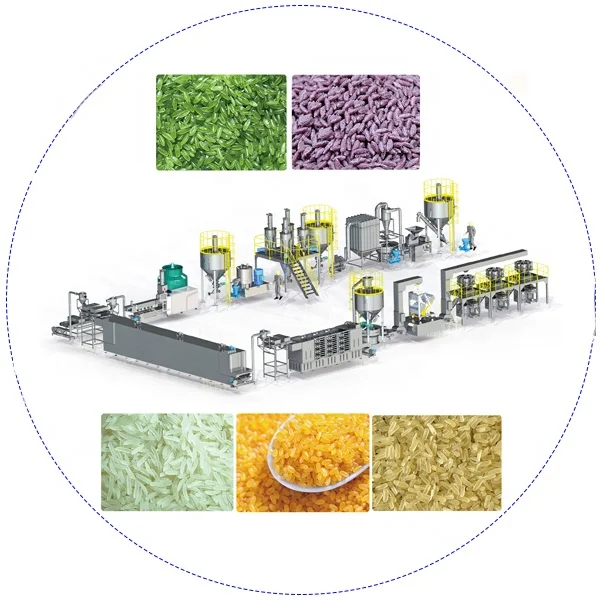
Matched Throughput Across Every Station — From MT65 to MT95 extruders, drying and roasting capacities are scaled to the extrusion output so no single segment bottlenecks the fortified rice line.
Technical Specifications
| Parameter | Value |
|---|---|
| Model | MT65 / MT70 / MT85 / MT75 / MT95 |
| Product Type | Fortified Rice Processing Line / Artificial Rice Extruder |
| Screw Type | Twin screw |
| Installed Power (MT65 / MT70 / MT75 / MT85 / MT95) | 85 kW / 120 kW / 180 kW / 235 kW / 260 kW |
| Power Consumption (MT65 / MT70 / MT75 / MT85 / MT95) | 60 kW / 85 kW / 135 kW / 165 kW / 195 kW |
| Output Capacity (MT65) | 80–100 kg/hr (basis not stated in source — confirm raw material / moisture content) |
| Output Capacity (MT70) | 100–120 kg/hr (basis not stated in source — confirm raw material / moisture content) |
| Output Capacity (MT75) | 300–500 kg/hr (basis not stated in source — confirm raw material / moisture content) |
| Output Capacity (MT85) | 200–300 kg/hr (basis not stated in source — confirm raw material / moisture content) |
| Output Capacity (MT95) | 800–1000 kg/hr (basis not stated in source — confirm raw material / moisture content) |
| Overall Dimensions (MT65 / MT70 / MT75 / MT85 / MT95) | 28×1.2×2.2 m / 30×1.5×2.2 m / 32×3.5×4.3 m / 34×3.5×4.3 m / 36×3.5×4.3 m |
| Control System | PLC / MCC with frequency speed control |
| Feeding System | Single or twin screw feeding (matched to material) |
| Screw Construction | Wear-resistant special alloy |
| Drying Oven Heating Source | Electric or gas |
| Drying Oven Control | Frequency motor controls mesh belt speed |
| Lubrication | Automatic lubricating and cooling system |
| Line Stations | Mixing → Extruding → Vibrating → Low-temperature drying → Cooling → High-temperature roasting → Cooling → Packing |
| Voltage & Frequency | Customized to local supply |
| Standards | CE, ISO |
Application Suitability
| Application | Material or Output |
|---|---|
| Nutritional fortified rice production | Broken rice, rice bran, corn, millet with added vitamins and minerals |
| Artificial rice kernel manufacturing | Wheat, oats, buckwheat, beans, starch as base ingredients |
| Fortified food and nutrition programme supply | High-throughput extruded rice kernels meeting institutional specifications |
| Specialty grain reconstitution | Multi-grain blends processed into uniform rice-shaped kernels |
What the Nameplate Capacity Leaves Out on a Fortified Rice Line
Nominal output means nothing until the dryer and roaster can keep pace with the extruder.
I once audited a facility where the extruder pushed out fortified rice dough at its rated speed, but the drying oven was sized for a smaller model. Kernels piled up on the belt, moisture stayed too high, and the roaster downstream could not achieve the surface finish the market expected. The whole Fortified Rice Processing Line full equipment range sat half-idle because one station choked the rest. When buyers compare quotations, the extruder price dominates attention, yet the bottleneck usually hides in the thermal stages [NEED_CITE: line throughput matching principles in extrusion plants]. A matched Fortified Rice Processing Line full equipment range eliminates that mismatch before the first bolt is tightened.
Extruder Station: Where Screw Geometry Meets the Recipe
Twin-screw extrusion handles the variable recipes typical of fortified rice, where broken rice flour meets vitamin premix and mineral salts that alter melt viscosity. The screw configuration and die design are specified to the buyer’s raw material rather than copied from a generic build, so starch gelatinisation happens uniformly across the barrel length. Frequency speed control on the main drive lets operators adjust shear input when switching between, say, a corn-heavy blend and an oat-heavy blend without stopping the line. Wear-resistant alloy screws extend service intervals even when abrasive mineral additives are part of the formula.
Thermal Stages: Drying and Roasting in Sequence
Low-temperature drying removes surface and internal moisture gradually, preventing case-hardening that would trap water inside the kernel. The mesh belt speed is governed by a frequency motor, giving operators a continuous variable to tune residence time without changing sprockets. After cooling, the high-temperature roaster develops the translucent appearance and firm bite that consumers associate with natural rice. Electric or gas heating is available depending on local utility costs and emissions rules, and each option carries a different burner or element layout to maintain even temperature across the belt width [NEED_CITE: thermal stage design in cereal kernel production].
Reading the Spec Sheet Beyond the Big Numbers
Installed power spans from 85 kW on the MT65 to 260 kW on the MT95, but actual power consumption is noticeably lower — 60 kW to 195 kW — because motors rarely run at full load once the line reaches steady state. The PLC / MCC control architecture means the extruder, feeder, dryer belt, and roaster all communicate through a single panel, reducing the chance that one station drifts out of sync. Single or twin screw feeding is selected based on whether the premix is free-flowing or prone to bridging; a twin screw feeder handles sticky vitamin blends that would stall a single auger. Automatic lubricating and cooling systems circulate oil through the gearbox continuously, which matters when production runs extend past a single shift. Line dimensions stretch up to 36 meters for the MT95 layout, so workshop length and column spacing need confirmation before the foundation is poured.
The Cost of Mismatched Stations Downstream
When the dryer is undersized relative to the extruder, operators either slow the screw speed or accept kernels that exit too wet and crack during roasting. Both outcomes erode the line’s effective output far below the nameplate figure. Similarly, if the roaster lacks the belt width to spread kernels in a thin layer, surface browning becomes uneven and a portion of the batch fails visual inspection. Electrical mismatches surface later: a control cabinet wired for 50 Hz shipped to a 60 Hz site causes motors to overspeed, shortening bearing life and invalidating the CE declaration. These are not rare edge cases [NEED_CITE: post-installation commissioning issues in food extrusion exports]. They show up whenever throughput, thermal capacity, and electrical supply are treated as separate purchasing decisions instead of one integrated Fortified Rice Processing Line full equipment range.
Why Source the Full Range from One Supplier
Screw configuration and die design are locked to the buyer’s exact raw material after a trial run in the testing workshop, not guessed from a catalog table. Every station — mixer, extruder, vibrating conveyor, dryer, roaster, cooler, packing scale — is sized against the same throughput calculation, so no single machine limits the others. Line layout and capacity calculation documents are issued before production begins, giving buyers a reference for workshop planning. Voltage, frequency, and control language are confirmed against the destination site’s supply before the cabinet is wired. Trial runs on the buyer’s actual fortified rice formulation happen before crating, with a written report that follows the shipment.
Documentation & Verification
- Line layout and capacity calculation matched to your chosen extruder model and thermal stations
- Screw and die configuration record specific to your fortified rice raw material blend
- Electrical schematic and voltage confirmation for the destination country’s grid standard
- Trial run report on customer raw material produced in the testing workshop before dispatch
- CE declaration of conformity covering the complete line assembly
Installation, Commissioning & Support
- Foundation plan references the 28 to 36 m line length and station weights for slab reinforcement
- Dedicated circuit sizing based on confirmed power consumption figures for each model variant
- Assembly state is turnkey on site with pre-wired control cabinets to reduce electrical hook-up time
- First-run commissioning includes screw speed and dryer belt calibration against your raw material
- Operator training covers PLC parameter adjustment for recipe changes between fortified rice blends
- Wear parts list identifies screw segments and die plates with reorder codes for your configuration
What We Need to Build Your Line Proposal
Share your base grain or flour blend, the vitamin and mineral premix ratio, and the target kernel dimensions so the screw and die can be specified from the start. Confirm the workshop length, ceiling height, and local voltage and frequency to ensure the layout and electrical cabinet match the site. Let us know whether electric or gas heating is preferred for the drying and roasting stages, and whether you can send a sample of your raw material for a pre-shipment trial run.
Frequently Asked Questions
Q: How do I verify the capacity figures for each model?
A: The capacity ranges listed for MT65 through MT95 depend on raw material composition and moisture content, which vary across fortified rice recipes. Before quotation, we run your actual blend in the testing workshop and record the achievable throughput. That trial report becomes the contractual capacity baseline rather than a generic catalog number.
Q: How are the drying and roasting stations matched to the extruder output?
A: Each thermal station is sized through a throughput calculation that starts from the extruder’s confirmed output on your material. Belt width, residence time, and heating capacity are all derived from that figure. The line layout document shows the matched capacity at every station so no segment becomes a bottleneck.
Q: Should I choose electric or gas heating for the dryer and roaster?
A: The choice depends on local utility pricing and emissions regulations at your facility. Electric heating offers precise zone control and simpler ductwork, while gas heating can lower operating costs where natural gas is inexpensive. Both options are available with the same frequency-controlled mesh belt, so belt speed tuning remains identical.
Q: How is the feeding system chosen for different premixes?
A: Free-flowing grain flours typically use a single screw feeder, while premixes containing sticky vitamin pastes or fine mineral powders benefit from a twin screw feeder that prevents bridging in the hopper. During the trial run we test your exact blend and specify the feeder type that maintains uniform material delivery to the extruder barrel.
Q: How do we confirm voltage and control language before shipment?
A: During the specification confirmation stage, you provide the destination site’s voltage, frequency, and preferred control panel language. The electrical schematic is then drawn to those values and reviewed by your electrical team before the cabinet is wired, avoiding rewiring delays during commissioning.