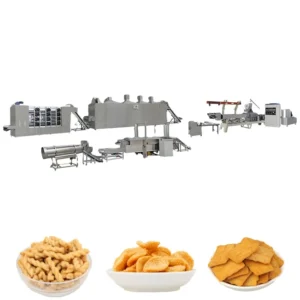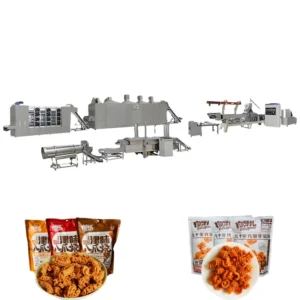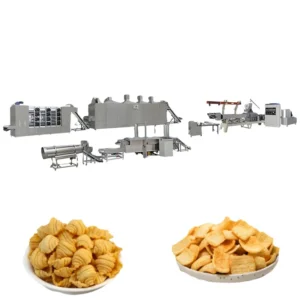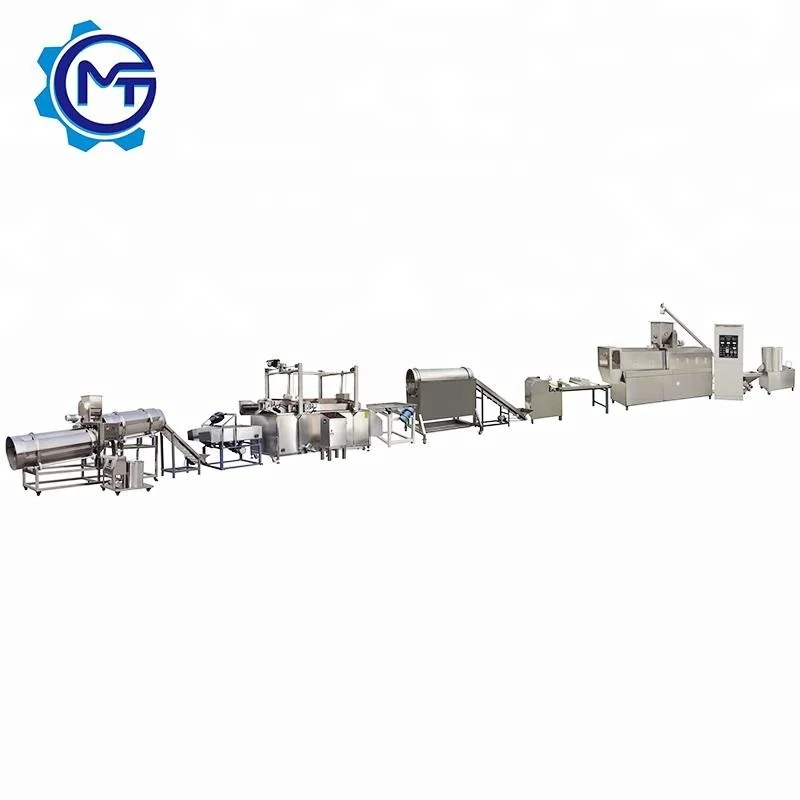
Integrated Line Throughput — Every station from powder mixer to packing is rated and balanced so no single machine bottlenecks the Fried Puffs Snack Food Making Machine full range.
Technical Specifications
| Parameter | Value |
|---|---|
| Product Type | Fried Puffs Snack Food Production Line |
| Models Available | MT65 / MT70 / MT85 / MT75 / MT95 |
| Screw Type | Twin-screw extruder |
| Installed Power | 142 kW (MT65) / 185 kW (MT70) / 240 kW (MT85) / 245 kW (MT75) / 370 kW (MT95) |
| Real Power Consumption | 100 kW (MT65) / 130 kW (MT70) / 180 kW (MT85) / 185 kW (MT75) / 280 kW (MT95) |
| Output Capacity | 120–150 kg/h (MT65) / 200–250 kg/h (MT70) / 300–500 kg/h (MT85) / 400–500 kg/h (MT75) / 800–1000 kg/h (MT95) (basis to be confirmed) |
| Overall Dimensions (L×W×H) | 22000×1200×2200 mm (MT65) to 30000×1500×2800 mm (MT95) |
| Powder Mixer Tank Volume | 150 kg |
| Powder Mixer Rotary Speed | 385 rpm |
| Powder Mixer Power | 4 kW |
| Fryer Temperature Range | 0–260 °C |
| Fryer Capacity | 200–300 kg/h (basis to be confirmed) |
| Fryer Dimensions | 4500 × 1350 × 2350 mm |
| Flavor Line Output | 400 kg/h (basis to be confirmed) |
| Flavor Line Power | 1.5 kW |
| Control System | PLC and MCC |
| Construction Material | Food-grade stainless steel contact parts |
| Line Stations | Mixing → Extrusion → Forming/Cutting → Frying → Flavoring → Drying → Packing |
| Product Shapes | Bugles, triangles, fish crisps, golden corners, rice crust, tortilla-style, sala-style |
| Warranty | 1 year with lifetime maintenance service |
Application Suitability
| Application | Material or Output |
|---|---|
| Corn chip and tortilla chip production | Corn flour, masa harina, corn grits |
| Bugle and horn-shaped fried puffs | Wheat flour, corn starch blends |
| Rice crust and cracker-style snacks | Rice flour, glutinous rice powder |
| Shaped fried snacks (fish, duck, tree forms) | Composite grain flours with starch |
| Non-fried puffed snack variants | Same flour bases, bypassing fryer station |
What "Line Capacity" Really Means When Stations Are Mismatched
A quoted throughput figure is only valid if every downstream station can keep pace with the extruder discharge.
I once saw a snack producer in Southeast Asia run their twin-screw extruder at full speed while the fryer belt was overloaded, causing half-fried product to pile up and darken in color. The seasoning drum downstream could not coat the volume either, leaving bare patches on finished pieces. Within weeks their retail buyer flagged inconsistent quality, and the line sat idle while they sourced a larger fryer and a second flavoring drum. [NEED_CITE: throughput balancing across extrusion and frying stations]
When you evaluate a Fried Puffs Snack Food Making Machine full range, the capacity number attached to the extruder means very little unless the fryer, flavoring drum, and dryer are each rated to handle that same discharge rate. This is where most line quotations fall short — the extruder is sized correctly but supporting equipment is undersized to keep the total price low.
Matching Every Station to the Extruder Discharge
The Fried Puffs Snack Food Making Machine full range lists each station with its own throughput rating so buyers can verify balance before signing off on a layout. The powder mixer rotates at 385 rpm with a 150 kg tank, feeding batches into the extruder hopper at intervals that match the screw feed rate. The fryer operates across a 0–260 °C range and carries its own capacity rating, while the flavoring drum runs independently at a rated output. This station-by-station transparency lets a process engineer confirm that no single unit will throttle the line.
How Screw Configuration Shapes Fried Snack Texture
Twin-screw extrusion gives operators control over shear, residence time, and moisture profile inside the barrel — all of which determine how the pellet or preform expands when it hits hot oil. The screw elements and die plate are configured to the buyer’s specific flour blend and target shape, whether that is a thin-walled bugle or a dense rice crust piece. Barrel sections are heated and cooled independently, allowing temperature profiling along the screw length. Food-grade stainless steel contact materials throughout the extruder and downstream stations meet hygiene requirements for snack food production. [NEED_CITE: twin-screw extrusion barrel temperature profiling for snack preforms]
Reading the Power and Capacity Figures Correctly
Installed power and real power consumption differ significantly across the five models, and understanding this gap matters for electrical planning. The MT85, for instance, carries 240 kW installed but draws around 180 kW in actual operation — a difference that affects transformer sizing and running cost projections. The fryer’s 0–260 °C range accommodates both low-temperature drying passes and high-heat frying for maximum expansion, and the specific setpoint depends on oil type and pellet moisture entering the fryer. Die design directly controls preform wall thickness, which in turn determines oil absorption and final product crunch — thicker walls absorb less oil but require longer fry times. The PLC and MCC control system manages barrel zones, screw speed, and fryer temperature from a central panel, reducing manual adjustment between product changeovers.
The Cost of Skipping a Fryer Capacity Check
When the fryer is sized below the extruder output, product backs up on the conveyor and sits in hot oil longer than intended, turning dark and tasting burnt. The seasoning drum then receives an uneven flow, so some pieces get over-coated while others leave the line bare. Buyers end up running the extruder at reduced speed to match the fryer, which means paying for capacity they cannot use. [NEED_CITE: fryer bottleneck effects on snack food line throughput]
Over time this mismatch causes excess oil degradation because product residues accumulate faster than the filtration system can handle, raising both oil replacement cost and maintenance frequency. The line never reaches the throughput that justified the investment in the first place.
Why Buyers Source the Complete Range Here
Screw configuration and die design are specified to the buyer’s raw material and target product shape rather than copied from a generic template. An in-house testing workshop runs trial production on the customer’s actual flour blend before shipment, so expansion behavior and fry response are verified in advance. Complete line throughput matching across every station means the mixer, extruder, fryer, flavoring drum, dryer, and packing unit are all selected as one system rather than assembled from separate vendors. Pre-sales consultation includes line layout and capacity calculation, followed by on-site installation and operator training. CE and ISO certification documentation is provided with every shipment, supporting import compliance in regulated markets. [NEED_CITE: CE machinery directive requirements for food processing equipment]
Documentation & Verification
- Line layout and capacity calculation showing throughput balance across all stations
- Machine specification sheet with electrical schematic for each model variant
- Screw and die configuration record matched to your flour blend and product shape
- Trial run report performed on your raw material in the testing workshop before dispatch
- Voltage and frequency confirmation document aligned to your local grid standard
- Operation and maintenance manual with wear parts list for extruder screws and fryer belt
Installation, Commissioning & Support
- Foundation and floor space planning based on overall line dimensions up to 30000 × 1500 × 2800 mm
- Dedicated electrical circuit sized to real power consumption of up to 280 kW for the MT95 configuration
- Factory-assembled stations shipped with packing photographs and customs documentation support
- On-site commissioning with PLC parameter setting and barrel temperature profile calibration
- Operator training covering screw speed adjustment, fryer temperature control, and die changeover
- Wear parts list including extruder screws, dies, and fryer belt sections with first replacement schedule
What to Share Before Requesting a Quotation
To configure the right model and supporting stations, provide your primary flour type along with any moisture or fat content data from your supplier. Confirm your target daily output and the shift pattern you plan to run. Share your facility voltage, frequency, and the control language your operators need on the HMI screen. If you have an existing upstream mixer or downstream packing machine, let us know the model and throughput so the new line integrates without bottlenecking.
Frequently Asked Questions
Q: How do I choose between the MT65 and MT95 for my fried puff line?
A: The choice depends on your target output and raw material characteristics. The MT65 suits smaller production runs with lower power draw, while the MT95 handles high-volume operations. We review your flour type, moisture content, and desired product shape before recommending a model, and run a trial in our testing workshop to confirm the configuration produces the texture your market expects.
Q: Are the fryer and flavoring drum sized to match the extruder I select?
A: Every station in the line carries its own throughput rating, and we match them during the layout phase so no single unit bottlenecks production. The fryer temperature range reaches 260 °C and its capacity is verified against your chosen extruder model. The flavoring drum output is cross-checked the same way before we finalize the quotation.
Q: What voltage and control options are available for different export markets?
A: Voltage and frequency are confirmed to your local grid standard before production begins, and the PLC and MCC control system can be set to your preferred operator language. We provide an electrical schematic and voltage confirmation document with each shipment so your electrician can prepare the site before the line arrives.
Q: Can I see a trial run on my own raw material before the line ships?
A: Our in-house testing workshop runs your actual flour blend through the configured extruder and fryer to verify expansion, color, and texture. You receive a trial run report documenting screw speed, barrel temperatures, fry time, and final product measurements so you know the line will perform on your material before it leaves the factory.
Q: What spare wear parts should I stock for the first year?
A: We provide a wear parts list specific to your line configuration, typically including extruder screw elements, die plates, and fryer belt sections. The list notes expected service intervals based on your planned operating hours. All parts are manufactured in-house, so replacements are available without third-party sourcing delays.