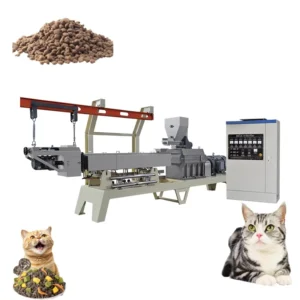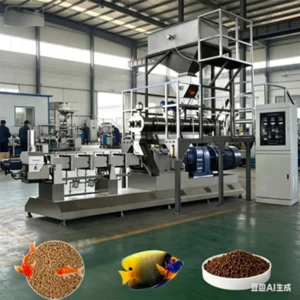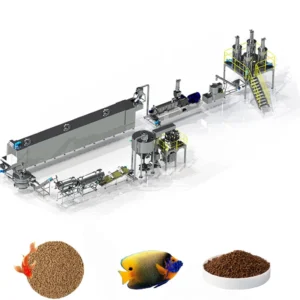
Throughput matched across stations — the fish feed processing line full equipment range is configured so mixing, extrusion, drying, coating, and packing capacities are verified against the same raw material formulation before any machine ships.
Technical Specifications
| Parameter | Value |
|---|---|
| Product Type | Fish Feed Processing Line |
| Output Capacity | 4–5 t/h (basis not stated in source — confirm raw material formulation, moisture content, pellet diameter) |
| Extruder Type | Twin-screw extruder |
| Construction Material (Food Contact) | 304 stainless steel |
| Control System | Configurable (PLC or MCC, to be confirmed) |
| Target Pellet Types | Floating and sinking aquatic feed |
| Target Species | Trout, salmon, catfish, and other fish species |
| Voltage & Frequency | Configurable by destination market (to be confirmed) |
| Certification | CE and ISO compliant (specific certificates to be confirmed) |
Application Suitability
| Application | Material or Output |
|---|---|
| Floating trout and salmon feed | High-protein fish meal, starch binders, lipid coating |
| Sinking catfish pellet production | Soybean meal, corn gluten, wheat middlings |
| Multi-species aquaculture mills | Variable formulations requiring frequent die and screw changes |
| Regional feed distributors | Pellet diameters ranging from micro-pellets to large grower sizes |
What "4–5 Tons per Hour" Actually Means for Your Raw Material
Capacity is only real when tested against your specific formulation and pellet size.
A fish feed processing line full equipment range quoted at a nominal throughput often assumes a standard starch-heavy formulation at moderate moisture. When a buyer switches to a high-proby protein aquatic feed mix, the actual extrusion output can drop noticeably because the material behaves differently under shear and heat. The dryer and coating drum downstream may still be sized for the original number, creating a bottleneck where the extruder runs below its rated speed just to let the rest of the line keep up. I have seen aquaculture producers sign for a line based on a brochure figure, only to find their actual daily tonnage falls short once the high-fishmeal recipe hits the barrel [NEED_CITE: twin-screw extrusion output variance with high-protein formulations].
Station-by-Station Equipment Visibility
Before committing capital, a buyer needs to see every machine in the fish feed processing line full equipment range as an individual spec sheet, not just a bundled line drawing. The mixer must handle the specific batch size that feeds the extruder without starving it or causing surge. The twin-screw extruder forms the pellet and controls density, which determines whether the feed floats or sinks. Downstream, the dryer must remove enough moisture to reach safe storage levels without over-drying and cracking the pellet surface. Each station has its own motor power, footprint, and utility demand that must be reviewed independently.
Coating and Cooling — Where Pellet Quality Is Won or Lost
The coating drum applies lipid and palatant to the pellet surface, directly influencing feed acceptance in the water and nutritional density. If the drum is undersized relative to the extruder output, pellets spend insufficient time in the coating zone and emerge with uneven coverage. Cooling then stabilizes the pellet temperature before packing; inadequate cooling leads to condensation inside the bag, inviting mold during storage. These two stations are often treated as secondary, yet field complaints about palatability and shelf life frequently trace back to coating and cooling mismatches [NEED_CITE: post-extrusion coating uniformity and pellet shelf stability].
Reading the Specs That Matter for Aquatic Feed
The twin-screw extruder is specified by its screw diameter and L:D ratio, which together determine residence time and the degree of starch gelatinization achievable inside the barrel. A longer L:D gives high-protein formulations more time to cook, improving pellet water stability — critical for shrimp and slow-feeding species. The die configuration controls pellet diameter and density; floating pellets require a specific die geometry that traps more gas during expansion, while sinking pellets use a tighter die that compresses the dough. Barrel zone count and temperature profiling let the operator fine-tune the cooking curve, preventing over-gelatinization that can destroy heat-sensitive vitamins. Moisture range and steam or water injection capability affect how much preconditioning happens before the material enters the extruder, directly influencing both throughput and pellet texture. Control system selection — PLC versus MCC — determines whether recipe changes can be stored and recalled, which matters when a mill runs multiple species formulations on the same line.
The Hidden Cost of Skipping a Trial Run
When a line ships without a trial run on the buyer’s actual raw material, commissioning becomes the first real test. Screw combinations and die plates selected from a generic build may produce pellets that sink when they should float, or vice versa. Adjusting on-site means ordering new wear parts, waiting for international shipping, and running production trials during what should be stable output. The cost shows up as delayed market entry, wasted raw material, and operator frustration during the first weeks of operation [NEED_CITE: extrusion commissioning delays due to untested screw and die configurations].
Why Source the Full Line from One Equipment Supplier
Matching throughput across every station eliminates the finger-pointing that happens when separate vendors supply the extruder, dryer, and coater. Screw configuration and die design are specified to the buyer’s raw material rather than copied from a generic catalog. An in-house testing workshop allows trial runs on the customer’s own formulation before the line ships, catching density and capacity issues early. Twin-screw expertise covers the range from floating salmon feed to sinking catfish pellets, so the same engineering team handles formulation changes. Pre-sales consultation extends through on-site installation, operator training, and ongoing wear parts support, keeping one point of contact for the entire line lifecycle.
Documentation & Verification
- Line layout and capacity calculation matched to your target species and pellet diameter
- Machine specification sheet for every station including motor power and utility demands
- Screw and die configuration record tied to your raw material formulation
- Trial run report on your raw material documenting pellet density and moisture
- Electrical schematic with confirmed voltage, frequency, and control language
- Wear parts list covering screws, dies, and cutter assemblies with replacement intervals
Installation, Commissioning & Support
- Foundation plan showing load points for the twin-screw extruder and dryer sections
- Dedicated circuit sizing based on confirmed total line rated power and voltage
- Assembly sequence from shipping split through final belt alignment and guarding
- First-run parameter logging for barrel temperatures, screw speed, and die pressure
- Operator training on recipe storage and recall if PLC control is selected
- Scheduled wear parts dispatch for screws and dies based on documented run hours
Before You Request a Quote
Share your target species, typical raw material formulation, desired pellet diameter range, and whether you need floating or sinking output. Confirm the voltage and frequency at your facility so every motor and control panel is wound correctly. If you have existing upstream mixers or downstream packing equipment, list their throughput so the new stations integrate without bottlenecks. Indicate whether you want to send a raw material sample for a pre-shipment trial run in the testing workshop.
Frequently Asked Questions
Q: What stations are included in a complete fish feed processing line full equipment range?
A: The line covers batching and mixing, twin-screw extrusion, drying, lipid and palatant coating, cooling, and packing. Each station is spec-documented individually so you can review motor power, footprint, and utility requirements before configuration is finalized. Stations can also be ordered separately to fill gaps in an existing layout.
Q: How do I verify the stated capacity against my raw material and pellet size?
A: Provide your formulation, target moisture, and pellet diameter. A trial run using your actual raw material in the testing workshop documents real throughput and pellet density. The resulting report becomes the baseline for sizing the dryer, coater, and cooler so no station bottlenecks the others.
Q: What is the difference between floating and sinking pellet die configurations?
A: Floating pellets use a die geometry that allows greater gas expansion at the die face, producing lower bulk density. Sinking pellets require a tighter die that compresses the extrudate, yielding higher density. Screw configuration and barrel temperature profile are adjusted alongside the die to achieve the target water stability.
Q: Can I order individual stations instead of the whole line?
A: Yes. Each station — extruder, dryer, coater, cooler — is available separately with its own specification sheet. When integrating into an existing line, share upstream and downstream equipment details so throughput and utility connections are matched correctly.
Q: What voltage and control language options are available?
A: Voltage and frequency are configured to the destination market before production. The control panel can be supplied with PLC or MCC logic, and the HMI language is set to the operator’s preference. Confirm these details early to avoid commissioning delays on site.