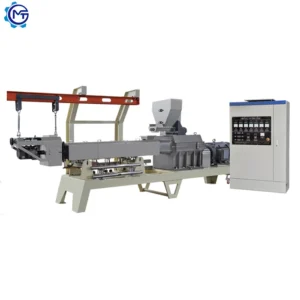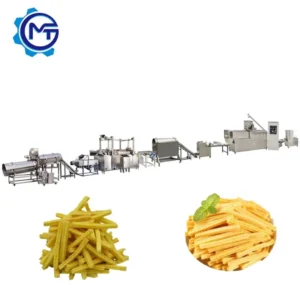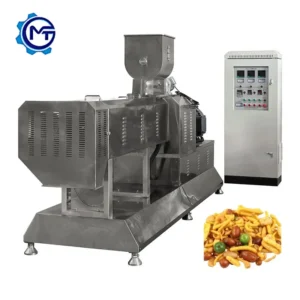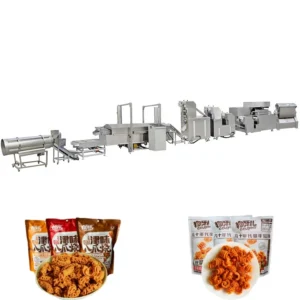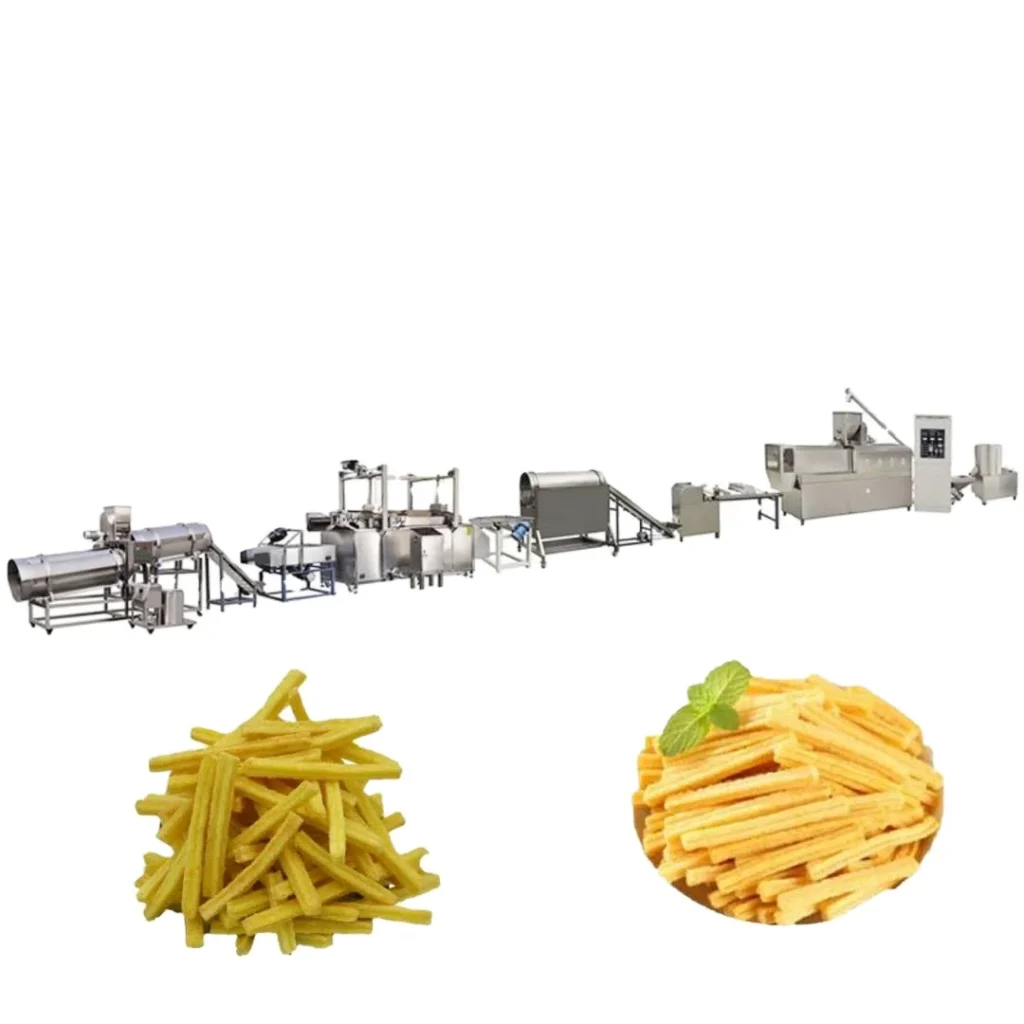
Balanced Line Throughput — Every station in this fried snack production line is capacity-matched from mixing to packing, preventing the extruder-dryer-fryer mismatches that stall output on poorly configured lines.
Technical Specifications
| Parameter | Value |
|---|---|
| Product Type | Fried Snack Production Line |
| Extruder Type | Single Screw Extruder |
| Screw Configuration | High and low pressure screw |
| Output Capacity | 120 kg/h (basis not stated in source — confirm raw material type and moisture content) |
| Rated Power | 50–70 kW (electric); 50–60 kW (gas or diesel) |
| Voltage & Frequency | Three phases 380 V / 50 Hz; Single phase 220 V / 50 Hz (customizable) |
| Overall Dimensions (L×W×H) | 12 000–26 000 × 1 200 × 2 200 mm |
| Construction Material | Food grade stainless steel 201 / 304 |
| Energy Options | Electricity / Gas / Diesel / Steam |
| Motor Brand | Siemens (made in China) or China top brand |
| Inverter | Delixi or Delta |
| Certification | CE / ISO 9001 |
| Warranty | One year warranty and lifetime technical guidance |
Application Suitability
| Application | Material or Output |
|---|---|
| Golgappa / Pani Puri production | Wheat flour, corn starch, potato starch blends |
| Salad strip and millet crust lines | Wheat flour and starch-based dough with secondary puffing |
| Screw shell and tube snack formats | Corn starch and potato starch with die-adjustable shaping |
| Cartoon-shaped fried puffed snacks | Multi-grain flour blends with custom die profiles |
Why the Fryer Rating Matters More Than the Extruder Nameplate
A fried snack production line full equipment range only delivers its stated output when the fryer, dryer, and extruder are balanced to the same throughput target.
I once watched a buyer commission a line where the extruder pushed product faster than the fryer could handle it. The cutting station piled up half-dried pieces on the conveyor while the fryer basket cycled at its own slower rhythm. Operators spent more time clearing jams than running product. That mismatch did not come from bad machines — it came from treating each station as an independent purchase rather than a linked chain. [NEED_CITE: throughput balancing principles in continuous snack processing lines]
When the fryer capacity lags behind extruder output, moisture content entering the oil bath becomes inconsistent, producing uneven colour and texture batch to batch. The reverse problem — an oversized fryer running half-empty — wastes energy and degrades oil life faster. Getting the fried snack production line full equipment range right means confirming every station against the same raw material and recipe before production begins.
Station-by-Station Equipment Breakdown
A complete fried snack production line full equipment range covers seven linked stations: mixing, extrusion, cutting, drying, frying, flavoring, and packing. Each station must pass product to the next at the same mass flow rate. The mixing system feeds the single screw extruder at a controlled rate, the extruder shapes and partially cooks the dough, and the cutting system sizes the pieces before they enter the dryer.
The dryer reduces moisture to the level required for consistent frying behaviour. After the fryer, the flavoring drum applies seasoning while pieces are still warm enough for adhesion. Finally, the packing station weighs and bags the finished product. If any one of these links runs faster or slower than the rest, the entire fried snack production line full equipment range underperforms its nameplate.
Matching Dryer and Fryer Capacity to Extruder Output
The single screw extruder in this line uses a high and low pressure screw configuration, which broadens the range of acceptable raw materials — from wheat flour to corn starch and potato starch blends. Each material exits the extruder at a different moisture level and density, which directly affects how long it must stay in the dryer and how much oil it absorbs in the fryer. [NEED_CITE: moisture content targets for secondary puffing fried snack substrates]
Specifying the dryer length and fryer basket volume without referencing the buyer’s actual recipe leads to the bottleneck scenario described earlier. The line is configured after the buyer confirms raw material type, target moisture after drying, and desired oil uptake percentage. This is why the overall line length varies between 12 000 and 26 000 mm — dryer and fryer sections are extended or shortened to match the extruder’s real output on the buyer’s material.
What the Screw and Die Configuration Decide
The high and low pressure screw design influences how thoroughly the raw material is gelatinised inside the barrel before it reaches the die. Incomplete gelatinisation leaves a dense, hard centre that will not puff properly during frying. Over-gelatinisation on a starch-heavy recipe can make the dough too sticky to cut cleanly. The screw profile is selected based on whether the buyer is running primarily wheat flour, corn starch, or a blend.
Die selection determines final product shape — screw shell, round tube, square tube, ring, or cartoon shapes — and also affects expansion behaviour. A wider die opening reduces back-pressure and produces a lighter, more expanded piece that absorbs oil differently than a denser tube shape. The motor drives the screw through a Siemens or equivalent inverter-controlled system, allowing speed adjustment to fine-tune residence time. Energy supply for the dryer and fryer is configurable across electricity, gas, diesel, and steam, so the line adapts to whatever utility infrastructure the buyer’s facility provides.
What Happens When Stations Are Sourced Separately
Buying the extruder from one vendor and the fryer from another often means nobody takes responsibility for the gap between them. The extruder supplier quotes output on a reference material that the fryer was never tested against. When the line is assembled on site, the conveyor between the dryer and fryer becomes a pile-up zone, and operators improvise with manual transfer. [NEED_CITE: integration challenges in multi-vendor snack processing lines]
The hidden cost is not just lost output — it is inconsistent product quality. Pieces that sit too long before frying cool down and absorb oil unevenly, producing a mix of pale and dark pieces in the same batch. Flavoring then adheres unevenly, and the packing station receives product that varies in weight per piece, causing fill-weight drift. These are the problems that surface only after the line has been running for a few shifts, when returns and complaints start arriving.
Why Procuring the Full Range from One Source Matters
This fried snack production line full equipment range is configured as a single project, so throughput calculations run across every station before any machine is built. The line layout document shows mass flow at each transfer point, confirming that the dryer exit rate equals the fryer inlet rate.
Screw and die configurations are specified against the buyer’s raw material and target product shape, not copied from a generic template. An in-house testing workshop allows trial runs on the buyer’s actual flour or starch blend before the line ships, catching gelatinisation or expansion issues early. Electrical schematics confirm voltage and frequency — whether three-phase 380 V or a local standard — before production starts, avoiding commissioning delays. The line is CE and ISO 9001 certified, and food grade stainless steel 201 or 304 is used across all product contact surfaces.
Documentation & Verification
- Line layout and capacity calculation confirming station-by-station throughput balance
- Machine specification sheet with screw profile and die configuration for your target shape
- Electrical schematic and voltage confirmation matched to your facility supply
- Trial run report on your raw material blend before shipment
- CE declaration of conformity and ISO 9001 certificate in shipment documentation
- Operation and maintenance manual with wear parts list for screw and die replacements
Installation, Commissioning & Support
- Foundation and floor space planning based on the 12 000–26 000 mm line length and utility routing
- Dedicated electrical circuits sized to the 50–70 kW rated power and confirmed voltage
- On-site assembly and alignment of extruder, dryer, fryer, and conveyor transfer points
- First-run parameter setting for screw speed, barrel temperature, dryer dwell, and fryer temperature
- Operator training covering die changes, screw cleaning, and oil filtration intervals
- Wear parts supply for screws, dies, and cutting blades with documented replacement schedule
Preparing Your Inquiry
To configure the line accurately, share your primary raw material (wheat flour, corn starch, potato starch, or a blend), target product shape from the available die options, and the daily output you need to meet. Confirm your facility’s voltage and frequency, available energy source for the fryer and dryer, and any local control language requirements. If you have existing upstream or downstream equipment that this line must connect to, include those interface details.
Frequently Asked Questions
Q: How is the 120 kg/h output capacity verified against my raw material?
A: The stated capacity is a reference figure that must be confirmed against your specific flour or starch blend, moisture content, and target product shape. We run a trial in the testing workshop using your raw material before finalising the screw configuration and dryer-fryer sizing, so the quoted throughput reflects your actual recipe rather than a generic test condition.
Q: What voltage and frequency options are available for my market?
A: The line supports three-phase 380 V / 50 Hz and single-phase 220 V / 50 Hz as standard, and is customizable to other local voltage and frequency requirements. Voltage and control panel language are confirmed during the specification stage before production begins, so the electrical system matches your facility on arrival.
Q: How are fryer and flavoring capacities matched to the extruder?
A: Each station is sized during the line configuration stage based on the extruder’s confirmed output on your raw material. The dryer length, fryer volume, and flavoring drum diameter are calculated so mass flow is continuous across every transfer point, eliminating bottlenecks and pile-ups between stations.
Q: Which energy sources can the dryer and fryer use?
A: The line supports electricity, gas, diesel, and steam as energy options for the dryer and fryer stations. The selection depends on your facility’s existing utility infrastructure and local energy costs. We confirm the energy source during the specification stage so the correct burners or heating elements are installed before shipment.