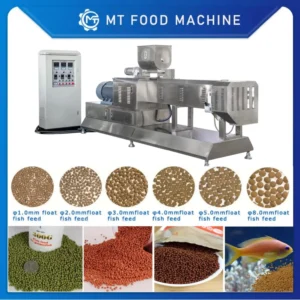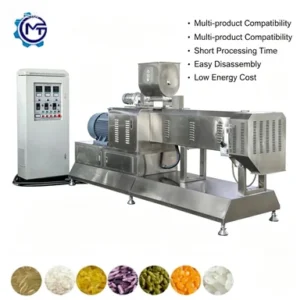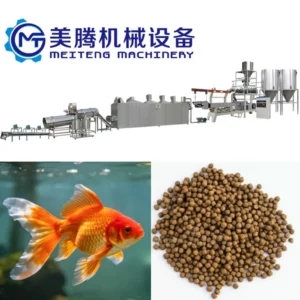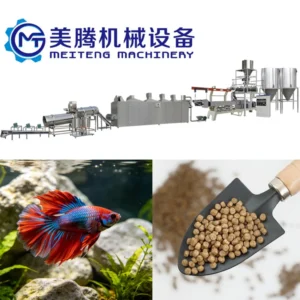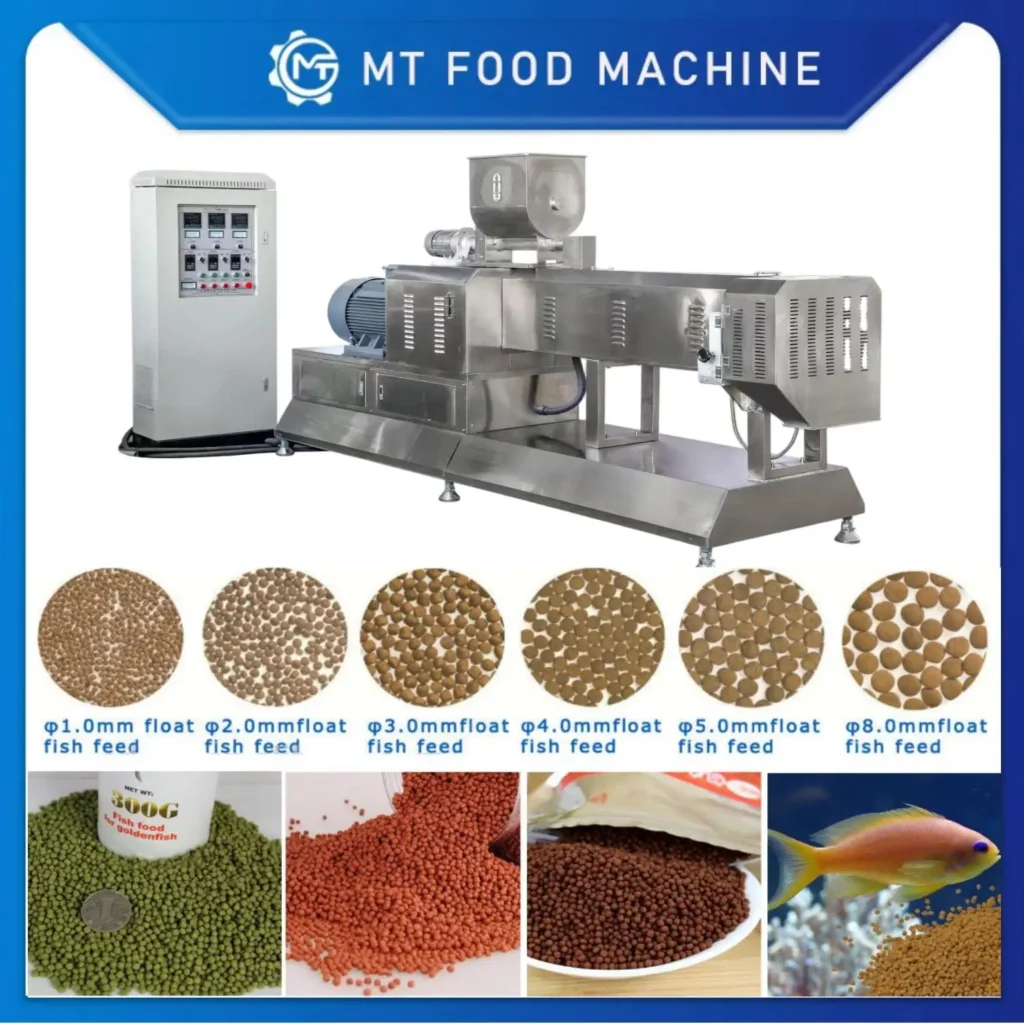
Throughput-Matched Station Integration — Every station in this fish feed processing line is supplied under one catalogue and calibrated to the same output target, eliminating the bottleneck risk that occurs when extruders, dryers, and coaters are sourced separately.
Technical Specifications
| Parameter | Value |
|---|---|
| Product Type | Fish Feed Processing Line |
| Screw Type | Twin-screw |
| Output Capacity | 4–5 t/h (basis not stated in source — confirm raw material formulation, moisture content, pellet size) |
| Construction Material | 304 Stainless Steel (food-grade contact parts) |
| Control System | PLC / MCC (per manufacturer standard) |
| Target Species | Trout, Salmon, Catfish, and other fish species |
| Assembly State | Complete processing line (batching through packing) |
| Certification | CE, ISO |
Application Suitability
| Application | Material or Output |
|---|---|
| Floating aquaculture feed | High-starch formulations for trout and salmon surface feeding |
| Sinking aquaculture feed | High-protein formulations for catfish bottom feeding |
| Multi-species commercial feed | Variable raw material blends across fish meal, soy, and grain bases |
| High-volume hatchery and grow-out operations | Continuous production runs requiring matched drying and coating throughput |
Why Extruder Capacity Means Nothing Without Matching Downstream Stations
A twin-screw extruder rated for high output will stall the entire line if the dryer and coating drum cannot keep pace.
I have watched production floors in Southeast Asia where extruded pellets piled up on conveyors waiting for dryer capacity that was never specified to match the extruder. The wet product loses its structural integrity, density targets slip, and floating feed ends up sinking. This full equipment range addresses that problem by presenting every supporting station — mixing, conveying, drying, flavouring, coating, cooling, and packing — as a coordinated Fish Feed Processing Line full equipment range rather than a collection of isolated machines [NEED_CITE: common line bottleneck causes in aquaculture feed production].
Every Station Catalogued and Positioned in the Line Flow
The purpose of this equipment range is to let buyers survey the complete machine lineup before specifying a production line. Each station has a defined position in the process sequence, from the initial batching and mixing stage through extrusion, drying, coating, cooling, and final packing. The twin-screw extruder sits at the core, but the surrounding stations determine whether the line actually holds its rated throughput. Understanding where each machine fits helps buyers identify gaps before committing to a configuration.
How Throughput Matching Works Across Stations
When a dryer is undersized relative to the extruder output, moisture remains trapped in the pellet core and shelf life drops. When a coating drum runs slower than upstream delivery, fat and palatant application becomes uneven. This catalogue approach means every station in the Fish Feed Processing Line full equipment range is specified with the same throughput target in mind, so material flow stays continuous from the mixer inlet to the packing station outlet [NEED_CITE: throughput balancing principles in feed processing lines].
Reading the Specifications With Your Raw Material in Mind
The twin-screw configuration handles a wider range of raw material formulations compared to single-screw alternatives, particularly when recipes include high fat or high moisture content that requires aggressive mixing and shear inside the barrel. The 304 stainless steel contact parts resist corrosion from fish meal and marine-based ingredients that accelerate wear on carbon steel surfaces. The PLC and MCC control integration allows coordinated speed and temperature adjustments across the extruder barrel zones and the downstream dryer, which matters when switching between floating and sinking pellet recipes. Output capacity is listed at 4–5 t/h, though this figure depends on the specific formulation, moisture level, and pellet diameter being produced — always confirm against your actual raw material profile before finalising line design.
The Hidden Cost of Specifying Stations in Isolation
Purchasing an extruder from one supplier and a dryer from another often leads to integration gaps that surface only during commissioning. Conveyor heights misalign, control systems do not communicate, and the coating drum receives product at a rate it was never designed to handle. These issues cause extended downtime during installation and force buyers to retrofit adapters or variable-speed drives at their own expense. Sourcing the Fish Feed Processing Line full equipment range under one catalogue eliminates these interface problems because every station is designed to connect mechanically and electrically from the start [NEED_CITE: integration challenges in multi-vendor feed processing lines].
Why Procurement From a Single Equipment Range Reduces Risk
The complete station coverage means buyers receive a line layout and capacity calculation that accounts for every transfer point, not just the extruder barrel. Screw and die configurations are documented against the target pellet size and species, so the extrusion station is not built from a generic template. Electrical schematics and voltage specifications are confirmed for the entire line before production begins, preventing the situation where the extruder is wired for one standard and the dryer for another. The in-house testing workshop runs trial production on the buyer’s actual raw material before shipment, which means product development starts before installation rather than after. Ongoing maintenance support covers wear parts across all stations, so screw segments, die plates, and dryer screens are available from a single source.
Documentation & Verification
- Line layout and capacity calculation showing throughput at every station from batching to packing
- Machine specification sheet for each individual station in the fish feed processing range
- Screw and die configuration record matched to target pellet size and species requirements
- Electrical schematic and voltage confirmation covering the full line control system
- Trial run report produced on customer raw material before dispatch
- CE declaration of conformity and ISO certificate for the complete processing line
Installation, Commissioning & Support
- Foundation and floor space planning based on the full line footprint including dryer and cooler dimensions
- Power supply specification covering PLC and MCC panel requirements for coordinated station control
- Assembly sequencing for station-by-station installation aligned with utility connection points
- First-run parameter setting across extruder barrel zones, dryer temperature, and coating drum speed
- Operator training covering recipe changes between floating and sinking feed formulations
- Wear parts inventory including twin-screw segments, die plates, and dryer screen replacements
What to Prepare Before Requesting a Quotation
To configure this line accurately, share your target species and whether you need floating, sinking, or both pellet types. Provide your raw material formulation including protein source, starch percentage, and fat content. Specify your local voltage and frequency standards, preferred control language, and the available floor space in your production facility so the line layout can be drawn to scale.
Frequently Asked Questions
Q: What supporting stations are included alongside the twin-screw extruder?
A: The range covers mixing and batching systems, screw conveyors, the twin-screw extruder, multi-pass dryers, flavouring and coating drums, cooling conveyors, and packing stations. Each station is specified to match the throughput of the others, preventing bottlenecks that occur when equipment is sourced from separate vendors without coordinated capacity planning.
Q: How do I configure the line for floating versus sinking feed?
A: Floating and sinking pellets require different moisture levels, barrel temperature profiles, and die configurations at the extrusion stage, followed by adjusted drying times and coating parameters. The dryer and coating stations are specified to accommodate both production modes when the target species and formulation are confirmed during the line design phase.
Q: Can individual stations be ordered separately from this range?
A: Individual stations can be ordered, though throughput matching is most effective when the complete line is configured together. Ordering a single station requires sharing your existing upstream and downstream equipment specifications so the new unit can be sized and controlled to integrate without creating a bottleneck.
Q: What food-grade certifications apply to the contact materials?
A: All product contact parts across the line are constructed from 304 stainless steel, which meets food-grade requirements for aquaculture feed production. The CE declaration of conformity and ISO certification cover the complete processing line and are provided as part of the standard documentation package before shipment.