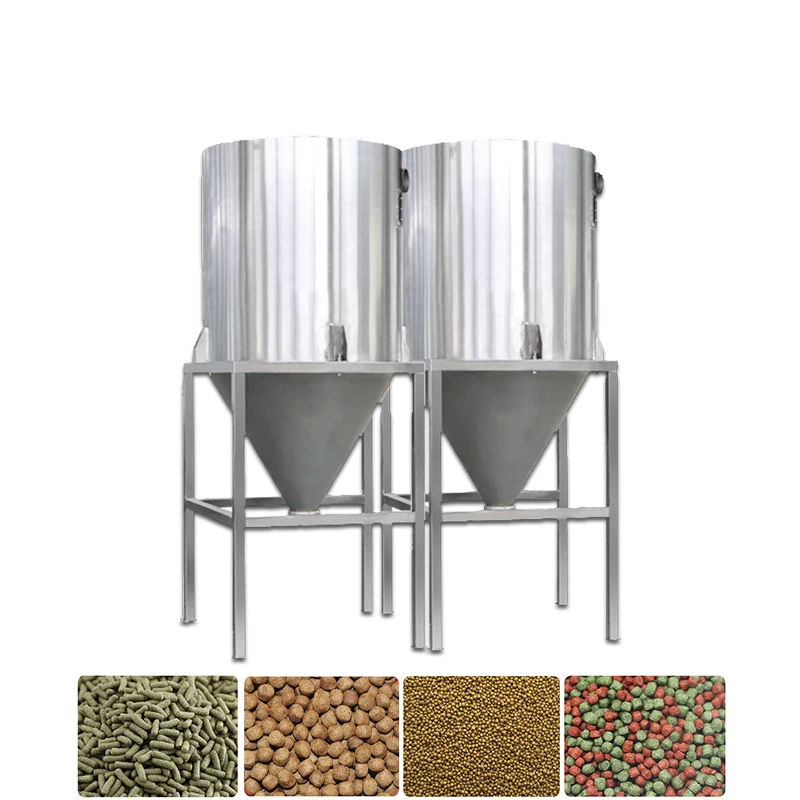
Capacity Matched to Your Material — Every extruder, dryer, and coating drum in this line is sized against the actual throughput your raw ingredients allow, not a catalogue maximum.
Technical Specifications
| Parameter | Value |
|---|---|
| Product Type | Pet Food Extrusion Production Line |
| Output Capacity | Up to 3 tons per hour (basis not stated in source — confirm raw material, moisture content, and product format) |
| Screw Configuration | Twin-screw, geometry matched to ingredient profile |
| Control Architecture | PLC and MCC control |
| Line Scope | Batching, mixing, extrusion, drying, flavouring, cooling, packing |
| Certification | CE compliant |
| Warranty | 1-year |
Application Suitability
| Application | Material or Output |
|---|---|
| Dry kibble for dogs and cats | Poultry meal, corn, wheat, soya, fats and palatants |
| Aquatic feed (floating and sinking) | Fish meal, starch binders, vitamin premix |
| Puppy and kitten starter diets | High-protein formulations requiring controlled expansion |
| Dental and functional treats | Fibre-enriched mixes with specific density targets |
Why the Quoted Output Rarely Survives Contact with Your Ingredients
A capacity figure means nothing until it is tested on the exact flour, meal, and moisture blend you will actually run.
I once watched a Middle East pet food producer stand beside a brand-new extrusion line that could only reach half its contracted output. The problem was not the motor or the gearbox — it was that the buyer’s local poultry meal carried a protein level well above the trial material used during factory acceptance. The expansion collapsed, the throughput dropped, and the dryer could not keep up with the wet, dense kibble coming off the die. That line eventually ran correctly, but only after the screw profile was reworked and the barrel heating zones were recalibrated on site. When sourcing a pet food making machine manufacturer, the first question should always be which raw material recipe underpins the quoted tonnage. [NEED_CITE: protein content and starch gelatinisation relationship in extrusion]
How the Complete Equipment Range Fits Together
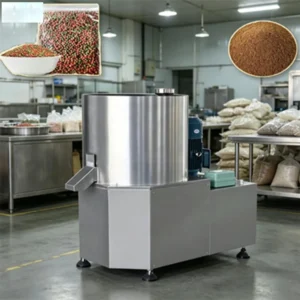
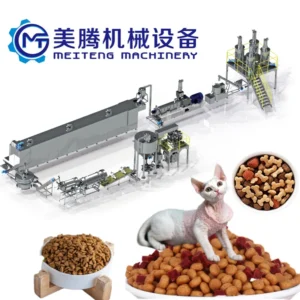
A pet food extrusion line is only as stable as its weakest station. If the mixer cannot deliver a homogeneous blend at the rate the extruder demands, the die pressure fluctuates and kibble density drifts batch by batch. This full equipment range for sale covers every link in the chain — batching, mixing, conveying, extrusion, drying, flavouring, cooling, and packing — so each stage is specified to the same throughput target rather than assembled from mismatched vendors.
What the Twin-Screw Platform Actually Does for Pet Food
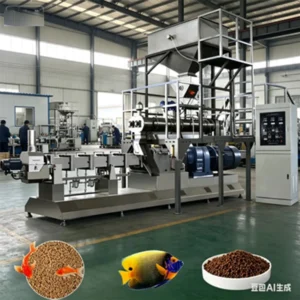
Twin-screw extrusion gives you independent control over shear, residence time, and barrel temperature across multiple zones. That matters when you switch from a standard adult dog kibble to a high-meat puppy formula: the screw elements can be rearranged to gentler conveying profiles, and the die geometry can be swapped to hold expansion without over-cooking the starch. The PLC tracks barrel temperatures and screw speed in real time, logging deviations that would otherwise go unnoticed until the lab reports a failed bulk-density test. [NEED_CITE: twin-screw extrusion shear and residence time control]
Reading the Spec Sheet Beyond the Headline Tonnage
The Output Capacity listed above carries a caveat because extrusion throughput depends on the raw material’s starch-to-protein ratio, incoming moisture, and target kibble size. A line that runs corn-heavy aquatic feed at one rate will behave very differently on a 40 % meat-meal dog food recipe. The Screw Configuration is twin-screw, which allows element-level reconfiguration rather than full barrel replacement when you change recipes. The PLC and MCC control architecture means motor starts, heater zones, and feeder speeds are interlocked; a fault in the dryer automatically ramps down the extruder to prevent a material backlog. CE compliance covers the electrical and mechanical safety directives required for most European and Middle Eastern import markets.
The Hidden Cost of an Undersized Dryer
Pet food extruders push out product at 25–30 % moisture, and that kibble must be dried down to roughly 8–10 % before flavouring and packing. If the dryer is specified to the extruder’s nominal capacity rather than its actual output on your recipe, wet kibble piles up on the cooling conveyor, mould risk climbs, and palatant adhesion fails because the surface is still damp. I have seen producers lose entire shifts to re-drying cycles that should never have been necessary. [NEED_CITE: moisture content targets for shelf-stable dry pet food]
Why Procurement Teams Source the Full Catalogue Here
Throughput matching across every station means the mixer, extruder, dryer, and flavouring drum are all calculated against the same raw-material profile, not picked from separate brochures. Screw and die configurations are specified to your ingredient list before the build starts, so the machine that arrives is already set up for your recipe. The in-house testing workshop runs your actual raw material before shipment, producing a trial report that confirms expansion, density, and output. Electrical schematics and voltage are locked in during the order stage, preventing the commissioning delays that happen when a 60 Hz motor lands in a 50 Hz plant.
Documentation & Verification
- Line layout drawing showing every station from batching silo to packing hopper with footprint dimensions
- Screw element and die plate configuration record matched to your ingredient specification
- Trial run report generated on your raw material in the testing workshop before dispatch
- Electrical schematic and voltage confirmation sheet aligned to your local grid standard
- Operation and maintenance manual covering PLC screen navigation, barrel disassembly, and screw element replacement sequence
- CE declaration of conformity and ISO certificate for customs and regulatory filing
Installation, Commissioning & Support
- Foundation plan provided showing load points for the extruder main frame and dryer support legs
- Dedicated circuit sizing for the PLC and MCC cabinet based on confirmed voltage and frequency
- Barrel and screw element assembly verified on site after transit to confirm alignment
- First production run supervised to set barrel temperature zones and die pressure for your recipe
- Operator training on PLC interface, screw changeover procedure, and daily grease-point lubrication
- Wear parts list with part numbers for screw elements, die plates, and cutter bearings supplied at handover
What to Include in Your First Inquiry
Send your target kibble size range, the protein and starch percentages of your base mix, and the daily tonnage you plan to run. Include your workshop’s available floor length and ceiling height, along with local voltage and frequency. If you already have upstream silos or downstream packing machines, list their throughput so the line can be matched at both ends.
Frequently Asked Questions
Q: How is the output capacity verified before the line ships?
A: We run your actual raw material through the extruder in our testing workshop, measuring throughput, expansion ratio, and kibble density. The trial report is shared with you and forms the basis of the final screw and die configuration before production begins.
Q: Which supporting stations are included, and how is throughput matched?
A: The line covers batching, mixing, extrusion, drying, flavouring, cooling, and packing. Each station is sized so its maximum capacity slightly exceeds the extruder’s verified output on your recipe, preventing bottlenecks at any stage.
Q: What voltage and control language options are confirmed before shipment?
A: Voltage, frequency, and plug standard are confirmed during the order stage and documented on the electrical schematic. The PLC interface language is set to your preference before the control cabinet leaves the factory.
Q: Is a trial run performed on my raw material before the line ships?
A: Yes. You send a representative batch of your ingredients to our testing workshop. We run multiple screw and die combinations, record expansion and density data, and ship the line with the proven configuration already installed.
Q: What spare wear parts are supplied, and how quickly can replacements arrive?
A: The initial shipment includes a wear parts kit covering screw tip elements, die plates, and cutter bearings. Replacement parts are machined in-house and dispatched within typical multi-week lead times once the order is confirmed.