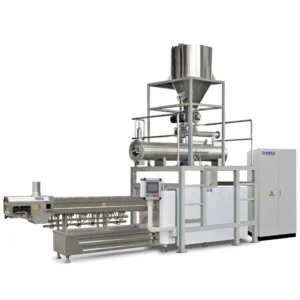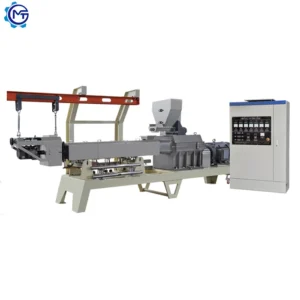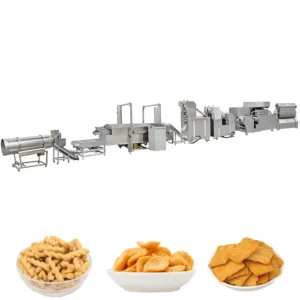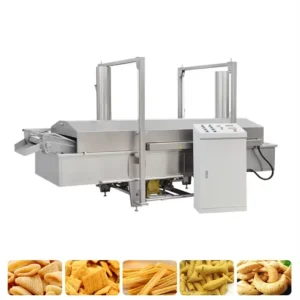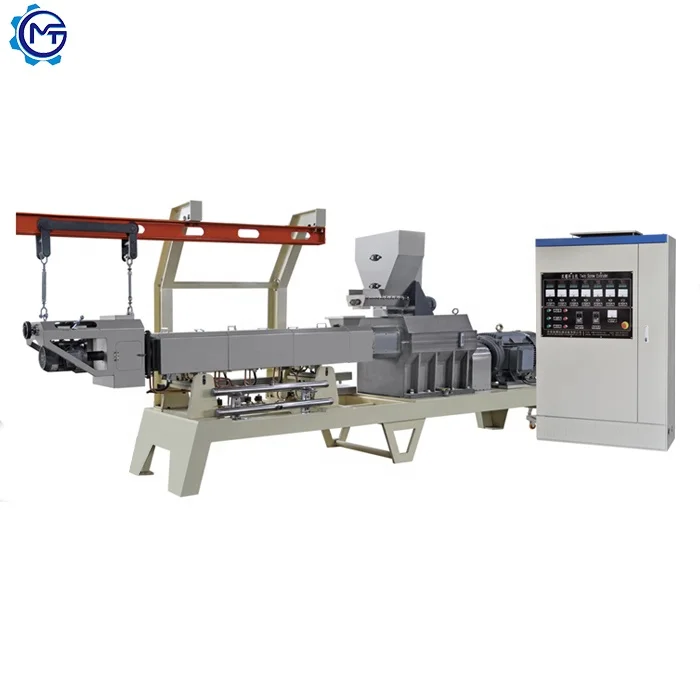
Throughput-Matched Engineering — Every station from mixing to packing is sized to the same output target, preventing the fryer or extruder from becoming the bottleneck on your snack line.
Technical Specifications
| Parameter | Value |
|---|---|
| Product Type | Automatic Deep Frying Production Line |
| Extruder Type | Single Screw Extruder |
| Raw Material Scope | Potato starch, corn starch, wheat flour |
| Output Capacity | 120 kg/h (basis not stated in source — confirm raw material blend, moisture content, product shape) |
| Rated Power | 50–70 kW (electrical heating); 50–60 kW (gas/diesel heating) |
| Voltage & Frequency | Three phase 380V/50Hz, Single phase 220V/50Hz (customizable to local standard) |
| Overall Dimensions (L×W×H) | 12,000–26,000 × 1,200 × 2,200 mm |
| Construction Material | Food grade stainless steel 201/304 |
| Energy Options | Electricity / Gas / Diesel / Steam |
| Process Flow | Mixer → Screw Conveyor → Single Screw Extruder → Pulling and Cutting Machine → Automatic Fryer → Automatic Flavoring Line → Cooling |
| Product Shapes | Screw shell, round tube, square tube, ring, cartoon shapes (die-dependent) |
| Certification | CE / ISO 9001 |
Application Suitability
| Application | Material or Output |
|---|---|
| Secondary puffing snack production (golgappa / pani puri) | Potato starch and wheat flour blends formed into thin, crisp discs before frying |
| Miscellaneous grain puffing line | Corn starch and multi-grain flour extruded into hollow tubes or rings |
| Starch-based fried snack formats | Custom die shapes including screw shells, cartoon figures, and square tubes |
| Snack factory capacity expansion | Matching the fryer and flavoring drum throughput to the single screw extruder output |
Why "120 kg/h" Means Nothing Without Matching the Fryer
An automatic deep frying production line manufacturer must size the fryer belt length, oil volume, and heating capacity to the exact output of the extruder upstream, or the entire line chokes.
I have walked into snack factories in Latin America where the extruder was running at full speed, but the product was piling up on the conveyor before the fryer because the oil temperature kept dropping every time a new batch entered. The fryer was simply undersized for the extrusion rate. The result was half-cooked product, inconsistent color, and an operator constantly adjusting the line speed down to compensate [NEED_CITE: thermal recovery rates in continuous industrial deep fryers]. When the frying station cannot recover its set-point temperature between product loads, the texture and moisture content of the final snack drift outside specification. This is the bottleneck that nominal capacity figures never reveal on a brochure.
Sizing the Frying Station to Extruder Throughput
The single screw extruder on this line pushes product continuously into the pulling and cutting machine, which then feeds the automatic fryer at a steady rate. If the fryer oil volume is too small relative to that feed rate, the thermal mass of the cold, moist product overwhelms the heating elements, and recovery time stretches well beyond the residence time needed for proper puffing and color development.
We calculate the required oil volume and belt speed based on the specific starch blend, moisture content after extrusion, and target final moisture of the fried snack. This ensures the automatic deep frying production line manufacturer delivers a fryer that holds temperature under continuous load, not just at idle.
Matching the Flavoring Drum Downstream
After frying, the product moves to the flavoring drum while still warm enough for seasoning adhesion. If the drum is undersized or the spray system cannot keep pace, product accumulates or passes through under-seasoned. Every station on this line — from the mixing system through the extruder, fryer, and flavoring drum — is specified to the same throughput target so no single machine dictates your actual output [NEED_CITE: seasoning adhesion and product temperature in snack coating drums].
Reading the Specs That Actually Matter
The rated power range of 50–70 kW for electrical heating and 50–60 kW for gas or diesel heating tells you the energy input available to maintain oil temperature under load. The choice between electricity, gas, diesel, or steam is not just a cost question — it determines how quickly the fryer recovers between product surges and how stable the oil temperature remains across a full production shift. The food grade stainless steel 201/304 construction across the line ensures contact surfaces resist corrosion from salted and seasoned product, extending the intervals between major cleaning shutdowns.
The Hidden Cost of a Mismatched Line
When a snack producer buys an extruder from one vendor and a fryer from another without reconciling their throughput curves, the gap shows up on day one of commissioning. Product either queues before the fryer, cooling and sticking together, or the fryer runs partially empty, wasting energy and degrading oil life through unnecessary heating cycles. The operator ends up running the line at a fraction of its nameplate capacity just to maintain product quality [NEED_CITE: oil degradation rates under partial-load frying conditions]. This is the scenario that turns a capacity investment into a daily source of lost output.
Why Source the Full Range From One Supplier
The single screw extruder and the continuous fryer on this line are specified together, meaning the screw configuration, die design, and fryer belt speed are all calculated against the same raw material and target product. The die-interchangeable forming system allows you to switch between screw shells, round tubes, rings, and custom shapes without changing the extruder platform, and the fryer is already sized to handle the maximum output of any die on that list. The multi-energy fryer option lets you align heating cost with your local utility rates, whether that is electricity, gas, diesel, or steam. Every contact surface is food grade stainless steel, and the voltage and frequency are confirmed against your local grid before production begins, not discovered at commissioning.
Documentation & Verification
- Line layout drawing showing matched throughput between extruder, fryer, and flavoring stations
- Screw and die configuration record for your specific starch blend and target shape
- Electrical schematic with voltage and frequency confirmed to your local grid standard
- Factory test record on your raw material before shipment, documenting output and product quality
- CE declaration of conformity and ISO 9001 certificate for the complete line
Installation, Commissioning & Support
- Foundation plan accounting for the 12,000–26,000 mm line length and fryer oil load weight
- Dedicated electrical circuit sized for the 50–70 kW heating demand at your confirmed voltage
- On-site assembly of the screw conveyor, extruder, and continuous fryer in sequence
- First-run parameter setting including barrel temperature profile and fryer oil set-point
- Operator training on die changeover, fryer oil filtration, and flavoring drum adjustment
- Wear parts list covering screws, dies, fryer belt segments, and conveyor chains
What to Prepare Before Requesting a Quote
To specify an automatic deep frying production line that actually runs at its stated capacity on your floor, we need your raw material blend and moisture content, the product shapes you intend to run, your local voltage and frequency, and the available energy source for the fryer. If you are retrofitting into an existing building, share the available floor length and ceiling height so the line layout accounts for your actual space constraints.
Frequently Asked Questions
Q: How is the 120 kg/h capacity verified against my specific starch blend and moisture?
A: The stated capacity is a reference figure that must be confirmed against your raw material blend, moisture content after extrusion, and target product shape. We run a trial on your actual material in our testing workshop before shipment, documenting the real output and product quality so you know what to expect on your floor.
Q: Which energy source is recommended for the fryer in my market?
A: The fryer is available with electricity, gas, diesel, or steam heating. The recommendation depends on your local utility cost per unit of energy, the available infrastructure at your plant, and how quickly the heating system must recover oil temperature under continuous product load.
Q: How is voltage, frequency, and control language confirmed before shipment?
A: We request your local grid specification and operator language preference during the quotation stage. The electrical schematic, motor ratings, and control panel labels are then built to match, so commissioning is not delayed by voltage mismatches or unreadable interfaces.
Q: Can I produce multiple shapes on the same extruder?
A: Yes. The single screw extruder uses interchangeable dies to form screw shells, round tubes, square tubes, rings, and custom cartoon shapes. The fryer and flavoring stations are already sized to handle the output of any die in the set, so shape changes do not require line rebalancing.