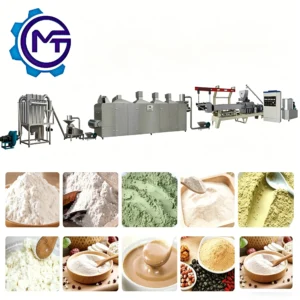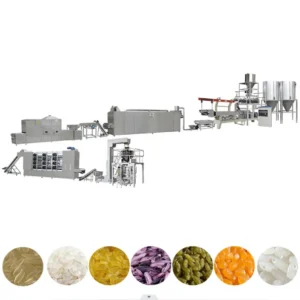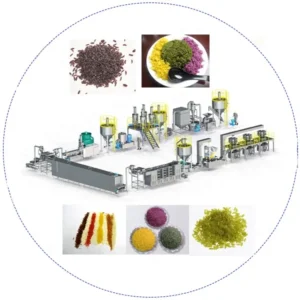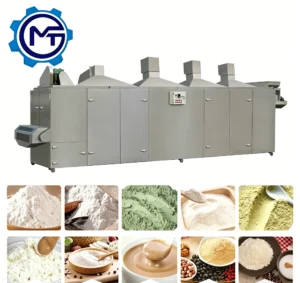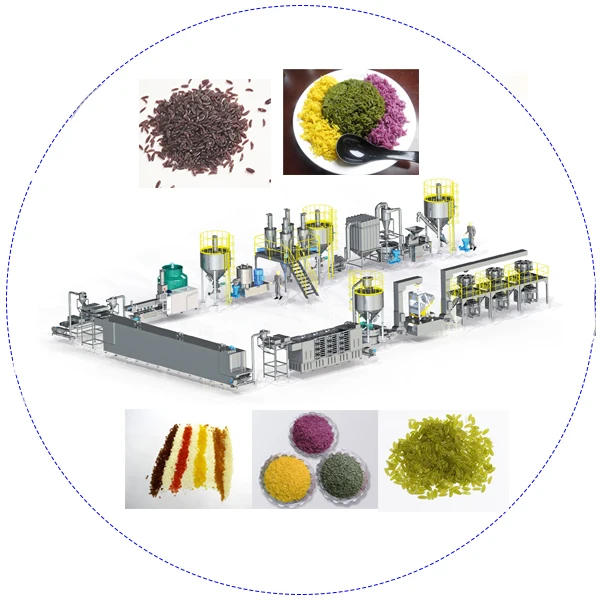
Throughput-Matched Stations — Every unit from the mixing hopper through the packing conveyor is specified as one system so the extruder, dryer and cooler run at the same real rate.
Technical Specifications
| Parameter | Value |
|---|---|
| Model | MT65 |
| Product Type | Artificial Fortified Rice Processing Line |
| Screw Type | Twin-screw extruder |
| Installed Power | 85 kW |
| Power Consumption | 60 kW |
| Output Capacity | 80–100 kg/h (basis not stated in source — confirm raw material formulation and moisture content) |
| Overall Dimensions | 28 × 1.2 × 2.2 m |
| Control System | Frequency speed control with high automation |
| Feeding System | Single or double screw feeding (selected according to material characteristics) |
| Screw Material | Special wear-resistant alloy |
| Lubrication | Automatic lubricating and cooling system |
| Drying Oven Heating Source | Electric or gas |
| Line Stations | Mixing → Extruding → Vibrating → Low-temperature drying → Cooling → High-temperature roasting → Cooling → Packing |
Application Suitability
| Application | Material or Output |
|---|---|
| Nutritional fortified rice kernels | Broken rice blended with vitamin and mineral premixes for public health feeding programmes |
| Artificial rice from milling by-products | Rice bran and broken rice fractions reconstituted into uniform, cook-stable kernels |
| Multi-grain fortified products | Corn, millet, oats and buckwheat bases with added micro-nutrients for commercial food brands |
| Institutional and humanitarian supply | Shelf-stable fortified grain kernels packaged for large-scale distribution channels |
Why Quoted Output Rarely Survives Contact With Your Actual Grain Blend
A capacity figure is only as honest as the raw material formula behind it.
I once supported a buyer who ordered a line based on a brochure rating, only to discover their specific blend of milled sorghum and local starch created a dough far more viscous than the test grain. The extruder could not push that mass at the quoted rate, and every downstream station — the vibrating screen, the low-temperature dryer — sat idle waiting for material. When evaluating any Artificial Fortified Rice Processing Machine full equipment range, ask the supplier what exact formula, moisture level and particle size the throughput number assumes [NEED_CITE: importance of raw material formulation to extrusion throughput]. Without that context, the number on the spec sheet is a ceiling you may never reach.
Feeding System Selection and Raw Material Behaviour
The Artificial Fortified Rice Processing Machine full equipment range can be configured with a single or double screw feeding system, and the choice is not cosmetic. A single screw feeder handles free-flowing broken rice and dry starch blends well, keeping the line simple and easy to clean between batches. A double screw feeder, with its positive displacement action, is the correct fit when the blend includes sticky vitamin premixes, oil-coated micro-nutrients or fine mineral powders that tend to bridge in a single-screw hopper. Getting this decision wrong shows up as inconsistent feed density entering the extruder barrel, which then produces kernels of uneven size and moisture content batch after batch.
Multi-Stage Drying and Kernel Integrity
Proper kernel texture in fortified rice depends on controlled moisture removal, not just high heat. This line routes product through a low-temperature drying stage first, which draws out surface and shallow moisture without case-hardening the kernel shell [NEED_CITE: grain drying principles for reconstituted rice products]. The product then passes through a cooling conveyor before entering high-temperature roasting, which sets internal starch structure and develops the slightly translucent appearance consumers associate with quality rice. Skipping or shortening either stage leaves kernels that crack during packaging or disintegrate when the end user washes them before cooking.
Interpreting the Power and Capacity Numbers
The 85 kW installed power and 60 kW operating consumption on this model tell you two different things: peak draw during startup and screw acceleration, versus the steady-state load once the barrel is thermally stable and material is flowing. The 80–100 kg/h capacity band is published without a stated formulation basis, so treat it as a starting point for discussion rather than a purchase commitment. What matters for your planning is running a trial on your actual grain blend — the exact broken rice source, the specific vitamin premix supplier, the moisture content your storage conditions produce — and recording the real throughput at stable screw speed and barrel temperature. The twin-screw configuration and automatic lubricating and cooling system are designed for continuous duty, but continuous duty at what output must be proven on your material.
The Hidden Cost of Mismatched Station Capacity
When extruder, dryer and packing stations are sourced from separate vendors, each supplier sizes their unit to a nominal figure that rarely aligns with the others. The result is a line where the extruder produces faster than the dryer can handle, forcing operators to dump product or idle the extruder in cycles [NEED_CITE: production line bottleneck caused by mismatched equipment capacity]. Over a full shift, this means you are paying for installed capacity you cannot actually use. Wear on the twin screws also increases when the extruder must start and stop repeatedly instead of running at a steady rate, leading to earlier replacement of screw elements and die plates.
Why Sourcing the Full Range From One Manufacturer Matters
Every station in this Artificial Fortified Rice Processing Machine full equipment range is specified together, so throughput is calculated end to end before any metal is cut. The screw configuration and die design are matched to your raw material formulation, not copied from a generic build. An in-house testing workshop runs your actual grain blend before shipment, producing a trial report that confirms kernel shape, density and moisture at the die exit. Frequency speed control across all stations lets operators adjust the entire line from one panel when formulations change between production runs. Documentation covers the complete line layout, capacity calculation, electrical schematic and voltage confirmation, not just individual machine data sheets.
Documentation & Verification
- Line layout drawing showing station spacing and material flow for the full 28 m footprint
- Screw and die configuration record matched to your grain blend and target kernel size
- Electrical schematic with voltage, frequency and control language confirmed before production
- Trial run report on your raw material from the in-house testing workshop before dispatch
- CE declaration of conformity and ISO certificate covering the full processing line
- Wear parts list identifying screw elements, die plates and feeder components by part number
Installation, Commissioning & Support
- Floor plan review to confirm the 28 × 1.2 × 2.2 m line footprint fits your workshop bay
- Electrical supply verified against 85 kW installed load with dedicated circuit breaker sizing
- Equipment arrives in sectional modules for sequential assembly along the production line
- First-run commissioning includes barrel temperature profiling and screw speed calibration on your blend
- Operator training covers feeding system changeover between single and double screw configurations
- Spare screw elements and die plates supplied with initial shipment to cover early wear replacement
What to Include With Your Inquiry
To size this line accurately, share your primary grain base — broken rice, corn, millet or a custom multi-grain blend — along with the specific vitamin and mineral premix formulation and target kernel dimensions. Confirm your local voltage, frequency and preferred control panel language so the electrical schematic can be finalized before production starts. If you have an existing dryer or packing station you want to integrate, provide its throughput rating so the new equipment can be matched accordingly.
Frequently Asked Questions
Q: How is output capacity verified across the full line, and what formulation is the quoted throughput based on?
A: The published 80–100 kg/h figure is a reference range. Real capacity depends on your specific grain blend, moisture content and premix ratio. We run a trial on your actual raw material in the testing workshop and document the stable output rate, kernel density and moisture content before confirming the final line configuration.
Q: Which drying oven heating source — electric or gas — suits my production scale?
A: The choice depends on local utility costs and available supply capacity. Electric heating offers precise zone control and simpler installation but draws significant amperage from the 60 kW operating load. Gas heating reduces electrical demand and often lowers per-kilogram drying cost where gas infrastructure is available. We calculate both options against your utility rates during line design.
Q: Can the feeding system be matched to my specific grain and additive blend?
A: Yes. The line supports single or double screw feeding, selected based on your material flow characteristics. Free-flowing broken rice typically uses single screw feeding, while blends containing fine mineral powders, oily premixes or sticky binders require double screw positive displacement to maintain consistent feed density into the extruder.
Q: What voltage and control panel language options are available?
A: Voltage and frequency are configured to your local grid standard before production begins. Control panel language is set to match your operator team. The frequency speed control system allows adjustment across all stations from a single interface, and the electrical schematic is provided in your preferred language for maintenance reference.
Q: How is throughput balanced between the extruder, dryer and packing stations?
A: Every station is specified as part of one integrated line, so capacity is calculated end to end. The dryer length, cooling conveyor speed and packing station rate are all sized to the confirmed extruder output on your formulation, eliminating bottleneck stations that cap real production below the quoted figure.