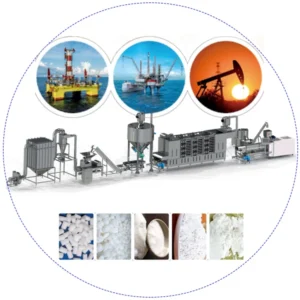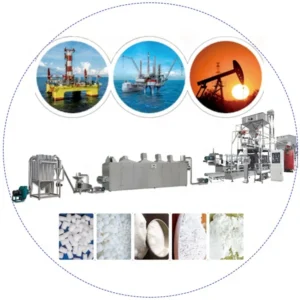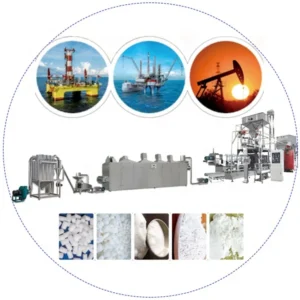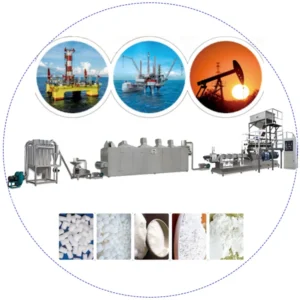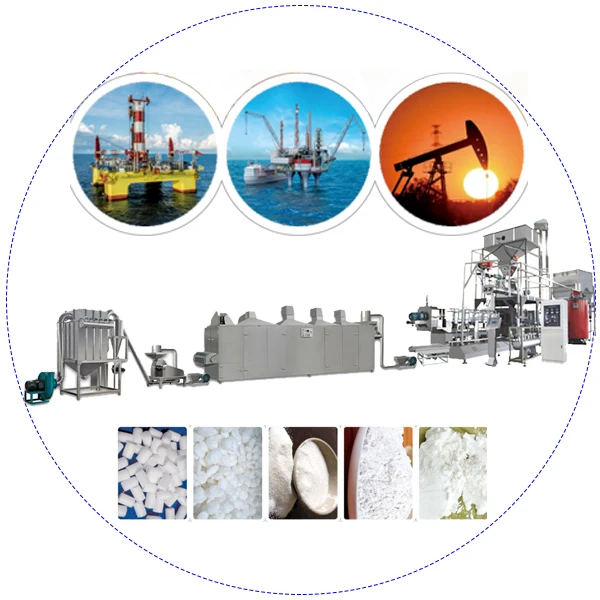
Integrated Throughput Matching — Every station from batching to grinding is sized against the same raw material data, so the extruder output never starves the dryer or floods the grinder.
Technical Specifications
| Parameter | Value |
|---|---|
| Product Type | Modified and Pregelatinized Starch Processing Line |
| Screw Type | Twin-screw extruder |
| Output Capacity | 80–500 kg/h (basis not stated in source — confirm raw material, moisture and gelatinisation degree) |
| Raw Materials | Wheat flour, corn starch, potato starch |
| Energy Source Options | Electricity / gas / diesel / steam |
| Rated Power | Approx. 100 kW (electric heating); approx. 50–60 kW (gas or diesel heating) (rated or peak not specified in source) |
| Control System | PLC and MCC (source value — verify against manufacturer catalog) |
| Frame Material | Stainless steel 201; food-grade contact parts in stainless steel 304 |
| Process Flow | Mixer → Screw conveyor → Twin-screw extruder → Shift → Air conveyor → Dryer → Air conveyor → Conditioning → Conveyor → Grinder |
| Mixer Motor | 4.0 kW |
| Mixer Output | 3.0–4.0 kg per batch (basis not stated in source — confirm batch time and moisture addition) |
| Screw Conveyor Motor | 1.1 kW |
| Screw Conveyor Output | 0–150 kg/h (basis not stated in source — confirm material bulk density) |
| Die Configuration | Interchangeable dies |
| Standards | CE; ISO |
Application Suitability
| Application | Material or Output |
|---|---|
| Pregelatinised starch for instant food and bakery formulations | Corn starch, cassava starch |
| Modified starch for sauce and dressing thickening | Wheat flour, potato starch |
| Industrial starch for paper and textile coating | Corn starch, wheat flour |
| Denatured starch for adhesive and binder applications | Cassava starch, corn starch |
Why a "500 kg/h" Quote Can Still Leave You Stuck at Half Output
The rated capacity of any modified starch processing line equipment for sale only matters if it was measured on your exact starch source at your target moisture level.
I have walked through too many factories where the extruder nameplate promised a certain throughput, but the actual material — say, a cassava starch with lower amylopectin content — could not absorb shear and heat the same way corn starch does. The result is a line that runs well below expectation from day one. When you specify a modified starch processing line, the capacity discussion must start with your raw material certificate of analysis, not the brochure figure [NEED_CITE: raw material variability in starch gelatinisation behaviour].
How Twin-Screw Geometry Meets Different Starch Sources
A modified starch processing line equipment for sale built around a twin-screw extruder gives you the shear control needed to gelatinise stubborn starches like cassava while still being gentle enough for wheat flour. Screw element arrangement — kneading blocks, reverse-pitch segments, conveying flights — is rearranged for each starch type so that residence time and mechanical energy match the granule disruption temperature of that specific material.
Energy Source Selection and Its Effect on Gelatinisation Consistency
The choice between electric, gas, diesel or steam heating changes how barrel zones hold temperature under load. Electric heating responds faster to PID corrections, which matters when you are holding a narrow gelatinisation window on potato starch. Gas or diesel heating suits sites where electricity costs are high, but barrel temperature swing can be wider, so the PLC must be tuned for that thermal lag [NEED_CITE: thermal response differences between electric and combustion heating in extrusion barrels].
What the Specification Sheet Actually Tells You About Daily Output
The 80–500 kg/h capacity range listed above must be confirmed against the raw material you will actually feed into the mixer. Corn starch, cassava starch and potato starch all gelatinise at different temperatures and absorb moisture differently inside the barrel. The 4.0 kW mixer motor and 3.0–4.0 kg per batch output determine how fast you can prepare each batch for the screw conveyor, and that batch cycle must keep pace with the extruder to avoid starvation. Stainless steel 304 contact surfaces are specified because modified starch destined for food-grade applications must avoid iron contamination that catalyses oxidation during storage.
What Happens When Stations Are Sized Independently
If the dryer is chosen only for its own rated evaporation rate without matching the extruder’s actual moisture discharge, you end up with either a bottleneck where wet product queues up, or an oversized dryer burning fuel to heat empty conveyor space. I have seen starch lines where the grinder was undersized for the extrudate density, causing the whole line to pause every few hours for clearing. Every station on this modified starch processing line equipment for sale is calculated together, using the same material data, so throughput stays balanced from the mixer through to the final grind [NEED_CITE: throughput balancing methodology in continuous food processing lines].
Why Buyers Source the Full Line from a Single Supplier
Screw configuration and die design are documented against your raw material before the extruder leaves the factory, so the same product quality is repeatable from the first production run. The in-house testing workshop runs your actual starch through the extruder before shipment, catching throughput mismatches while adjustments are still cheap. Complete lines from batching to packing under one supplier mean that warranty responsibility and spare parts accountability sit with one party rather than being split across five vendors. Pre-sales engineering covers line layout, utility planning and voltage confirmation for your destination market before production begins.
Documentation & Verification
- Line layout drawing with station-by-station throughput calculation for your starch source
- Screw and die configuration record listing element positions and die bore diameter
- Trial run report documenting output, moisture and gelatinisation degree on your raw material
- Electrical schematic with confirmed voltage, frequency and PLC language for destination market
- CE declaration of conformity and ISO certificate covering manufacturing scope
Installation, Commissioning & Support
- Foundation plan specifying load points for the twin-screw extruder and dryer assemblies
- Dedicated circuit requirement for the approx. 100 kW electric heating variant
- Assembly sequence for the screw conveyor and air conveyor sections to align with ceiling clearance
- Barrel temperature profile tuning during first start-up on your local starch batch
- Operator training covering die change procedure and screw element inspection intervals
- Wear parts list identifying screw segments, die inserts and mixer blade replacement schedule
What We Need to Quote an Accurate Line
Send us the starch source you will process — corn, cassava, wheat or potato — along with a recent certificate of analysis showing amylose-to-amylopectin ratio and typical moisture content. Let us know the gelatinisation degree or modification type your market requires, and the daily output you need to hit. Confirm your local voltage and frequency, and whether your site has gas, steam or only electrical supply available, so we can select the right heating configuration for the modified starch processing line equipment for sale.
Frequently Asked Questions
Q: How is output capacity verified before the line ships?
A: We run your actual starch through the twin-screw extruder in the in-house testing workshop, recording throughput at your target moisture and gelatinisation degree. The trial run report documents the measured output so the capacity figure you receive is tied to your material, not a generic test.
Q: How are screw configuration and die design chosen for my starch?
A: The screw element sequence and die bore are selected based on the gelatinisation temperature and shear sensitivity of your specific starch source. Kneading block angles, reverse-pitch positions and flight pitch are adjusted so that residence time and mechanical energy match what your material requires.
Q: What voltage and frequency can the line be configured for?
A: Standard supply is three-phase 380 V / 50 Hz with single-phase 220 V / 50 Hz for auxiliary circuits. Voltage and frequency are confirmed against your destination market before production, and the electrical schematic reflects the agreed specification so commissioning starts without transformer delays.
Q: How do you prevent bottlenecks between the extruder and dryer?
A: Each station is sized using the same raw material data and target moisture figures. The dryer evaporation rate is calculated from the extruder’s actual discharge moisture, and the grinder capacity is matched to the extrudate density, so no single station limits the overall modified starch processing line equipment for sale output.