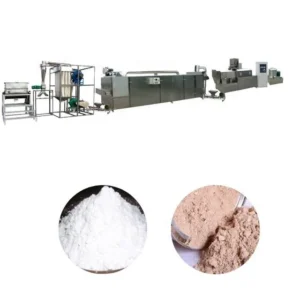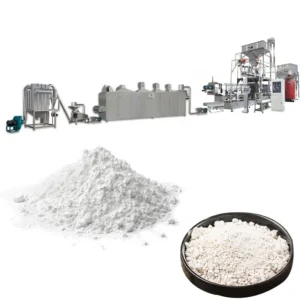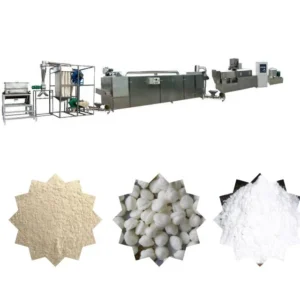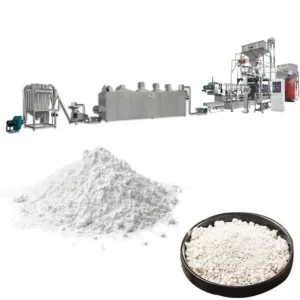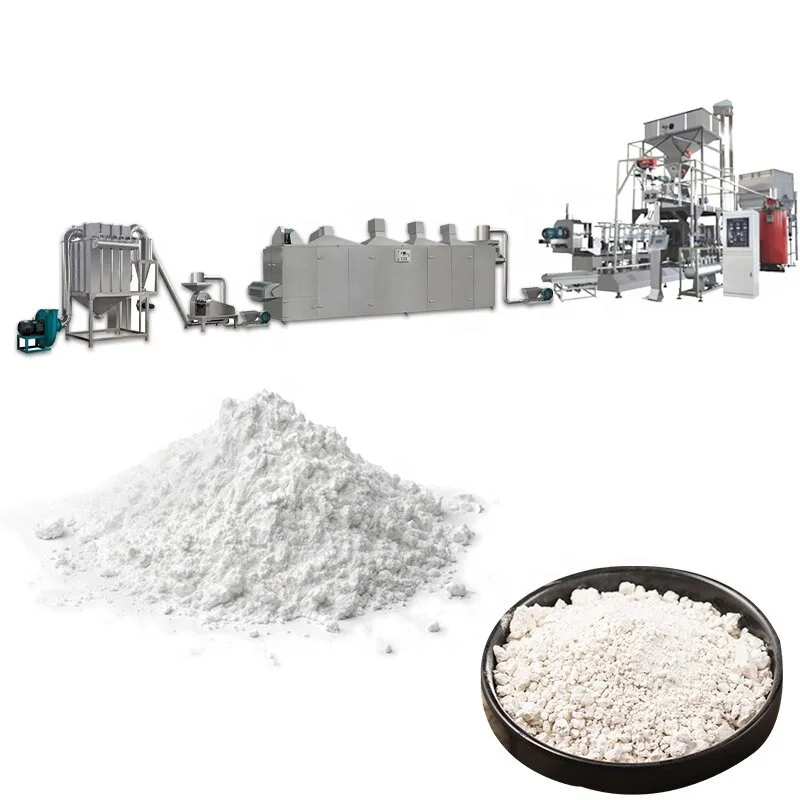
Full-Line Matching — Every station from batching to grinding is configured under one supplier, so throughput aligns across the modified starch processing line rather than depending on separate vendors to synchronize.
Technical Specifications
| Parameter | Value |
|---|---|
| Product Type | Twin-Screw Extrusion Modified Starch Production Line |
| Capacity Range | 80–500 kg/h (basis not stated in source — confirm raw material type, moisture content and degree of modification) |
| Extruder Type | Twin-screw extruder |
| Screw Material | 45 steel (barrel interior) |
| Contact Material | Food-grade stainless steel 304 |
| Frame Material | Stainless steel 201 |
| Energy Source Options | Electricity / Gas / Diesel / Steam |
| Rated Power (Electric) | Approx. 100 kW (basis to be confirmed) |
| Rated Power (Gas/Diesel) | Approx. 50–60 kW (basis to be confirmed) |
| Voltage & Frequency | Three-phase 380V/50Hz; Single-phase 220V/50Hz (customizable) |
| Motor Brand | Siemens (China-made) or China top brand |
| Inverter | Delixi or Delta |
| Mixer Motor | 4.0 kW |
| Mixer Dimensions | 1.2 × 0.9 × 1.4 m |
| Mixer Output | 3.0–4.0 kg per batch |
| Screw Conveyor Motor | 1.1 kW |
| Screw Conveyor Dimensions | 2.5 × 0.6 × 2.3 m |
| Screw Conveyor Output | 0–150 kg/h |
| Process Flow | Mixer → Screw Conveyor → Twin-Screw Extruder → Air Conveyor → Dryer → Air Conveyor → Conditioning → Conveyor → Grinder |
| Die Configuration | Interchangeable dies for different product forms |
| Assembly State | Complete line with supporting equipment |
| Warranty | One year |
| Certification | CE |
Application Suitability
| Application | Material or Output |
|---|---|
| Pregelatinised starch for instant food mixes | Corn starch, cassava starch |
| Modified starch for paper coating and sizing | Corn starch, wheat flour |
| Cross-linked and oxidized starch for industrial adhesives | Potato starch, cassava starch |
| Nutritional and functional starch ingredients | Corn starch, wheat flour, potato starch |
| Textile and printing paste starch modification | Corn starch, cassava starch |
Why Nominal Capacity Figures Mislead Starch Buyers
A line rated at a single output number tells you nothing until you run your actual raw material through it.
I have watched buyers compare proposals based on a headline capacity figure, only to discover during commissioning that their specific starch source — with its own amylose-to-amylopectin ratio and native moisture level — behaves completely differently inside the barrel. Corn starch at one moisture content may extrude cleanly at a given screw speed, while cassava starch at the same moisture turns gummy and blocks the die plate within minutes. The modified starch processing line full equipment range you see on paper means little without trial data tied to your exact feedstock [NEED_CITE: starch gelatinisation behaviour varies by botanical source and moisture content].
How Screw Configuration Controls Starch Gelatinisation
The twin-screw extruder sits at the heart of this modified starch processing line full equipment range, and its screw arrangement determines how thoroughly starch granules break down under heat and shear. Forward-conveying elements push material through quickly, while kneading blocks introduce the mechanical energy needed to disrupt crystalline structures within the granule. The ratio between these two element types must shift depending on whether you are producing a lightly pregelatinised starch for cold-water swelling or a heavily modified product requiring near-total molecular disruption. Getting this balance wrong means either under-processed starch that fails viscosity tests or over-processed material that loses its functional properties entirely.
Barrel Temperature Zones and Reaction Consistency
Multiple heating zones along the barrel allow operators to build a temperature profile that matches the specific modification chemistry taking place. Oxidation reactions, for instance, demand a different thermal curve than simple pregelatinisation. Each zone can be set independently, giving the process engineer control over where along the screw length the peak gelatinisation temperature is reached. This level of zoning becomes critical when switching between corn starch and potato starch in the same extruder, since their gelatinisation onset temperatures differ by several degrees [NEED_CITE: gelatinisation temperature ranges for common starch sources].
Decoding the Specification Sheet for Your Operation
The 80–500 kg/h capacity range appears broad, and it is — that span reflects the difference between running a low-moisture corn starch through a short residence-time configuration versus a high-moisture cassava blend requiring extended barrel length and slower throughput. The food-grade 304 stainless steel contact surfaces matter because modified starches destined for food applications must avoid metal contamination that carbon steel barrels can introduce over time. Motor selection between Siemens China-made and domestic alternatives affects long-term bearing reliability rather than immediate output. The inverter choice between Delixi and Delta governs how precisely screw speed can be ramped during start-up and shutdown sequences, which influences product consistency during those transitional periods.
What Happens When Stations Are Not Matched
I visited a facility in Guangdong last year where the extruder was sized correctly but the dryer had been purchased from a different vendor based on a generic moisture-evaporation estimate. The result was a bottleneck: the twin-screw unit had to be throttled back because wet starch accumulated faster than the dryer could handle it. Downstream, the grinder received material that had not fully equilibrated in moisture, producing uneven particle sizes that failed the buyer’s specification [NEED_CITE: importance of throughput balancing in multi-station food processing lines]. Every station in a modified starch processing line full equipment range must be calculated against the same raw material data and target moisture at each transfer point.
Why Buyers Choose This Configuration
Each piece of supporting equipment is selected against the extruder’s actual output curve on the buyer’s raw material, not against a catalogue maximum. The screw configuration and die design are specified for the target starch modification type before production begins. An in-house testing workshop allows trial runs on customer-supplied samples before shipment, so gelatinisation degree and viscosity can be confirmed in advance. Twin-screw expertise across multiple starch sources means the barrel profile is designed for your specific amylose content. Pre-sales engineering consultation carries through to on-site installation, commissioning, and ongoing maintenance support.
Documentation & Verification
- Line layout drawing showing capacity calculation for your starch type and target modification degree
- Screw and die configuration record matched to your raw material sample
- Trial run report from in-house testing on customer-supplied starch before dispatch
- Electrical schematic confirming voltage, frequency, and control language for your facility
- CE declaration of conformity and ISO certificate included with shipment
- Wear parts list with recommended first-order quantities for screws, dies, and seals
Installation, Commissioning & Support
- Foundation plan accounts for mixer dimensions (1.2 × 0.9 × 1.4 m) and extruder footprint with leveling points
- Dedicated three-phase 380V/50Hz circuit with rated capacity above 100 kW for electric-heated configurations
- Line arrives in modular sections requiring on-site assembly of conveyor connections and dryer ductwork
- First-run commissioning includes barrel temperature profiling and screw speed calibration on your starch
- Operator training covers die changeover procedures and kneading block arrangement for product switches
- Spare screw elements and interchangeable dies stocked with recommended first-order quantities
- Routine maintenance schedule covers barrel liner inspection intervals and motor bearing lubrication cycles
What We Need From You to Quote Accurately
Share the specific starch source or blend you plan to process — corn, cassava, potato, wheat, or a combination — along with the modification type and target functional properties. Confirm your local voltage and frequency, plus the control panel language your operators require. Let us know whether you need a trial run on your raw material before shipment so we can schedule testing workshop time accordingly.
Frequently Asked Questions
Q: What conditions determine the actual output within the 80–500 kg/h range?
A: The reachable throughput depends on your raw starch type, its native moisture content, the degree of modification required, and the screw configuration selected. Cassava starch at higher moisture may require slower throughput for complete gelatinisation, while dry corn starch under lighter modification can run toward the upper end. We confirm actual output during a trial run on your sample before finalizing the line specification.
Q: How are the screw elements and dies configured for different modified starch products?
A: Each product type — pregelatinised, oxidized, cross-linked — demands a different ratio of kneading blocks to conveying elements and a specific die geometry. We design the screw arrangement based on your target viscosity, swelling power, and particle density, then document the configuration so you can replicate or adjust it during future production runs.
Q: How do you prevent bottlenecks between the mixer, extruder, dryer, and grinder?
A: Every station is sized against the same material balance calculation using your raw starch data and target moisture at each transfer point. The mixer batch cycle, screw conveyor feed rate, extruder throughput, dryer evaporation capacity, and grinder throughput are all cross-checked so no single unit constrains the others during steady-state operation.
Q: Can the voltage and control panel language be customized for my country?
A: Yes. The electrical system is configurable beyond the standard three-phase 380V/50Hz and single-phase 220V/50Hz to match your local supply. Control panel labels and HMI language are set before shipment based on your operator requirements, avoiding commissioning delays caused by mismatched documentation or unfamiliar interface text.
Q: Can you run my raw material in your testing workshop before I commit?
A: Our in-house machine testing workshop accepts customer-supplied starch samples for trial extrusion runs. We measure gelatinisation degree, expansion behaviour, and moisture profile at each station, then share a full trial run report so you can evaluate whether the modified starch processing line meets your product specification before placing the order.