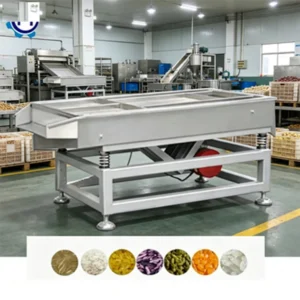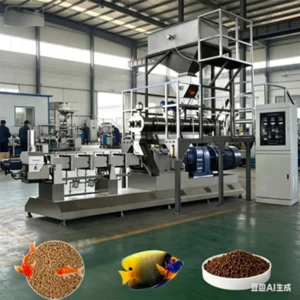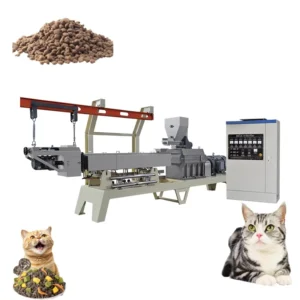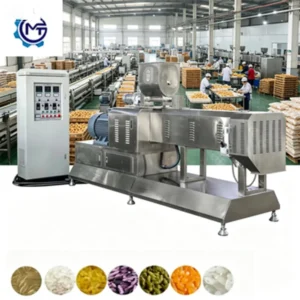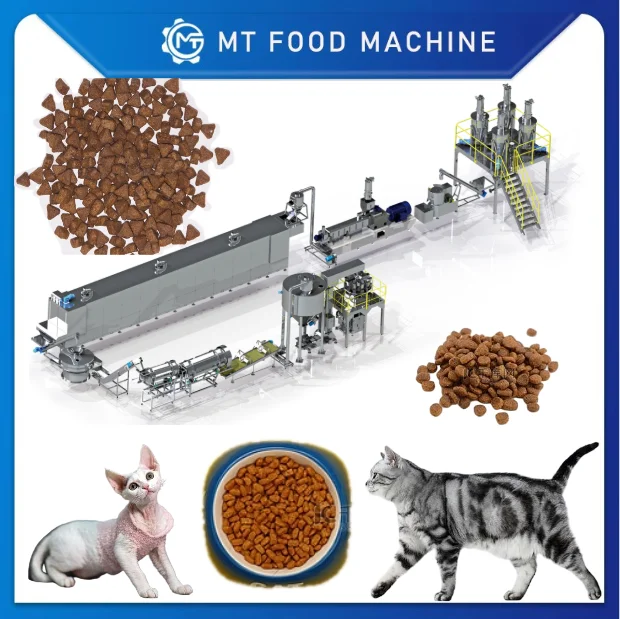
Throughput-Matched Line Integration — Every station from mixing to packing is sized to the MT100 extruder so no single unit bottlenecks your pet food processing line for sale.
Technical Specifications
| Parameter | Value |
|---|---|
| Model | MT100 |
| Product Type | Multi-Species Pet Food Processing Line |
| Output Capacity | 1.5–2.0 t/h (basis not stated in source — confirm raw material formulation, moisture content, and kibble size) |
| High Capacity Variant | Up to 550 kg/h (basis not stated in source — confirm raw material, pellet geometry, and operating conditions) |
| Control System | PLC Controlled |
| Application Range | Cat, dog, fish, bird, and cattle feed |
| Screw Type | Configurable to formulation requirements |
| Assembly State | Complete processing line with supporting stations |
| Technical Support | Video technical support and online after-sales service |
| Certifications | CE and ISO compliant |
Application Suitability
| Application | Material or Output |
|---|---|
| Dry kibble production for dogs and cats | Corn, meat meal, poultry by-product, rice flour blends |
| Floating and sinking aquatic feed | Soybean meal, wheat gluten, fish meal, starch binders |
| Bird feed pellet extrusion | Millet, sorghum, sunflower meal, vitamin premix |
| Cattle feed supplement pellets | Bran, oilseed cake, urea, mineral concentrates |
| Multi-species co-production runs | Rapid die and screw changeover between feed formats |
What a Quoted Capacity Figure Leaves Out on a Pet Food Processing Line for Sale
Real throughput depends entirely on your formulation, not the nameplate.
I have watched lines rated at two tonnes per hour struggle past one tonne when the buyer switched to a high-meat-meal recipe without telling anyone before shipment. Meat meal raises fat content and changes the friction profile inside the barrel; the screw shear that works on a corn-dominant blend will not gelatinise starch properly when protein dominates. A pet food processing line for sale should always be validated against the actual raw material you intend to run [NEED_CITE: raw material impact on extrusion throughput].
Matching Dryer and Coating Capacity to the Extruder
An extruder that pushes out two tonnes per hour means nothing if the dryer downstream can only handle one. Many buyers focus on the extruder model and treat downstream stations as afterthoughts, then discover that moisture removal becomes the real ceiling on daily output. The MT100 configuration pairs the dryer bed area, airflow volume, and residence time to the extruder discharge rate so kibble reaches the coating drum at the correct moisture level. Without this matching, surface moisture stays trapped and shelf life shortens.
PLC Control Across Every Station in the Line
The PLC system on the MT100 extends beyond the extruder barrel. Temperature zones, screw speed, feeder rate, dryer belt speed, and coating drum rotation all sit on the same control network. This means an operator adjusting the recipe for a switch from dog kibble to cat kibble can load a saved profile that changes setpoints across every station simultaneously. For plants running multi-species production in the same shift, this reduces changeover error and keeps batch records consistent for traceability audits [NEED_CITE: PLC integration in food extrusion lines].
Reading the Specs That Actually Matter
Output capacity figures quoted without raw material context are starting points, not guarantees. The MT100 lists 1.5–2.0 t/h, but that range shifts depending on whether you run a starch-heavy bird feed or a high-protein aquatic pellet. Screw configuration determines residence time and shear intensity; die geometry controls expansion ratio and final kibble density. The PLC-controlled system lets you log temperature profiles and screw speeds per recipe, which is where true repeatability comes from. Buyers comparing machines should ask for the screw and die configuration record matched to their specific formulation rather than relying on a generic spec sheet alone.
The Hidden Cost of Mismatched Station Configuration
When the flavouring drum cannot keep pace with the extruder, product piles up on the conveyor, cools unevenly, and absorbs coating inconsistently. I have seen plants where the coating step added an extra shift per week simply because the drum volume was undersized. On a pet food processing line for sale, the consequence is not just lost capacity — it is off-spec product that your customer rejects because the fat coating percentage drifts outside the label declaration [NEED_CITE: downstream bottleneck effects on product quality].
Why Source the Complete Line from One Supplier
Every station in the MT100 line — batching, mixing, extruding, drying, coating, cooling, packing — is selected so throughput aligns at each transfer point. The screw and die configuration is specified to your raw material and target kibble density before the machine is built. An in-house testing workshop runs trial production on your actual formulation before shipment, so product development does not start on your factory floor. Pre-sales engineering covers line layout and utility planning, and the same team handles on-site commissioning and operator training.
Documentation & Verification
- Line layout and capacity calculation confirming station-by-station throughput balance
- Screw and die configuration record matched to your raw material and kibble geometry
- Trial run report produced on your formulation before dispatch
- Electrical schematic with voltage and frequency confirmation for your site
- Operation and maintenance manual covering every station in the line
- Wear parts list with reorder codes for screws, dies, and seals
Installation, Commissioning & Support
- Foundation and utility plan covering PLC cabinet power feed and dryer gas or electric heat source
- Voltage and frequency confirmed against site supply before the MT100 control panel is wired
- Extruder barrel alignment and screw assembly checked on site during first startup
- Dryer airflow balanced and coating drum spray calibrated to your fat application rate
- Operator training on PLC recipe management across all stations
- Wear parts inventory reviewed and reorder lead times confirmed before handover
What We Need to Configure Your Line
To move from catalogue review to a firm proposal, share your target species and kibble size, the raw material formulation you plan to run including moisture and fat percentages, and your daily production target. We also need your site voltage, frequency, and preferred control language so the PLC is programmed correctly before dispatch. If you have existing upstream or downstream equipment that must integrate, send us the connection points and throughput figures.
Frequently Asked Questions
Q: How is the MT100 output capacity verified before shipment?
A: We run a trial on your actual raw material in our testing workshop, recording throughput, barrel temperature, and screw speed. The trial run report ships with the machine so you know the capacity you will see on your floor, not just a catalogue figure.
Q: Which downstream stations are matched to the MT100 extruder?
A: The dryer bed area, coating drum volume, cooler length, and packing scale speed are each calculated against the extruder discharge rate. This prevents any single station from becoming the bottleneck on your pet food processing line for sale.
Q: How is the screw and die configuration adapted for different feed species?
A: Screw element arrangement and die hole geometry change between floating aquatic feed and dense dog kibble. We specify the configuration to your formulation and record it so future reorders stay consistent.
Q: What voltage and control language options does the PLC support?
A: The PLC panel is wired to your site voltage and frequency, confirmed before production. Control language is set to your operator preference so the HMI screens and alarms read correctly from day one.
Q: What spare wear parts are included with the first shipment?
A: A starter set of screws, dies, and seals ships with the line. The wear parts list includes reorder codes and typical multi-week lead times so you can plan inventory before the first replacement is due.