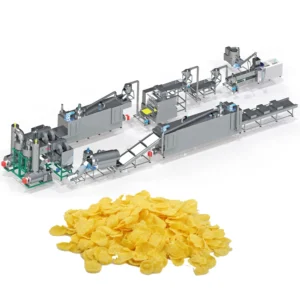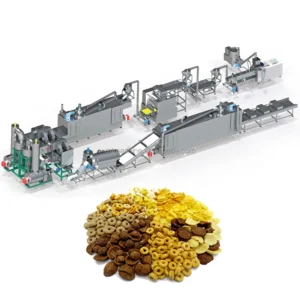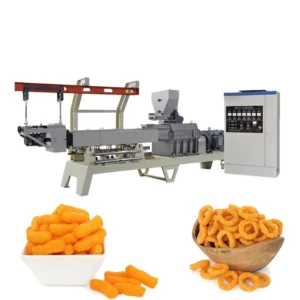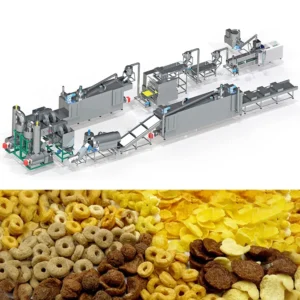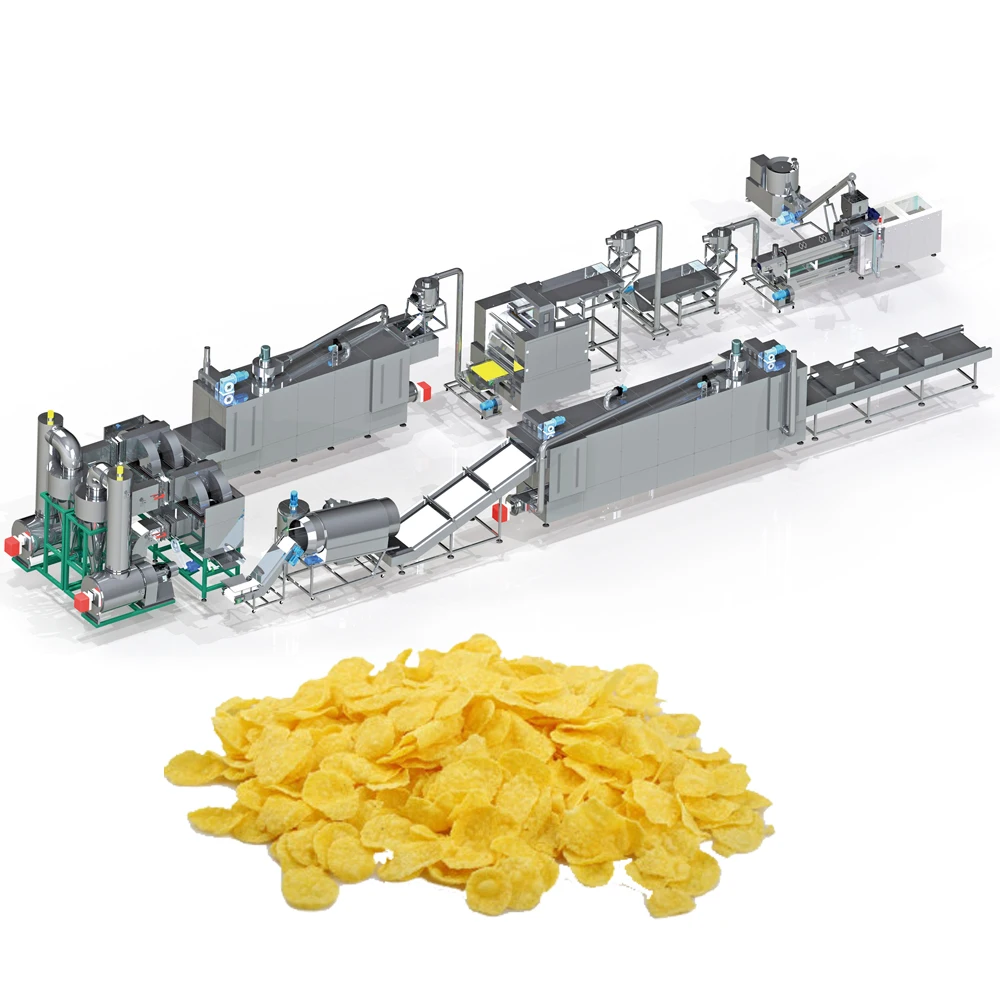
Capacity-Matched Line Integration — Every station from mixing to packing is sized so the flaker, dryer and coater never throttle the extruder on your actual grain formulation.
Technical Specifications
| Parameter | Value |
|---|---|
| Product Type | Corn Flakes Production Line (Twin-Screw Extrusion System) |
| Model Options | MT70 / MT85 / MT75 |
| Screw Type | Twin-screw |
| Installed Power | 160 kW (MT70) / 190 kW (MT85) / 210 kW (MT75) |
| Power Consumption | 120 kW (MT70) / 140 kW (MT85) / 150 kW (MT75) |
| Output Capacity | 150–200 kg/hr (MT70) / 300–400 kg/hr (MT85) / 300–500 kg/hr (MT75) (basis not stated in source — confirm raw material formulation, moisture content and target flake thickness) |
| Overall Dimensions (L×W×H) | 41 × 1.5 × 2.2 m (MT70) / 43 × 1.5 × 3.2 m (MT85) / 45 × 1.5 × 3.5 m (MT75) |
| Control System | PLC control on flaking machinery; MCC and PLC across the full line |
| Flaking Drive | Double motors for separate roller driving; hydraulic system for roller gap |
| Flaking Temperature Control | Infrared sensor for even temperature pipe regulation |
| Dryer Heating Source | Gas or electric, configurable to site utility |
| Hot Air Roasting Oven | Vibrating pan, reconciliation burner, dual circulating fans, cyclone dust removal |
| Coating System | Double tumble sugar melter, elevator, coating drum, spraying nozzle |
| Key Features | Automatic screw lubrication and cooling; grinding-resistant screw construction; food-grade contact materials |
| Standards | CE certified, ISO certified |
Application Suitability
| Application | Material or Output |
|---|---|
| Natural corn flakes production | Corn grits or corn flour, toasted to crisp breakfast flakes |
| Sugar-coated corn flakes | Extruded corn flakes with sugar syrup coating and secondary drying |
| Multi-grain breakfast flakes | Rice, wheat, oat or barley powder blended into flake format |
| Extruded cereal shapes | Balls, rings, fruit loops, stars, wheels via die change on the same extrusion platform |
Why Nominal Throughput Rarely Survives Contact With Your Grain
A breakfast cereal corn flakes equipment full range is only as fast as its slowest station — and that station is usually the one nobody checked against your actual formulation.
I spent two weeks in a Kenyan plant where the extruder was rated for corn grits, but the customer was running a mixed grain flour with higher fibre content. The dough sheeted too thick through the flaker, and the roaster could not pull the moisture down fast enough. The line technically ran, but the end product was hard, dense and unsellable. Throughput mismatches like this are the quiet reason cereal lines disappoint after commissioning. The extruder pushes volume the dryer was never sized to handle, or the flaker produces sheets the roaster cannot finish in a single pass. [NEED_CITE: thermal load calculation for cereal flake drying stages]
How Each Machine Station Fits the Next
The extruder cooks and shapes the dough under controlled shear and temperature. What leaves the die is a soft, high-moisture pellet that must be flattened before the surface sets. The flaking machinery uses hydraulic double-roller pressure and independent dual-motor drive to press each pellet into a uniform sheet. Infrared sensors monitor roller temperature continuously, preventing the dough from sticking or tearing at higher feed rates.
Where Capacity Planning Usually Breaks Down
Problems appear between stations, not inside them. A dryer that receives more wet flakes than its evaporation rate allows will discharge product still above safe packaging moisture. The hot air roasting oven compensates with a vibrating pan and dual circulating fans, but it cannot rescue flakes that entered already over-dried or under-pressed. Matching dryer evaporation rate to extruder output is where most breakfast cereal corn flakes equipment full range proposals fall short. [NEED_CITE: moisture reduction targets across cereal flake drying and roasting]
Reading the Specs That Actually Matter
The twin-screw design handles mixed grain formulations better than single-screw alternatives because intermeshing screws self-clean and maintain consistent residence time across varying starch contents. Automatic lubrication and cooling inside the screw assembly reduces unplanned stops during long production runs. The flaking station’s hydraulic gap adjustment lets operators respond to dough behaviour changes without halting the line — critical when switching between corn, oat and wheat formulations that each demand different pressing forces. On the roasting side, the reconciliation burner paired with cyclone dust removal keeps blistering even while capturing fine particulate that would otherwise contaminate the product stream. Control across all stations runs through PLC with MCC integration, so a fault at the extruder automatically signals the dryer and coater to hold rather than over-process the material already in transit.
The Cost of Ignoring Station-to-Station Balance
When the coater receives more flakes than the sugar tumbling drum can evenly cover, you get clumps on some batches and bare flakes on others. When the dryer is undersized, flakes enter the roaster with inconsistent moisture, producing a mix of scorched and undercooked product in the same batch. These failures do not show up in factory acceptance tests run on standard corn grits. They appear weeks after installation, once the buyer’s real formulation enters the line. [NEED_CITE: common post-installation failure modes in cereal extrusion lines]
What This Supplier Brings to the Line
Every machine in the corn flakes line is specified against the buyer’s raw material and target flake density, not pulled from a standard catalogue. The in-house testing workshop runs your actual grain formulation before the line ships, so screw configuration, die selection and roller gap are validated against real behaviour. Complete line integration under one supplier means throughput is calculated across every station rather than assembled from disconnected equipment vendors. Electrical schematics confirm voltage, frequency and HMI language for the target market before production begins. CE and ISO certification documentation supports import clearance without last-minute surprises.
Documentation & Verification
- Line layout drawing matched to your factory footprint and utility connection points
- Screw and die configuration record specified to your grain blend and target flake density
- Electrical schematic with voltage, frequency and control language confirmed before build
- Trial run report on your actual raw material conducted in the testing workshop
- Factory test record documenting throughput and moisture at each station before dispatch
- Packing photographs and customs documentation support for shipment clearance
Installation, Commissioning & Support
- Foundation plan for line footprint up to 45 m length with leveling requirements per station
- Dedicated power circuit sized to the selected model’s installed power up to 210 kW
- Modular station delivery with sequenced assembly from extruder through to packing end
- First-run parameter setting covering screw speed, roller gap, dryer temperature and roaster cycle
- Operator training on PLC interface, hydraulic flaker adjustment and fault response procedures
- Wear parts list covering screws, dies and roller surfaces with recommended replacement intervals
What to Include With Your Inquiry
Send your grain formulation — including the percentage split if you blend corn with rice, oat or barley — along with your target flake thickness and whether you need sugar coating on the same line. Confirm your site voltage, frequency and preferred HMI language. Share your available workshop length and ceiling height so the line layout can be drafted to fit.
Frequently Asked Questions
Q: How is throughput verified across every station before the line ships?
A: Each station — extruder, flaker, dryer, roaster and coater — is calculated against the others using your raw material data. Before dispatch, a trial run on your actual grain formulation is conducted in the testing workshop, and a report documenting throughput, moisture content and flake density at every stage is provided.
Q: What screw configuration and die design will be used for my grain blend?
A: Screw elements and die geometry are selected based on your specific grain formulation, moisture content and target flake texture. The configuration is recorded and shared with you, so replacements can be ordered accurately when wear parts are due.
Q: Can one line produce both natural and sugar-coated corn flakes?
A: Yes. The natural line runs mixing, extruding, flaking, drying, roasting, cooling and packing. Sugar-coated production adds a sugar spraying station, coating drum and secondary drying stage after roasting, all included in the sugar-coated configuration.
Q: How are voltage, frequency and control language confirmed before production?
A: During the proposal stage, electrical schematics are drafted to your site’s voltage, frequency and phase. The PLC and HMI language are specified at the same time, so the control system is built to your operator requirements before the line enters manufacturing.
Q: What does the pre-shipment trial run cover?
A: Your raw material is run through the extruder, flaker and dryer in the testing workshop. The trial run report records screw speed, barrel temperature profile, roller gap, moisture reduction and flake thickness, giving you verified parameters to start from during on-site commissioning.