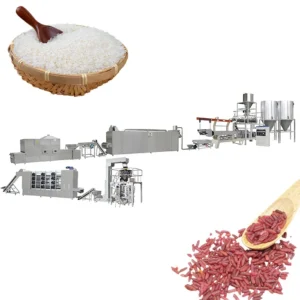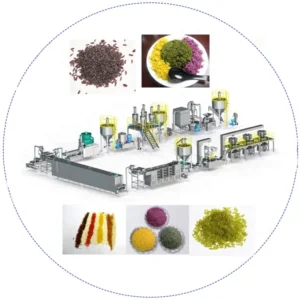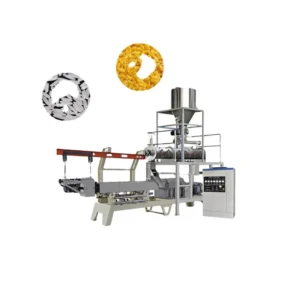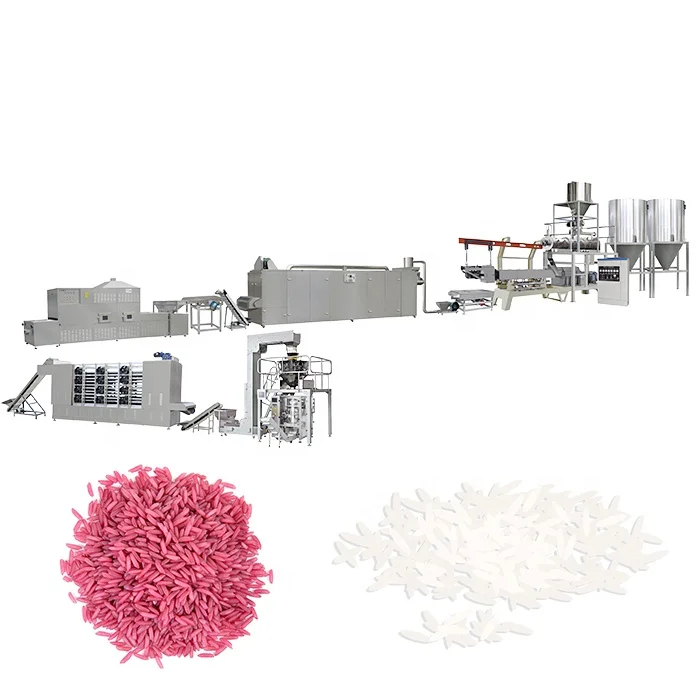
Screw and die configuration specified to the raw material — every extruder model in this artificial rice processing line ships with barrel zones, screw profiles, and die geometry matched to your specific grain blend and target kernel shape.
Technical Specifications
| Parameter | Value |
|---|---|
| Model | MT65 / MT70 / MT75 / MT85 / MT95 |
| Product Type | Fortified Artificial Rice Processing Line |
| Screw Type | Twin-screw (single or double screw feeding system selectable based on material) |
| Installed Power | 85 kW (MT65) / 120 kW (MT70) / 180 kW (MT75) / 235 kW (MT85) / 260 kW (MT95) |
| Power Consumption | 60 kW (MT65) / 85 kW (MT70) / 135 kW (MT75) / 165 kW (MT85) / 195 kW (MT95) |
| Output Capacity | 80–100 kg/h (MT65) / 100–120 kg/h (MT70) / 300–500 kg/h (MT75) / 200–300 kg/h (MT85) / 800–1000 kg/h (MT95) (basis to be confirmed with raw material blend, moisture content, and target kernel size) |
| Overall Dimensions | 28 × 1.2 × 2.2 m (MT65) / 30 × 1.5 × 2.2 m (MT70) / 32 × 3.5 × 4.3 m (MT75) / 34 × 3.5 × 4.3 m (MT85) / 36 × 3.5 × 4.3 m (MT95) |
| Control System | Frequency speed control, high automation |
| Lubrication & Cooling | Automatic lubricating and cooling system |
| Heating Source (Dryer) | Electric or gas |
| Line Stations | Mixing → Extruding → Vibrating → Low-temperature drying → Cooling → High-temperature roasting → Cooling → Packing |
| Raw Materials Processed | Broken rice, rice, corn, millet, wheat, oats, buckwheat, bean, starch as main ingredient; vitamin and mineral as supplementary ingredient |
| Standards | CE certified; ISO certified |
Application Suitability
| Application | Material or Output |
|---|---|
| Fortified rice kernel production | Broken rice and rice bran with added micro-nutrients and vitamins |
| Nutritional artificial rice processing | Corn, millet, wheat, oats, and buckwheat grain blends |
| Instant rice manufacturing | Starch-based formulations with supplementary minerals |
| Fortified food programme supply | Multi-grain blends with bean and vitamin enrichment |
What a Nominal Capacity Figure Hides from You
The capacity your line actually holds depends on the grain blend you feed it, not the number on the quote.
I spent years commissioning lines in the Middle East and learned the hard way that a machine rated for one formulation will behave entirely differently when the real recipe hits the barrel. A line running clean on standard rice flour might choke on a blend loaded with whey protein isolate and micronutrient premix. Gelatinisation curves shift, melt viscosity changes, and suddenly the output drops while reject rates climb. That is why every Fortified Artificial Rice Processing Line full equipment range configuration must be validated against the buyer’s actual raw material [NEED_CITE: twin-screw extrusion behaviour on multi-component grain blends].
Surveying the Full Machine Catalogue Before Specifying
The Fortified Artificial Rice Processing Line full equipment range covers every station from batching to packing under a single supplier, which means throughput matching across extruder, dryer, roaster, and cooler is calculated before the line is built rather than discovered during commissioning. Each of the five extruder models — MT65 through MT95 — maps to a distinct capacity band and footprint, allowing buyers to survey options against factory floor space and utility availability before committing to a configuration.
Downstream Station Coverage and Utility Matching
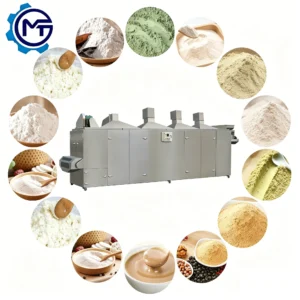
Every supporting station in the catalogue is sized relative to the extruder model selected. The low-temperature dryer and high-temperature roaster handle moisture removal and kernel hardening in sequence, while the vibrating separator removes oversize and undersize material before the product reaches the cooling conveyor. The dryer heating source is configurable for electric or gas, which matters significantly in regions where industrial gas supply is more economical than electrical heating for continuous thermal processing [NEED_CITE: industrial dryer energy source selection criteria].
Reading the Specification Sheet Against Your Production Target
The twin-screw configuration across all five models provides the shear and residence time needed for thorough starch gelatinisation when processing multi-grain blends with added micronutrients. Frequency speed control allows operators to adjust screw speed in real time as different formulations move through the barrel, which is critical when switching between a simple broken rice recipe and a complex fortified blend with higher fat or protein content. The automatic lubricating and cooling system on the extruder gearbox supports continuous operation without scheduled shutdowns for manual lubrication. Installed power ranges from 85 kW on the MT65 to 260 kW on the MT95, and power consumption figures are proportionally lower, reflecting actual energy draw during steady-state extrusion rather than peak startup load.
The Cost of Ignoring Throughput Matching Across Stations
When an extruder is paired with a dryer that cannot remove moisture fast enough, the entire line backs up and operators begin reducing feed rate to prevent wet product from reaching the packing station. I have watched this happen on nutritional powder lines where the roaster capacity was never recalculated after a client changed their target kernel density. The result is a line that technically runs but never reaches the throughput the buyer planned their shift schedule around [NEED_CITE: downstream bottleneck effects in continuous food processing lines]. Selecting each station from a single equipment catalogue eliminates the guesswork of cross-referencing specifications from separate vendors.
Why Procuring the Full Range from One Source Matters
Throughput is matched across every station — from the mixing system through extrusion to packing — so no single unit constrains the line. Screw configuration and die design are specified to the buyer’s raw material blend and target kernel geometry, not copied from a generic build sheet. The in-house machine testing workshop allows trial runs on the customer’s actual formulation before the line ships, catching gelatinisation and expansion issues before they become on-site emergencies. Pre-sales consultation covers line layout, capacity calculation, and utility planning, extending through on-site installation, commissioning, and operator training. Documentation includes the screw and die configuration record, electrical schematic with confirmed voltage and frequency, and factory test records specific to your product [NEED_CITE: machinery documentation requirements for international food equipment trade].
Documentation & Verification
- Line layout and capacity calculation reflecting your chosen extruder model and downstream stations
- Screw and die configuration record matched to your grain blend and target kernel shape
- Electrical schematic with voltage, frequency, and control language confirmed for your market
- Factory test record on your actual raw material formulation before dispatch
- Wear parts list covering screws, dies, and barrel liners with replacement intervals
- CE declaration of conformity and ISO certificate for customs and regulatory clearance
Installation, Commissioning & Support
- Foundation requirements mapped to the overall dimensions and operating weight of your selected model
- Dedicated electrical circuit planned around installed power rating and local voltage standards
- Pre-assembled extruder stations arrive with barrel and screw alignment verified at factory
- First-run commissioning includes screw speed calibration and barrel temperature profiling on your formulation
- Operator training covers frequency speed control adjustment and automatic lubrication system monitoring
- Spare screws, dies, and barrel segments available with wear parts list from day one
What We Need to Move Forward
To configure the Fortified Artificial Rice Processing Line full equipment range for your facility, share your raw material formulation including the ratio of base grain to supplementary ingredients, your target daily output across shifts, and the available floor space with ceiling height. Confirm your local voltage, frequency, and preferred control language so the electrical schematic can be finalised before production. If you have an existing upstream milling system or downstream packing equipment, provide the interface specifications so the line connects without flow interruptions.
Frequently Asked Questions
Q: How do I verify the output capacity of each extruder model against my specific grain formulation and moisture level?
A: Output capacity for each model is listed with a note that the basis must be confirmed against your raw material blend, moisture content, and target kernel size. We run your actual formulation in the testing workshop and record the sustainable throughput before finalising the quotation, so the capacity figure reflects your recipe rather than a generic benchmark.
Q: What is the full equipment range included in the line, and where does each station fit in the production sequence?
A: The line follows a fixed sequence: mixing, extruding, vibrating separation, low-temperature drying, cooling, high-temperature roasting, final cooling, and packing. Each station is listed in the catalogue with throughput data matched to the extruder model you select, ensuring no downstream unit becomes a bottleneck during continuous operation.
Q: Can the dryer heating source be configured for electric or gas based on my local utility supply?
A: Yes. The dryer heating source is configurable for either electric or gas, and the choice depends on your local industrial energy costs and available infrastructure. This decision is confirmed during the specification stage so the correct burner or heating element configuration is installed before the line ships from the factory.
Q: How are downstream stations sized to match the extruder model I select so no single station bottlenecks the line?
A: Every supporting station — vibrating separator, dryer, roaster, cooler — is sized based on the output range and moisture removal requirement of the extruder model you choose. Throughput calculations are completed during the line layout phase, and the capacity data for each station is documented in the specification sheet you receive before committing to production.
Q: What supporting equipment is available in the catalogue to complete the line from raw material to packed product?
A: The catalogue covers mixing and batching systems, screw conveyors between stations, the vibrating separator for size grading, dryers, roasters, cooling conveyors, and packing station interfaces. Each piece of supporting equipment is specified with throughput and utility data so the entire Fortified Artificial Rice Processing Line full equipment range operates as one coordinated system.