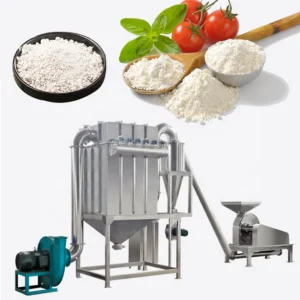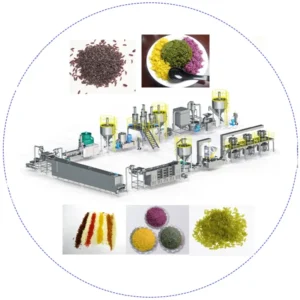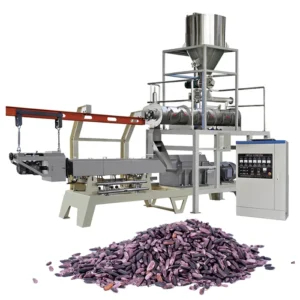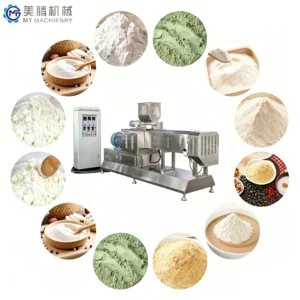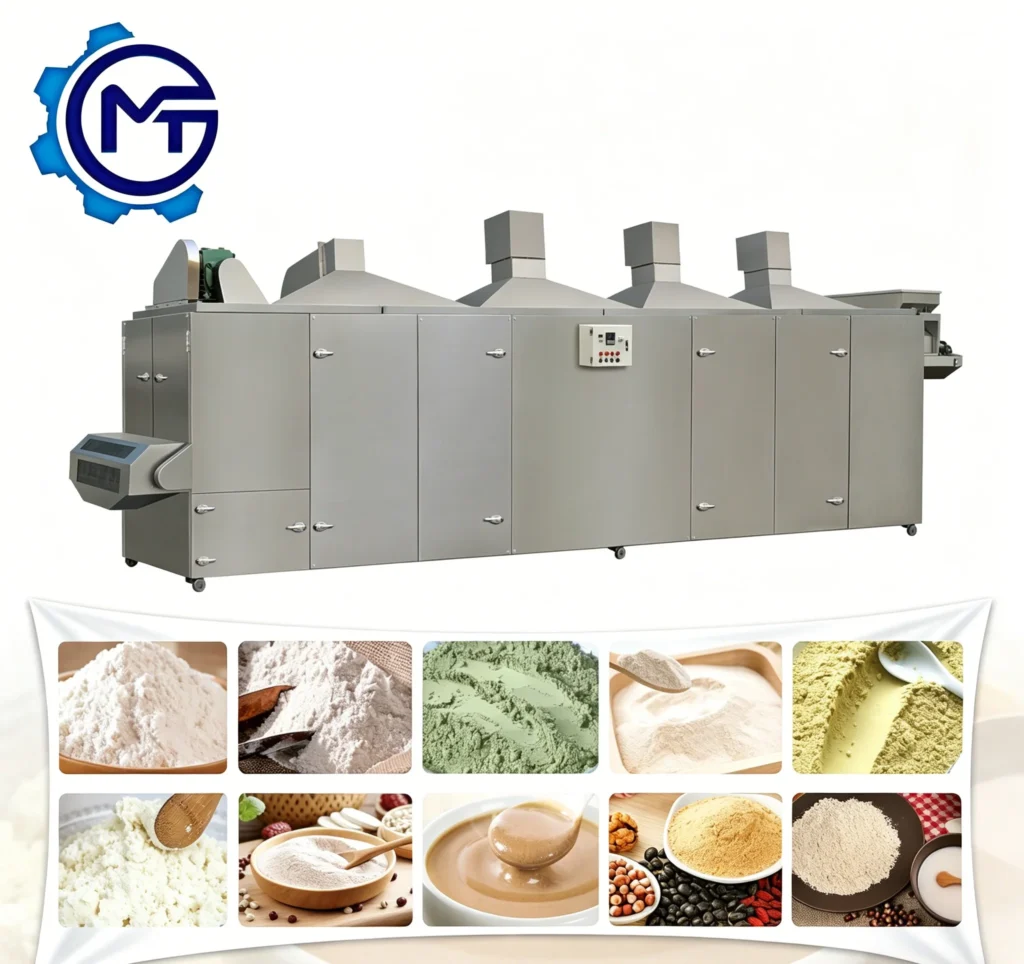
Integrated Station Matching — every mixer, extruder, dryer, and packing unit is sized together so no single node chokes the throughput of your nutrition powder line.
Technical Specifications
| Parameter | Value |
|---|---|
| Product Type | Nutrition Powder Processing Line |
| Output Capacity | 200–500 kg/h (basis not stated in source — confirm raw material / moisture / formulation) |
| Construction Material | Food-Grade 304 Stainless Steel |
| Control System | Touch Control Panel with Digital System |
| Heat Source Options | Electric / Gas / Steam |
| Supported Raw Materials | Rice, Corn, Beans, Various Grains |
| Automation Level | Full Automatic |
| Warranty | 1 Year |
| After-Sales Service | Overseas Engineer Service Available |
| Voltage & Frequency | Configurable per destination market (confirm before quotation) |
| Standards | CE, ISO |
Application Suitability
| Application | Material or Output |
|---|---|
| Baby food nutrition powder | Rice flour, corn starch, oat, and multi-grain blends |
| Infant formula powder base | Pre-gelatinised cereal matrices with fortified minerals |
| Porridge powder for weaning | Milled rice and bean composites |
| Fortified grain powder | Corn-soy-bean blends for nutrition programmes |
| Instant breakfast cereal powder | Toasted rice and corn with added micronutrients |
Why "500 kg/h" Can Sink a Nutrition Powder Project Before It Starts
A capacity figure without raw-material context is just a number on a quote — the real throughput depends on your exact formulation, moisture, and fat content.
When sourcing a nutrition powder processing line full equipment range, buyers often anchor on the headline output figure. I once watched a Middle Eastern customer commit to a line rated at 500 kg/h, only to discover on-site that his recipe’s high oil content caused severe agglomeration inside the extruder barrel. The screws were configured for a lean grain mix, and the whole parameter set needed reworking — commissioning ran two weeks over schedule [NEED_CITE: impact of high-fat formulations on extruder throughput]. That experience cemented a rule I still follow: run the customer’s actual raw material in our testing workshop before any machine leaves the factory.
Surveying the Full Equipment Chain Before You Commit
The mtfoodmachinery.com catalogue covers every station a nutrition powder processing line requires — batching, mixing, extrusion, drying, milling, and packing — so technical buyers can audit the entire sequence rather than inheriting a bottleneck they never specified. Each piece of supporting equipment is matched to the extruder’s output envelope, preventing situations where a dryer sized for a different product category slows the whole line to a fraction of its nameplate rate.
Material Contact Hygiene Across Every Station
Food-grade 304 stainless steel runs through all product-contact surfaces, from the mixer bowl to the dryer trays and the packing hopper. This consistency matters because nutrition powder destined for infant consumption faces strict microbial limits [NEED_CITE: international hygiene standards for infant food manufacturing equipment]. A line assembled from separate vendors often mixes 304 and 201 stainless at hidden junctions, creating corrosion points that harbour residue and complicate cleaning validation.
Reading Between the Specification Rows
The touch control panel with digital system centralises temperature zones, screw speed, and feeder rates on a single screen, cutting the training curve for operators who may be running grain-based nutrition powder for the first time. Heat source flexibility — electric, gas, or steam — lets you align the dryer and oven with whatever utility infrastructure your factory already has, avoiding costly new boiler installations. The listed capacity band of 200–500 kg/h assumes a standard grain formulation at moderate moisture; high-fat or high-sugar recipes shift the effective output, which is why a pre-shipment trial on your exact blend is non-negotiable. Screw configuration and die geometry are selected to match your target powder particle size and degree of gelatinisation, rather than copied from a generic build.
The Hidden Cost of Skipping Station-by-Station Verification
Buyers who skip the line-layout review sometimes find the cooling conveyor is too short for the extruder’s output, so powder enters the packing stage still warm and condenses moisture inside the bag. In other cases the flavouring or fortification drum is under-sized, leading to uneven micronutrient distribution that fails lab testing [NEED_CITE: consequences of mismatched station throughput in powder lines]. These problems surface weeks into production, not during the factory acceptance test, and retrofitting a larger dryer or conveyor into an already-installed line means unplanned downtime and re-engineering.
What We Bring to Your Nutrition Powder Project
Complete line supply under one manufacturer means throughput is calculated station by station, not guessed from catalogue covers. Screw and die configurations are documented against your specific raw material and target powder density, so re-orders stay consistent. An in-house testing workshop allows trial runs on your grain blend before the line ships, catching formulation surprises early. Electrical schematics, voltage, and control language are confirmed in writing before production begins, eliminating on-site rewiring delays. CE and ISO documentation travels with every shipment for customs and local regulatory clearance.
Documentation & Verification
- Line layout drawing with station-by-station capacity calculation for your grain formulation
- Screw and die configuration record matched to your target powder particle size
- Factory trial run report on your raw material before dispatch
- Electrical schematic confirming voltage, frequency, and control language
- CE declaration of conformity and ISO certificate included with shipping documents
Installation, Commissioning & Support
- Foundation plan based on the full line footprint and dryer weight distribution
- Dedicated circuit schedule matching the chosen electric, gas, or steam heat source
- Overseas engineer available for first-run parameter tuning on your grain recipe
- Operator training on the touch control panel covering recipe storage and fault diagnostics
- Wear parts list with lead times for screws, dies, and dryer tray replacements
- Preventive maintenance calendar aligned to food-grade lubrication intervals
How to Structure Your Inquiry
Send us your target grain formulation — including rice, corn, bean ratios and any added fats or fortificants — along with the daily output you need and your factory’s available floor space. Confirm the local voltage, frequency, and preferred control language so the electrical package is built correctly from day one. If you have existing upstream milling or downstream packing equipment, share the interface dimensions so we can match conveyor heights and signal protocols.
Frequently Asked Questions
Q: How is the 200–500 kg/h output range verified, and what assumptions sit behind it?
A: The range is based on standard grain formulations at moderate moisture. Actual throughput shifts with fat content, particle size, and gelatinisation targets. We run your specific raw material in our testing workshop before quoting a firm capacity, documenting screw speed, barrel temperatures, and die pressure so the figure on the contract reflects your real recipe.
Q: Which supporting stations come with the line, and how is throughput balanced?
A: The line includes mixers, extruders, dryers, milling units, and packing stations. Each is sized so its maximum throughput matches or slightly exceeds the extruder’s output, preventing bottlenecks. We provide a line layout with calculated dwell times and conveyor speeds for your review before production starts.
Q: What heat source options exist, and how do I choose?
A: Electric, gas, and steam options are available for drying and baking stations. The choice depends on your factory’s existing utility infrastructure and local energy costs. We confirm the heat source during the specification stage so ductwork, burners, or heating elements are fitted before shipment.
Q: How are screw and die configurations decided for different grain blends?
A: Screw elements are selected based on your raw material’s starch, protein, and fat profile, and the die geometry is matched to the target powder particle size. Configuration records are kept on file so replacement parts and future re-orders maintain the same product texture and density.
Q: What electrical details are locked in before the line enters production?
A: We confirm voltage, frequency, plug type, and control language in writing. An electrical schematic is shared for your approval, covering motor ratings, heater loads, and PLC I/O mapping, so the line arrives ready to connect without on-site rewiring or component swaps.