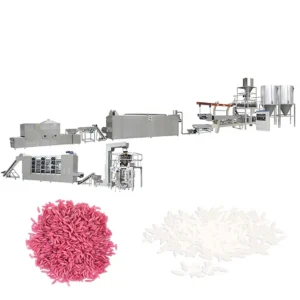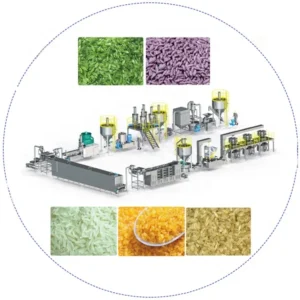
Screw Configuration Matched to Your Recipe — we require your actual fortified formulation for an in-house trial run before shipment, rather than quoting a generic build based on standard rice flour alone.
Technical Specifications
| Parameter | Value |
|---|---|
| Product Type | Baby Food Nutrition Powder Extrusion Processing Line |
| Output Capacity | 200–500 kg/h (basis not stated in source — confirm raw material formulation and moisture content) |
| Construction Material | Food-Grade 304 Stainless Steel (all product contact surfaces) |
| Control System | Touch control panel with digital interface |
| Heat Source Options | Electric, gas, or steam (selectable based on factory utility) |
| Supported Raw Materials | Rice, corn, beans, various grains |
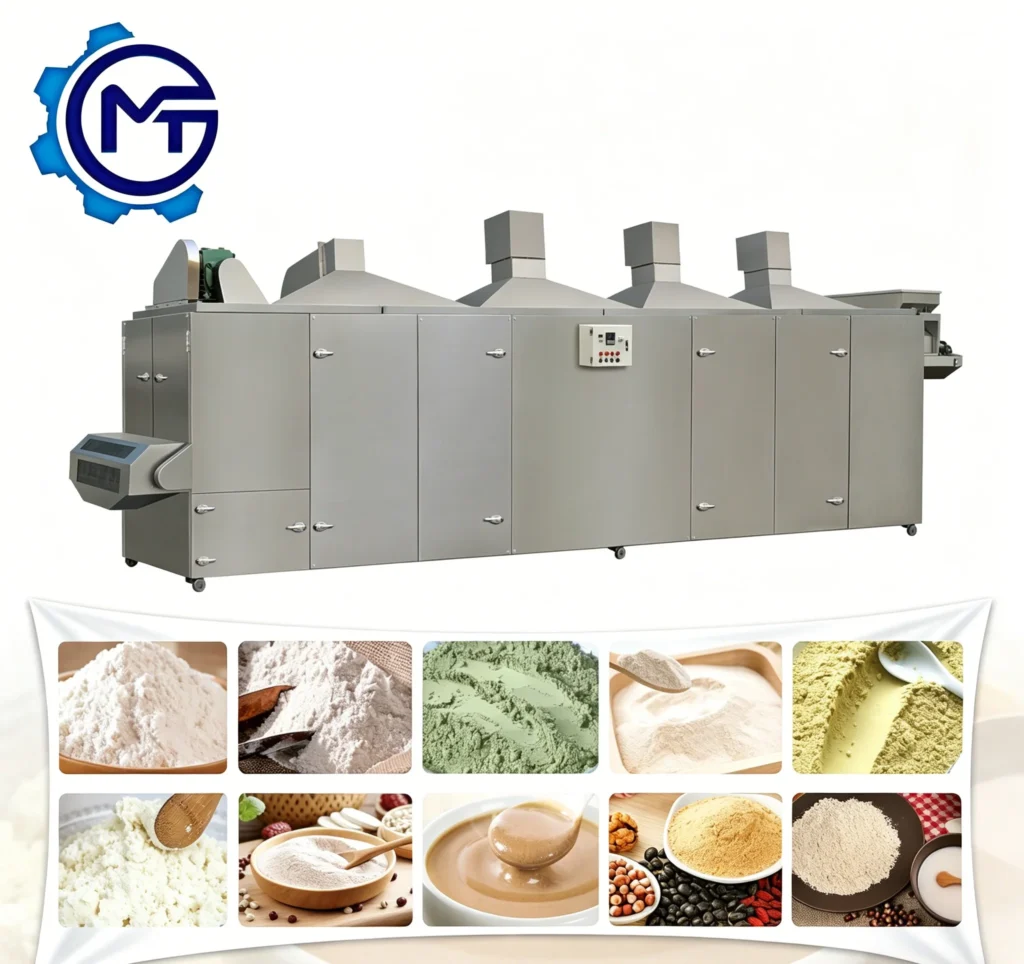
| Line Stations | Baking ovens, mixers, extruders, and supporting stations (full line configuration to be confirmed) |
| Assembly State | Complete production line |
| Warranty | 1 year |
| After-Sales Service | Overseas engineer service available |
| Certification | CE, ISO |
Application Suitability
| Application | Material or Output |
|---|---|
| Infant formula powder processing | Rice and grain blends with added whey protein and micronutrients |
| Baby food nutrition powder production | Corn, beans, and multi-grain formulations for weaning food |
| Fortified nutritional powder manufacturing | Vitamin and mineral-enriched cereal matrices |
| Porridge powder production | Pre-gelatinised starch bases from rice and corn |
What "200–500 kg/h" Actually Means for Your Fortified Recipe
Stated output figures only hold when the extruder is matched to your specific raw material formulation, including every additive.
I watched a 500 kg/h nutrition powder line stall completely when the buyer switched from plain rice flour to a recipe loaded with whey protein and trace minerals. The screw shear profile was set for standard grain behaviour, and the added proteins altered the melt viscosity inside the barrel. The powder clumped at the die face, and the drying section could not handle the uneven moisture profile coming through. The line sat idle for two weeks while we reconfigured the screw elements and adjusted preconditioning parameters. That is the gap between a capacity number on a brochure and what your line actually delivers on your recipe. Every baby food nutrition powder processing line full equipment range we ship now runs through a trial on the buyer’s own formulation before it leaves our testing workshop [NEED_CITE: material behaviour under twin-screw extrusion shear and thermal profiles].
How Each Station Connects to the Next
A baby food nutrition powder processing line full equipment range is not a collection of standalone machines bolted together. The mixer discharge rate must match the extruder feed hopper capacity, the extruder output must align with the dryer belt loading, and the dryer throughput must feed the cooling and packing stations without accumulation or starvation. When one station is undersized, the entire line runs below its rated capacity. Our line layout calculations trace material flow from batching through packing, sizing each station to the actual throughput of its neighbours rather than quoting independent capacities.
The Role of Preconditioning in Powder Consistency
Moisture content entering the extruder barrel determines how thoroughly starches gelatinise and how uniformly the product expands at the die. For baby food applications, incomplete gelatinisation leaves raw starch pockets that affect both digestibility and shelf stability. The preconditioning stage — where steam and water are blended into the dry mix before it enters the barrel — must be calibrated to the specific grain blend and any protein or fibre additives in the recipe. We document the preconditioning parameters during the in-house trial so your operators start with a proven baseline rather than spending weeks on the floor searching for the right moisture window [NEED_CITE: starch gelatinisation requirements in infant cereal extrusion].
Reading the Specification Sheet for What It Does Not Say
The 200–500 kg/h capacity range covers a wide span because output depends heavily on raw material density, moisture at the die, and the screw configuration in use. Food-grade 304 stainless steel on all contact surfaces matters for infant food compliance — it resists corrosion from acidic vitamin premixes and withstands the caustic wash-down cycles that hygiene protocols demand. The touch control panel with digital interface reduces the reliance on operator intuition for barrel temperature zones and screw speed, which is where batch-to-batch variation often originates. Heat source flexibility — electric, gas, or steam — means the line can integrate with whatever utility infrastructure your facility already has without requiring a custom engineering overhaul. The selection between these heat sources affects both operating cost and temperature response time inside the dryer and oven sections [NEED_CITE: industrial heat source selection for food processing facilities].
The Cost of Skipping a Recipe-Specific Trial
When a line ships without being tested on the buyer’s actual formulation, the first production run becomes the trial. Raw material gets wasted, delivery commitments slip, and the buyer’s own customers lose confidence. The screw combination that works for plain corn meal will not necessarily handle a blend containing fifteen percent whey protein isolate and microencapsulated iron. We saw this happen first-hand: the powder bridged in the feed hopper, the die pressure spiked, and the product density came out far above specification. Correcting that after installation means flying in an engineer, sourcing replacement screw elements internationally, and running test batches on a live production schedule.
Why Buyers Source This Line from One Supplier
Every station from batching to packing comes from a single source, which means throughput is calculated across the entire baby food nutrition powder processing line full equipment range rather than each vendor quoting their machine in isolation. Screw configuration and die geometry are specified to the buyer’s raw material, not copied from a catalogue build. Our in-house testing workshop runs the buyer’s actual formulation before shipment, producing a documented trial report that becomes the baseline for commissioning. Technical support extends from pre-sales line layout through on-site installation, operator training, and wear parts supply, so there is one point of accountability rather than a chain of vendors pointing at each other when output falls short.
Documentation & Verification
- Line layout and capacity calculation tracing every station from batching through packing
- Machine specification sheet with screw and die configuration matched to your grain blend
- Electrical schematic and voltage confirmation for your facility’s power supply
- Trial run report produced on your raw material in our testing workshop before dispatch
- CE declaration of conformity and ISO certification documentation
- Operation and maintenance manual with wear parts list and replacement intervals
Installation, Commissioning & Support
- Foundation and floor space plan aligned to the line’s actual footprint and station sequence
- Dedicated electrical circuits sized to the extruder motor and dryer heat source requirements
- Section-by-section assembly with alignment checks between extruder barrel and die face
- First-run parameter setting using the trial report baseline as the starting point
- Operator training on the touch control panel interface, including alarm response procedures
- Initial spare wear parts kit covering screws, dies, and seals for the first maintenance cycle
- Scheduled maintenance intervals documented for each station’s bearings, belts, and heating elements
What We Need to Quote Your Line Accurately
To configure a baby food nutrition powder processing line full equipment range that holds its rated output on your actual product, we need your complete ingredient list with inclusion percentages, target moisture content at packing, and daily or shift-based production volume. Share your factory’s available voltage, frequency, and preferred heat source so the electrical and thermal systems match from day one. If you have existing upstream or downstream equipment that this line must integrate with, let us know the connection points and throughput rates.
Frequently Asked Questions
Q: How is the 200–500 kg/h output capacity verified, and on which raw material formulation?
A: The stated range depends on the specific grain blend, moisture content, and additive profile running through the extruder. We verify capacity by conducting a trial run using your actual recipe in our testing workshop. The trial report documents the achieved throughput, product density, and gelatinisation level, so the capacity figure you receive is tied to your formulation rather than a generic test material.
Q: What is the complete station list from batching to packing, and how is throughput matched between stations?
A: The line typically includes batching, mixing, extrusion, drying, cooling, and packing stations. Each station is sized based on the throughput of the adjacent equipment so that no single point bottlenecks the system. We provide a line layout and capacity calculation document that shows the material flow and confirms balanced output across every section.
Q: Which heat source option is recommended for my factory’s existing utility setup?
A: The line supports electric, gas, and steam heating. The choice depends on your facility’s available infrastructure, local energy costs, and the temperature control precision your product requires. We confirm your utility specifications during the quotation stage and configure the dryer and oven sections to match without requiring additional plant modifications.
Q: Can the touch control panel and HMI language be configured for my local operators before shipment?
A: Yes. The digital control interface can be set to your preferred language and configured with the specific alarm labels and parameter names your operators will use. This is confirmed during the specification stage so the panel is ready on day one of commissioning, reducing the training time needed on site.
Q: What spare wear parts are included, and what is the lead time for first replacement orders?
A: Each line ships with an initial wear parts kit covering screws, dies, and high-wear seals. The wear parts list in your documentation identifies every replaceable component with part numbers. First replacement orders are processed through our after-sales channel with lead times confirmed at the time of order based on current production scheduling.