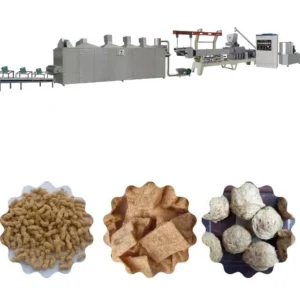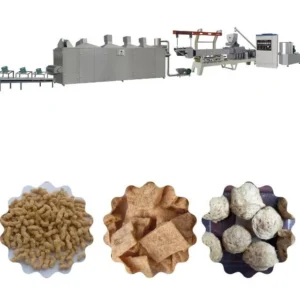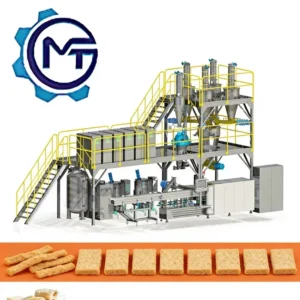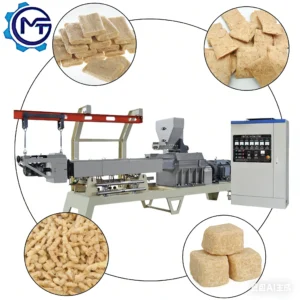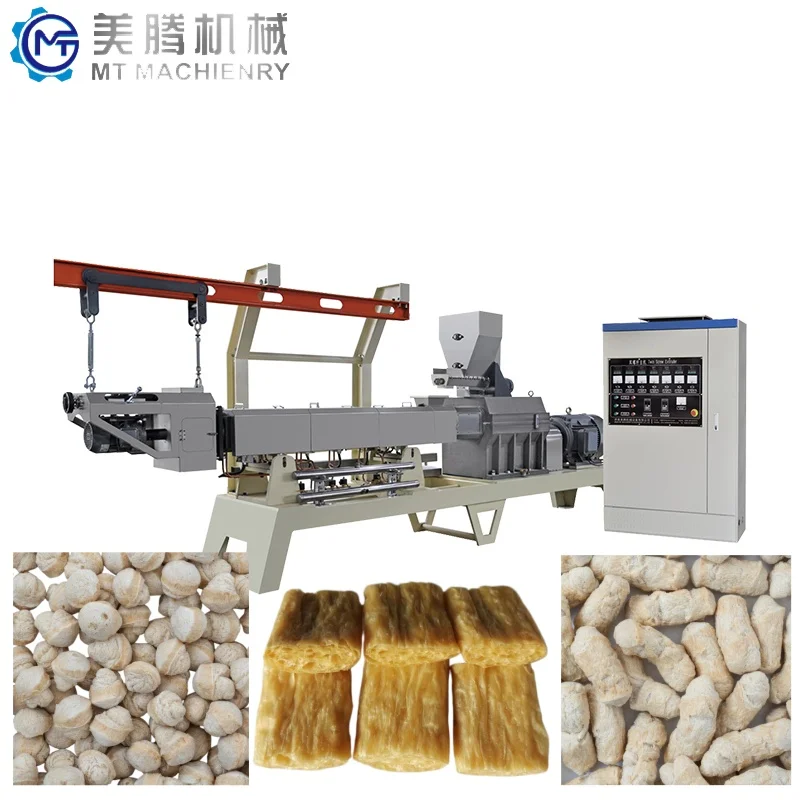
Integrated Line Engineering — Every station from the powder mixer through the high-temperature roaster is sized against the twin-screw extruder’s actual throughput so the plant based meat processing line equipment range holds its rated output without bottlenecking at the dryer or cooler.
Technical Specifications
| Parameter | Value |
|---|---|
| Product Type | Textured Soy Protein Extrusion Line |
| Extruder Models Available | MT65 / MT70 / MT85 |
| Screw Configuration | Twin-screw |
| MT65 Installed / Real Power | 85 kW / 65 kW |
| MT70 Installed / Real Power | 120 kW / 90 kW |
| MT85 Installed / Real Power | 195 kW / 165 kW |
| MT65 Output Capacity | 150–200 kg/h (basis not stated in source — confirm raw material / moisture) |
| MT70 Output Capacity | 200–300 kg/h (basis not stated in source — confirm raw material / moisture) |
| MT85 Output Capacity | 600–800 kg/h (basis not stated in source — confirm raw material / moisture) |
| Powder Mixer Tank Volume | 150 kg |
| Powder Mixer Mixing Time | 10 min per batch |
| Powder Mixer Rotary Speed | 385 rpm |
| High-temperature Roaster Belt Effective Length | 3.5 m |
| High-temperature Roaster Far Infrared Heater | 3.9 kW × 24 units |
| Cooling Machine Operating Temperature Range | 0–260 °C (source value — verify against manufacturer catalog) |
| Material of Construction | Stainless steel, food-grade contact materials |
| Control System | PLC and MCC control |
| Certifications | CE, ISO |
Application Suitability
| Application | Material or Output |
|---|---|
| Textured vegetable protein for vegetarian meat alternatives | Low-temperature soybean meal, defatted soy flour |
| Plant-based protein chunks for sausage and ham analogues | Soy protein isolate blends, peanut meal |
| Fortified protein ingredients for canned and quick-frozen foods | Multi-grain protein blends, pea-soy formulations |
| Meat extender and filler production | Defatted soy meal with starch carriers |
| Snack-grade textured protein pieces | Soy and legume blends with seasoning integration |
What the Plant Based Meat Processing Line Equipment Range Leaves Unmatched Between Stations
An extruder quoted at nominal capacity means nothing if the dryer downstream cannot keep up with the actual throughput on your raw material.
When buyers evaluate a plant based meat processing line equipment range, they often focus on the extruder motor power and screw diameter while the mixer batch size and dryer belt length go unverified. The result is a line where the twin-screw extruder produces at full rate but the high-temperature roaster accumulates a backlog, forcing operators to throttle the extruder down and run below the capacity they paid for. [NEED_CITE: throughput mismatch consequences in multi-station extrusion lines] I have walked through facilities where the cooling station was specified for a different product density entirely, leaving textured soy protein chunks arriving at the packing station still too warm to bag without condensation forming inside the packaging.
Matching Every Station to the Extruder’s Real Output
The powder mixer in this plant based meat processing line equipment range runs a 150 kg tank volume with a 10-minute batch cycle at 385 rpm, producing enough blended material to feed the extruder continuously without starvation or surge. When the mixer output drops below the extruder’s draw rate, the screw flights run partially empty, which changes the shear profile inside the barrel and produces inconsistent fiber structure in the textured soy protein. Consistent feed density is the first requirement for repeatable extrusion results.
How the Dryer and Cooler Preserve Fiber Integrity
The high-temperature roaster provides 3.5 meters of effective belt length with 24 far infrared heater elements at 3.9 kW each, giving textured protein pieces sufficient residence time to reduce moisture without case-hardening the exterior. If the surface dries too quickly while the core remains wet, the protein fibers collapse internally and the final product lacks the tear-apart texture that plant-based meat applications demand. The cooling machine then brings the product temperature down gradually before packing, preventing moisture migration inside sealed bags. [NEED_CITE: moisture gradient effects on textured protein fiber structure]
Reading the Power and Dimension Data for Facility Planning
The MT65 draws 65 kW real power while the MT85 reaches 165 kW, and these figures determine the transformer capacity and dedicated circuit requirements at the installation site. Overall line dimensions stretch from 18000×1300×2300 mm for the MT65 configuration up to 24000×3500×4300 mm for the MT85, which means ceiling clearance and floor slab loading must be confirmed before the equipment ships. The stainless steel construction adds significant weight to each station, so floor anchoring points need to align with the machine base frames. Voltage and frequency must match the local supply — a 50 Hz motor running on 60 Hz power will overspeed and wear the gearbox prematurely, while the reverse causes overheating and reduced torque at startup.
The Cost of Skipping the Trial Run
Sending a line to site without testing on the buyer’s actual formulation means screw configuration and barrel temperature profiles are set to generic defaults. Low-temperature soybean meal behaves differently from peanut meal in the barrel — different gelatinization points, different moisture absorption rates, different expansion characteristics. When the trial run is skipped, the first production batches reveal that the fiber structure is either too dense or too open, and reconfiguring the screw elements on-site takes days of downtime while the installation team waits for replacement die plates to ship. [NEED_CITE: importance of raw material trial runs before extrusion line shipment]
Why the Full Range Comes from One Source
Every station in this line — mixer, extruder, roaster, cooler — is specified and supplied together so throughput calculations are based on actual inter-station transfer rates rather than individual machine nameplate ratings. The screw configuration and die design are matched to the buyer’s raw material and target fiber structure before production begins. The in-house testing workshop runs the buyer’s actual formulation through the extruder before shipment, generating a trial run report that documents the working parameters. PLC and MCC control integrates all stations under one interface so operators monitor the full line from a single point. Food-grade stainless steel contact materials throughout every station meet hygiene requirements for protein food production.
Documentation & Verification
- Line layout drawing with throughput calculations for each station matched to your target output
- Screw and die configuration record documenting the elements selected for your raw material
- Trial run report produced from your actual formulation in the testing workshop before dispatch
- Electrical schematic with voltage, frequency, and control language confirmed for your facility
- CE declaration of conformity and ISO certificate for customs and regulatory submission
- Operation and maintenance manual with wear parts list specific to your extruder model
Installation, Commissioning & Support
- Foundation plan reflecting the MT85 footprint of 24000×3500×4300 mm with anchor bolt locations
- Dedicated power circuit sized for the selected model’s real power draw, up to 165 kW for the MT85
- Station-by-station alignment verification ensuring conveyor transfers match between mixer, extruder, roaster, and cooler
- PLC and MCC commissioning with control language set to operator preference before training begins
- Initial production run supervised on-site with screw speed, barrel temperature, and dryer belt speed documented
- Spare screw elements and die plates identified in the wear parts list with reorder lead times confirmed
Preparing Your Inquiry
To configure the right plant based meat processing line equipment range for your project, share the raw material formulation you intend to run — including the protein source, starch ratio, and target moisture content at the extruder inlet. Specify your local voltage, frequency, and whether the control panel language needs to match a particular operator group. If your facility has ceiling height constraints or existing upstream and downstream equipment that the new line must integrate with, include those dimensions so the layout can be drafted before the quotation stage.
Frequently Asked Questions
Q: How is the output capacity verified on my specific raw material and formulation?
A: Your exact raw material blend is run through the extruder in the testing workshop before the line ships. The trial run documents the screw speed, barrel temperature profile, moisture content, and achievable throughput on your formulation. This report travels with the equipment so the installation team starts commissioning from proven parameters rather than generic defaults.
Q: Which supporting stations are included and how is throughput matched across the line?
A: The line includes the powder mixer, twin-screw extruder, high-temperature roaster, cooling machine, and packing station. Each station’s capacity is calculated against the extruder’s actual output on your material so no single station creates a bottleneck. The mixer batch cycle and dryer belt speed are both adjusted to maintain continuous flow.
Q: What voltage, frequency, and control language options are confirmed before shipment?
A: Your facility’s electrical supply specifications are confirmed during the quotation stage and documented in the electrical schematic. The PLC and MCC control panel is configured to your voltage and frequency, with the operator interface set to your preferred language before the control cabinet leaves the factory.
Q: Can I review the full station dimensions and footprint before finalizing the layout?
A: Yes. Each station’s overall dimensions are provided in the line layout proposal so you can verify floor space, ceiling clearance, and access paths for maintenance. The layout drawing shows conveyor transfer points between stations and identifies utility connection locations for water, compressed air, and electrical supply.