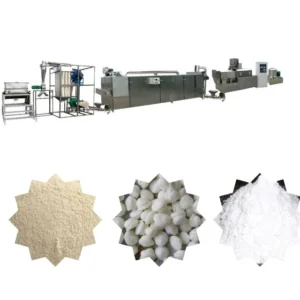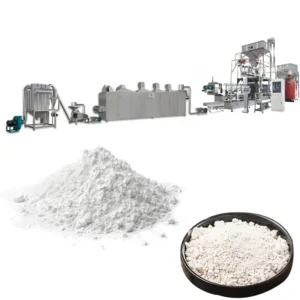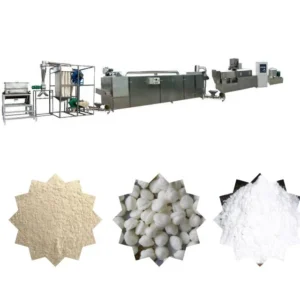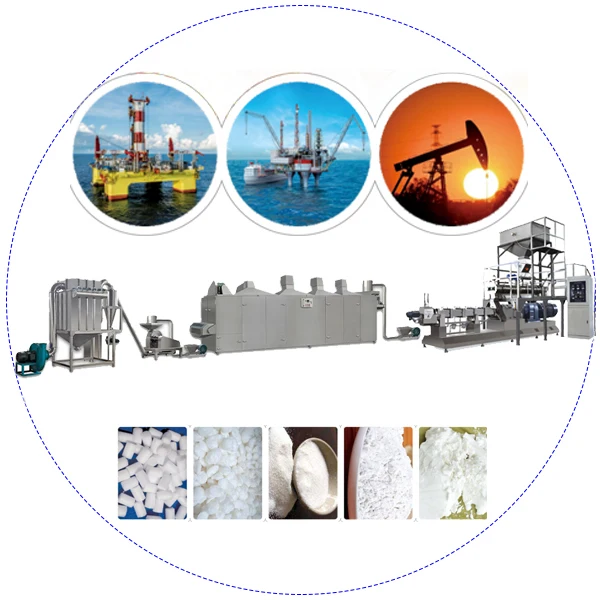
Matched Throughput Across Every Station — the mixer, extruder, dryer, and cooling belt are specified as one system sized to your starch source rather than assembled from independent vendors.
Technical Specifications
| Parameter | Value |
|---|---|
| Product Type | Modified Starch Production Line (Twin-Screw Extrusion) |
| Model Options | MT65 / MT70 / MT85 |
| Extruder Type | Twin-screw, co-rotating with sectional screw modules |
| MT65 Installed Power | 72 kW |
| MT65 Power Consumption | 50 kW |
| MT65 Capacity | 140–160 kg/h (basis not stated in source — confirm raw material type, moisture content, and starch source) |
| MT65 Dimensions | 2200 × 1000 × 2300 mm |
| MT70 Installed Power | 92 kW |
| MT70 Power Consumption | 65 kW |
| MT70 Capacity | 240–260 kg/h (basis not stated in source — confirm raw material type, moisture content, and starch source) |
| MT70 Dimensions | 2600 × 1000 × 2300 mm |
| MT85 Installed Power | 108 kW |
| MT85 Power Consumption | 75 kW |
| MT85 Capacity | 500–600 kg/h (basis not stated in source — confirm raw material type, moisture content, and starch source) |
| MT85 Dimensions | 4500 × 1000 × 2600 mm |
| Voltage & Frequency | Configurable per destination market (confirm before order) |
| Control System | PLC and MCC options available |
| Mixer Construction | Stainless steel contact parts with safety interlock on top cover and discharge |
| Dryer Type | Mesh belt with adjustable belt speed and temperature control |
| Assembly State | Complete line from batching through drying |
| Warranty | 24 months with lifetime service support |
Application Suitability
| Application | Material or Output |
|---|---|
| Pregelatinized starch for food processing | Corn starch, cassava starch, tapioca starch |
| Modified starch for textile sizing | Wheat starch, corn starch |
| Denatured starch for paper making | Cassava starch, tapioca starch |
| Industrial starch for building materials | Corn starch, wheat starch |
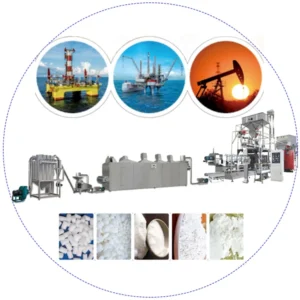
| Modified starch for oil drilling fluids | Corn starch, cassava starch |
| Viscosity-adjusted starch for casting binders | Tapioca starch, wheat starch |
What a Nominal Capacity Figure Leaves Out About Your Starch Source
Every modified starch production line equipment quote must state the raw material, moisture level, and target gelatinization degree behind its capacity number.
When a supplier tells you their extruder runs a certain throughput without specifying which starch, at what moisture content, and to what modification target, you are buying an untested assumption. I have watched lines stall because corn starch at one moisture level behaves completely differently from cassava starch at another, and the screw configuration was never adjusted for the switch. The modified starch production line equipment you select must be validated against your exact input, not a generic laboratory standard. [NEED_CITE: starch gelatinization behavior relative to moisture and source variability]
Sectional Screw Modules and Starch Modification Precision
The twin-screw extruder in this line uses sectional screw modules rather than a single continuous flight. Each barrel zone can be fitted with different screw elements — kneading blocks, conveying segments, or reverse-pitch sections — to control shear intensity, residence time, and mixing energy at each stage of gelatinization. This modular approach is what allows the same modified starch production line equipment to produce a lightly pregelatinized starch for cold-water swelling in food applications and a heavily denatured starch for industrial adhesive use, simply by reconfiguring the screw profile.
Throughput Matching From Mixer to Dryer
A common line-building mistake is sizing the extruder correctly and then underestimating the dryer load. Modified starch exits the die at elevated moisture, and if the mesh belt dryer cannot remove water fast enough, the entire line backs up. Every station in this system — the stainless steel mixer, the volumetric feeder, the twin-screw extruder, and the mesh belt dryer with variable speed and zone temperature — is calculated against the same throughput target so that no single station creates a bottleneck. [NEED_CITE: continuous extrusion line throughput balancing principles for starch drying]
Reading the Specs That Actually Matter
The installed power figures across the MT65, MT70, and MT85 models reflect different barrel lengths and screw diameters, which directly govern how much mechanical energy the twin screws can deliver to the starch mass per unit of time. Higher installed power on the MT85 means more kneading zones and longer residence time, enabling deeper modification of starch granule structure — essential when your target product requires a specific viscosity profile for oil drilling or textile sizing. The mesh belt dryer’s adjustable speed and temperature control determine whether you achieve the target final moisture or send semi-wet starch downstream where it will cake and degrade. Voltage and frequency must be confirmed against your facility’s supply before production begins, because rewiring a 108 kW extruder on site is neither cheap nor fast.
The Hidden Cost of Skipping the Screw Configuration Record
When a supplier ships an extruder with a generic screw build copied from another customer’s order, your starch may gelatinize unevenly or fail to reach the modification level your downstream buyer requires. I once saw a line produce pregelatinized starch that tested within spec for viscosity but failed a cold-water solubility test because the kneading zone was too short for the cassava starch being used. The buyer had to fly in a technician, pull the screws, reorder elements, and lose weeks of production before the line was making saleable product. Generic builds are the cheapest mistake to prevent and the most expensive to fix after delivery. [NEED_CITE: twin-screw configuration impact on starch property consistency]
Why Source This Line From a Single Equipment Supplier
Every station from the mixer through the dryer is specified under one supplier, meaning throughput calculations are internally consistent rather than stitched together from separate vendor datasheets. Screw configuration and die design are selected to match your specific starch source and modification target, not borrowed from a catalog build. An in-house testing workshop allows trial runs on your actual raw material before the line ships, so product development happens at the factory rather than on your floor. Food-grade stainless steel contact surfaces in the mixer and feeder sections meet both food-processing and industrial starch hygiene requirements. Formula support is provided and adjustable to your local raw material conditions and end-use specifications.
Documentation & Verification
- Line layout drawing showing each station footprint and throughput match for your starch source
- Screw and die configuration record tied to your raw material trial
- Factory test report on your starch before dispatch
- Electrical schematic with confirmed voltage and frequency for your market
- Wear parts list specifying screw elements, barrel liners, and die plates
- Operation and maintenance manual in your required language
Installation, Commissioning & Support
- Foundation plan based on the longest model footprint of 4500 × 1000 × 2600 mm
- Dedicated power circuit sized to the selected model’s installed power up to 108 kW
- Sectional screw modules shipped assembled or staged for on-site barrel loading
- First-run parameter setting for barrel temperature zones and die pressure
- Operator training covering screw changeover for different starch modification targets
- Spare screw elements and die plates stocked for immediate first replacement
What to Share When Requesting a Quotation
Send the specific starch source you will process — corn, cassava, tapioca, or wheat — along with the incoming moisture content and the modification or gelatinization specification your end buyer requires. Include your facility’s voltage, frequency, and any control language preference so the electrical build matches from day one. If you have a target daily output, state it alongside the number of operating hours you plan so the correct model can be selected and the dryer sized accordingly.
Frequently Asked Questions
Q: How is line capacity verified against my specific starch source and moisture content?
A: We run your actual starch in our testing workshop before shipment, documenting throughput, barrel temperature profile, and screw configuration. The trial run report is shared with you so the modified starch production line equipment capacity claim is tied to your material, not a generic standard.
Q: What screw configuration is used for pregelatinized versus denatured starch?
A: Pregelatinized starch typically requires shorter residence time with moderate kneading to open granule structure without degrading it. Denatured starch needs higher shear and longer barrel contact. The sectional screw modules are reconfigured accordingly, and the die selection is matched to the target expansion and density.
Q: How are the mixer, extruder, and dryer throughput-matched?
A: Each station is sized from the same capacity calculation based on your starch source and target moisture reduction. The mesh belt dryer length and zone count are selected so drying does not become the bottleneck when the extruder runs at its verified output rate.
Q: What voltage and control options are available?
A: Voltage and frequency are configurable for your destination market, and the control system is available with PLC or MCC options. Confirm your facility supply and preferred operator language before production so commissioning proceeds without electrical rework or interface confusion.
Q: Is a pre-shipment trial run on my raw material included?
A: Yes. Your starch is processed in our testing workshop, and a report covering screw configuration, barrel temperatures, throughput achieved, and product test results is provided before the line ships. This eliminates guesswork when the modified starch production line equipment arrives at your facility.