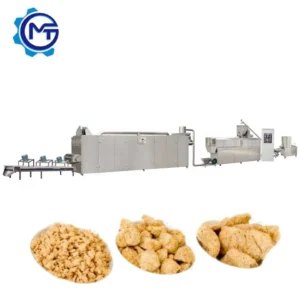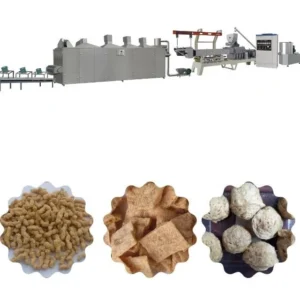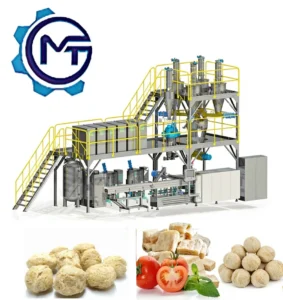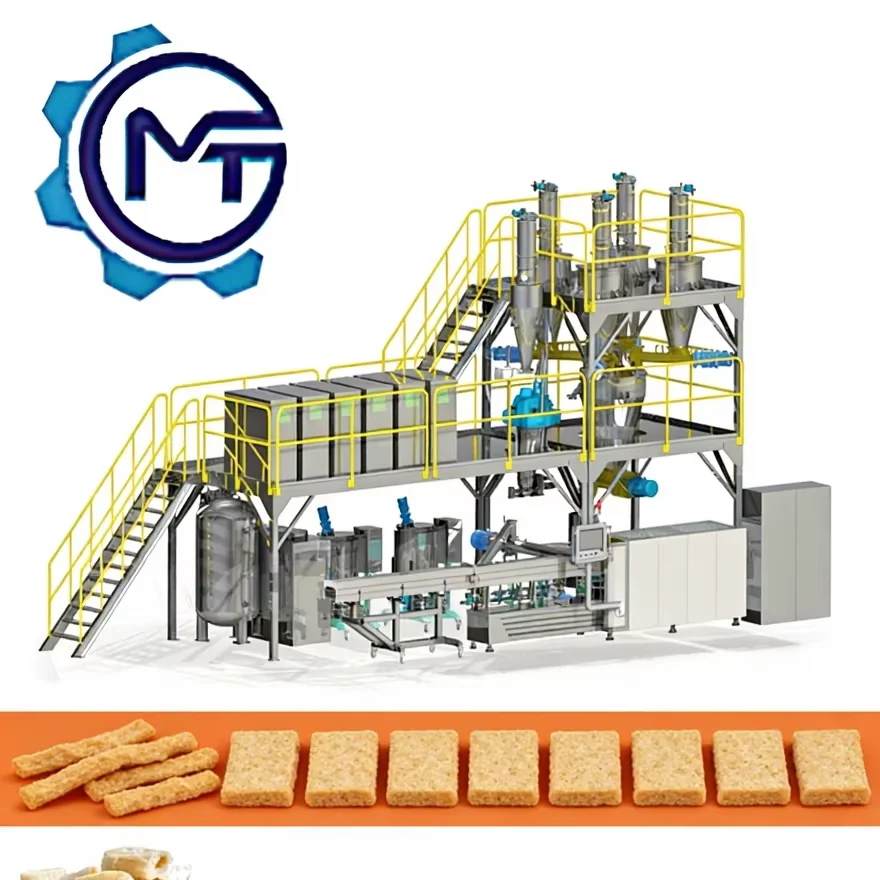
Matched Throughput Across All Stations — every unit from the MT65 through MT85 is specified against the actual raw material moisture and protein content you will run, not against a generic catalogue output.
Technical Specifications
| Parameter | Value |
|---|---|
| Model | MT65 / MT70 / MT75 / MT85 |
| Product Type | Twin Screw Soy Protein Extrusion Line |
| Screw Type | Twin screw |
| Installed Power | 84 kW (MT65) / 160 kW (MT70) / 190 kW (MT75) / 210 kW (MT85) |
| Power Consumption | 59 kW (MT65) / 120 kW (MT70) / 140 kW (MT75) / 140 kW (MT85) |
| Output Capacity | 100–150 kg/h (MT65) / 150–200 kg/h (MT70) / 150–200 kg/h (MT75) / 250–300 kg/h (MT85) (basis not stated in source — confirm raw material formulation and moisture content) |
| Overall Dimensions (L×W×H) | 40,000×1,200×2,200 mm (MT65) / 41,000×1,500×2,200 mm (MT70) / 43,000×1,500×3,200 mm (MT75) / 45,000×1,500×3,500 mm (MT85) |
| Main Motor Power | 22 kW / 30 kW / 45 kW |
| Screw Length | 1,050 mm / 1,520 mm |
| Mixer Construction | Stainless steel 304 mixing blade, carbon steel frame |
| Dryer Type | Multi-layer, round-trip, double pitch roller chain drive |
| Dryer Heating Options | Fuel, gas, or electricity (buyer selectable) |
| Line Sequence | Mixer → Screw Conveyor → Twin Screw Extruder → Air Conveyor → Multi-layer Dryer → Cooling Machine |
Application Suitability
| Application | Material or Output |
|---|---|
| Texturized vegetable protein (TVP/TSP) | Defatted soya flour, low-temperature soya flakes |
| Soy nuggets and soya chunks | Soya flour blends at controlled moisture |
| Plant-based meat analogues | Soy protein isolate, soybean dregs, peanut dregs |
| Cereal and snack formats | Grain blends via screw and die reconfiguration |
What "Nominal Capacity" Leaves Out on a Soy Protein Line
A twin screw extruder rated for 200 kg/h on standard soya flour may drop to half that when your local feedstock carries a different protein-to-starch ratio. The soy protein extrusion line complete equipment range must be balanced around your actual formulation, not a generic benchmark. I have seen installations where the extruder ran comfortably but the downstream dryer could not keep up because the two stations were specified from different catalogues without cross-checking moisture removal rates. When protein content shifts, the screw combination must be re-profiled, the barrel temperature zones re-tuned, and the die opening resized — otherwise the fibrous structure collapses into a dense, under-expanded mass [NEED_CITE: raw material variability impact on extrusion throughput].
Station-by-Station Catalogue Coverage
This soy protein extrusion line complete equipment range covers every node from raw material batching through final cooling. The mixer uses a stainless steel 304 blade on a carbon steel frame, sized in batch increments from 20 kg to 180 kg depending on the extruder model feeding it. A screw conveyor then meters the blended flour into the twin-screw barrel at a controlled rate, which is critical because inconsistent feeding directly destabilises the protein denaturation window inside the barrel.
Dryer and Cooling Sizing
The multi-layer dryer runs a round-trip belt path on a double pitch roller chain drive, giving the product multiple passes through the heated zone without requiring an impractically long machine footprint. Heating is selectable between fuel, gas, and electric sources so the dryer can match whatever utility supply the buyer’s facility provides. After drying, the cooling machine brings the product temperature down before packing, preventing condensation inside bags that would otherwise shorten shelf life [NEED_CITE: moisture management in TVP drying stages].
Reading the Motor and Screw Specifications
The main motor options span 22 kW to 45 kW, and screw lengths are offered at 1,050 mm and 1,520 mm. A longer screw gives the material more residence time inside the barrel, which matters when processing soy blends that need extended shear and heat to fully denature and restructure into fibrous strands. The rotary cutting motor at 0.75 kW and feeding motor at 0.75 kW are fixed across the range; these are sized for continuous duty at the maximum throughput each extruder model can sustain. Installed power reaches 210 kW on the MT85, which signals the total connected load the buyer’s transformer must accommodate — a detail that must be confirmed against site voltage before the line ships.
The Cost of Skipping a Trial Run
Dispatching an extruder with a generic screw profile and then commissioning it on unfamiliar local soya flour often means days of on-site adjustment. I once spent four full days in a South Asian plant re-cutting screw elements because the client’s defatted flour had a noticeably lower protein content than the test material, and the original configuration produced a crumbly, non-fibrous output. That lost time also stalled the dryer and cooling stations downstream because nothing was flowing at the planned rate. A factory trial on the buyer’s own raw material locks the screw combination, die geometry, and barrel zones before the crate is closed [NEED_CITE: extrusion commissioning delays due to untested formulations].
Why Source the Full Sequence Here
The line is supplied as a matched set, so the mixer batch size, extruder throughput, dryer belt area, and cooling capacity are all calculated against the same production target rather than assembled from independent vendors. Screw configurations and die designs are specified against the buyer’s raw material and target product format, not copied from a standard build. The in-house testing workshop allows trial runs on your actual soya flour before shipment, so parameters are locked rather than guessed. CE and ISO certifications are maintained at company level, and electrical schematics are confirmed per market before production begins.
Documentation & Verification
- Line layout drawing showing throughput matching between extruder, dryer, and cooling stations
- Screw and die configuration record matched to your soya flour formulation
- Electrical schematic with voltage and frequency confirmed for your target market
- Trial run report produced on your raw material before dispatch
- CE declaration of conformity and ISO certificate on file
- Wear parts list covering screws, dies, and cutter blades
Installation, Commissioning & Support
- Floor space planning based on the MT85’s 45 m line length and 3.5 m height clearance
- Dedicated circuit sizing for up to 210 kW installed load depending on model selected
- Machine arrives in sectioned modules for on-site assembly and alignment
- First-run parameter setting covers barrel zones, screw speed, and dryer temperature
- Operator training on screw element changes for switching between TVP and nugget formats
- Spare screw and die elements listed for first replacement cycle
Before You Send an Inquiry
Please share your target product format — whether TVP, soya chunks, or a plant-based meat analogue — along with the raw material spec sheet showing protein and moisture content. Confirm your factory’s voltage and frequency, the available floor space, and whether you need the dryer configured for gas, electric, or fuel heating. If you can send a sample of your actual soya flour, we can schedule a testing workshop trial to lock the screw and die parameters before quoting.
Frequently Asked Questions
Q: What is included in the soy protein extrusion line complete equipment range?
A: The line covers a mixer, screw conveyor, twin-screw extruder, air conveyor, multi-layer dryer, and cooling machine. Optional stations can be discussed for specific formats. Each unit is sized so throughput is balanced across the sequence, preventing one station from bottlenecking the next.
Q: How do I choose the right extruder model for my output target?
A: Model selection depends on your target hourly output and the raw material formulation you will run. The MT65 suits smaller batches while the MT85 handles higher volumes, but actual capacity depends on protein content and moisture — both of which must be confirmed before a firm throughput figure is set.
Q: Can the dryer heating source be matched to my factory utilities?
A: Yes. The multi-layer dryer is available with fuel, gas, or electric heating. The choice affects operating cost and the utility infrastructure your facility must provide, so this should be confirmed during the layout and specification stage.
Q: How does the screw configuration change between TVP and snack formats?
A: Switching from TVP to a snack or cereal format requires different screw element arrangements, die geometries, and barrel temperature profiles. The same twin-screw platform accommodates these changes, but each product needs its own configuration record established during testing.